Article
What Is the Primordial Spirit (Yuanshen) in Xianxia?
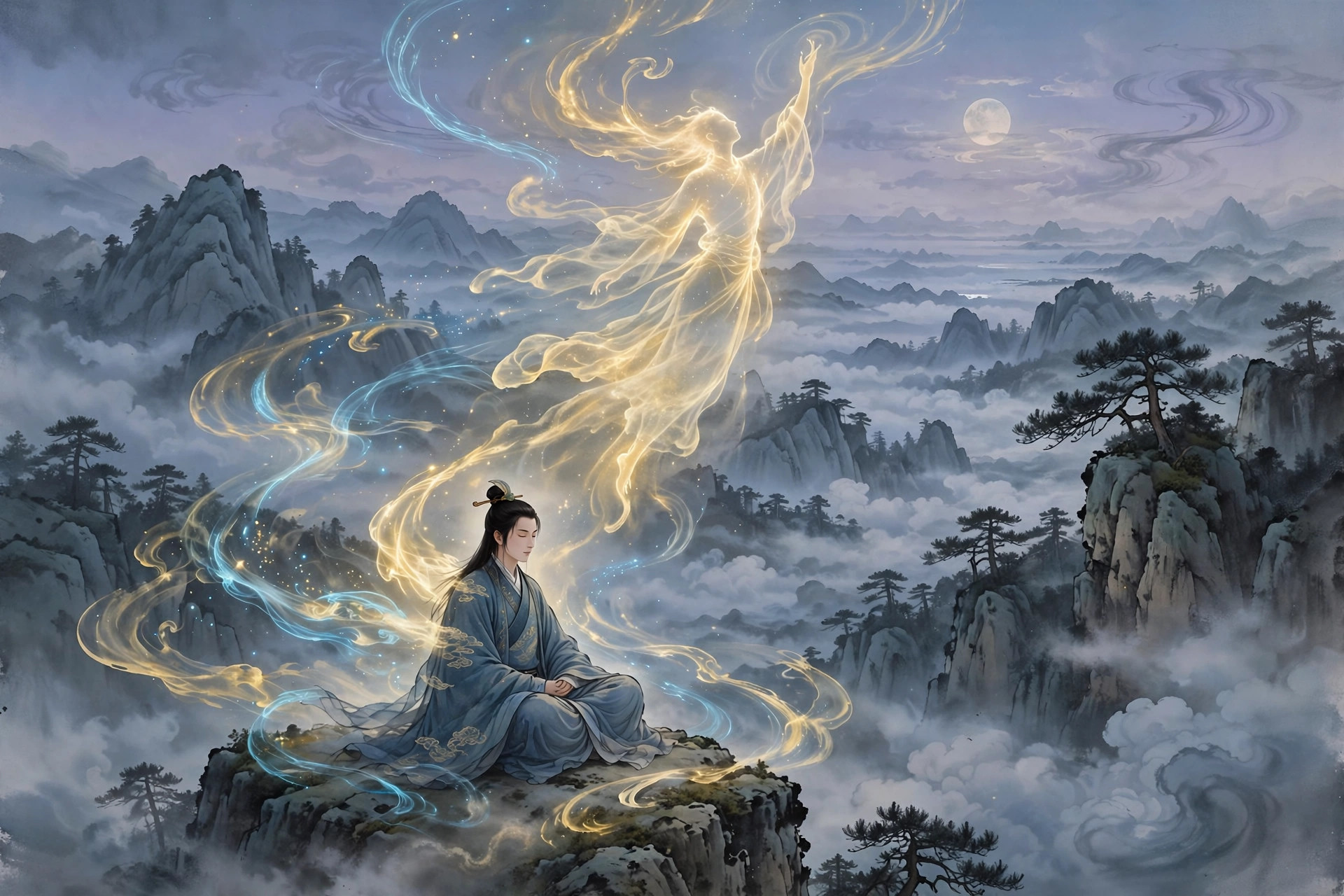
In xianxia, the body is a shell and the soul is the real person. The primordial spirit is the name the genre gives to that real person — the part of a cultivator that can step out of the body, survive its destruction, and eventually become an immortal.
The primordial spirit (元神, yuánshén — literally "original spirit") is, in xianxia and xuanhuan novels, the cultivator's true self refined into a spiritual form that exists independently of the physical body. Fans commonly describe it as the soul after years of cultivation have stripped away everything mortal about it: it can leave the body, travel on its own, perceive the world without eyes, and, at the highest levels, survive death entirely. It is one of the oldest ideas in the genre, and one of the most confusing for new readers — because it sounds almost identical to the nascent soul, and most novels never stop to explain the difference.
If you only remember one thing, remember this: the nascent soul is a body for the soul; the primordial spirit is the soul. One is a container, the other is what lives inside it.
New readers trip over this constantly, so here is the distinction as fans commonly draw it:
In practice, many authors blur the line, and some use the two terms almost interchangeably. That is not a mistake on your part as a reader; it is a feature of a genre where every author inherits a shared vocabulary and then reshapes it. But when a novel does keep them separate, the pattern is usually this: the nascent soul comes first, at a middle-high stage, and the primordial spirit is what the nascent soul matures into — or reveals itself to be — at a much higher stage, often around Soul Formation (化神, huàshén, "transforming the spirit").
That stage name is a clue. 化神 literally means the transformation of the spirit, and fans commonly read it as the point where the cultivator's spirit stops being a passenger inside the body and becomes something that can stand on its own.
The abilities attached to the primordial spirit follow a logic: the less it needs a body, the more the story can do with it. Fans commonly describe the following as standard fare:
Leaving the body. The signature ability. A cultivator's primordial spirit can slip out of the flesh and travel as a glowing, semi-transparent figure. In most novels this is dangerous at first — the spirit is vulnerable outside the body, and enemies know it — and safe only at high levels. The classic scene is a master whose body is meditating in a cave while their spirit is three provinces away, watching an enemy army assemble.
Surviving death. This is the reason the concept matters to the plot. A cultivator whose body is destroyed but whose primordial spirit escapes is not dead; they are inconvenienced. They can possess another body, rebuild a new one over centuries, or linger as a ghost-like presence guiding a disciple. Whole arcs are built on a villain the hero "killed" three hundred chapters ago returning in a borrowed body.
Perceiving without senses. Once the spirit is free of the flesh, it no longer needs eyes or ears. Fans describe high-level cultivators as sensing everything within a radius through their spirit alone — a cousin of divine sense, but treated as deeper and more fundamental, because the spirit is the perceiver rather than a tool the cultivator uses.
Possession and rebirth. The darker half of the idea. If a primordial spirit can leave its own body, it can try to enter someone else's. Novels treat this as one of the most feared techniques in the genre: a dying old monster seizing a talented young body is a plot readers instantly recognize, and the defense against it — a strong primordial spirit of one's own — is why characters guard their souls so jealously.
The exact list changes from novel to novel, and authors love inventing new tricks: splitting the spirit into avatars, hiding it inside treasures, using it to control puppets at a distance. What stays constant is the underlying rule — the stronger the spirit, the less the body matters.
In the Daoist material the genre borrows from, the primordial spirit is not a single flat thing. It has stages of its own, and novels often borrow two of them:
Not every novel uses this pair, and those that do often rename or reorder them. But when you see a character described as having "only" a yin spirit, the novel is telling you they are powerful but unfinished — their soul can travel, but it cannot yet live on its own.
The primordial spirit is not a webnovel invention. It comes from Daoist internal alchemy, where 元神 names the original, pre-heaven spirit a person is born with — the part of consciousness that exists before experience, habit, and desire bury it. Daoist teaching draws a sharp line between two kinds of awareness: shi shen (识神), the everyday conscious mind that runs on the six senses, and yuan shen, the deeper spirit that sits beneath it and is treated as the true self.
That distinction is the engine of the whole concept. In the tradition, the Three Treasures — essence (精, jīng), energy (气, qì), and spirit (神, shén) — are the raw materials of a human life, and the primordial spirit is the one that governs the other two. Cultivation, in this framework, means quieting the noisy everyday mind so the primordial spirit can take charge — and the ultimate goal, in both Daoism and Buddhism, is described as the spirit emerging from the body: liberation in Buddhist terms, ascension and becoming an immortal in Daoist ones.
Xianxia authors took this sober, inward-looking idea and gave it a body count. Where the old texts describe the spirit's emergence as a spiritual event, the novels literalize it into glowing figures, astral battles, and villains who refuse to stay dead. The core image, though — a true self that outlives the flesh — is unchanged.
In practice, three quick checks will sort out which "soul" a novel means in any given scene:
And if a novel uses the terms loosely, do not fight it. The genre has spent twenty years letting authors bend this vocabulary, and the bending is part of the fun. What matters is the question the concept always asks: when the body is gone, what is left? In xianxia, the answer is the primordial spirit — and everything in the story flows from that.