Article
What Is a Jade Slip in Xianxia? The Pocket Library Every Cultivator Carries
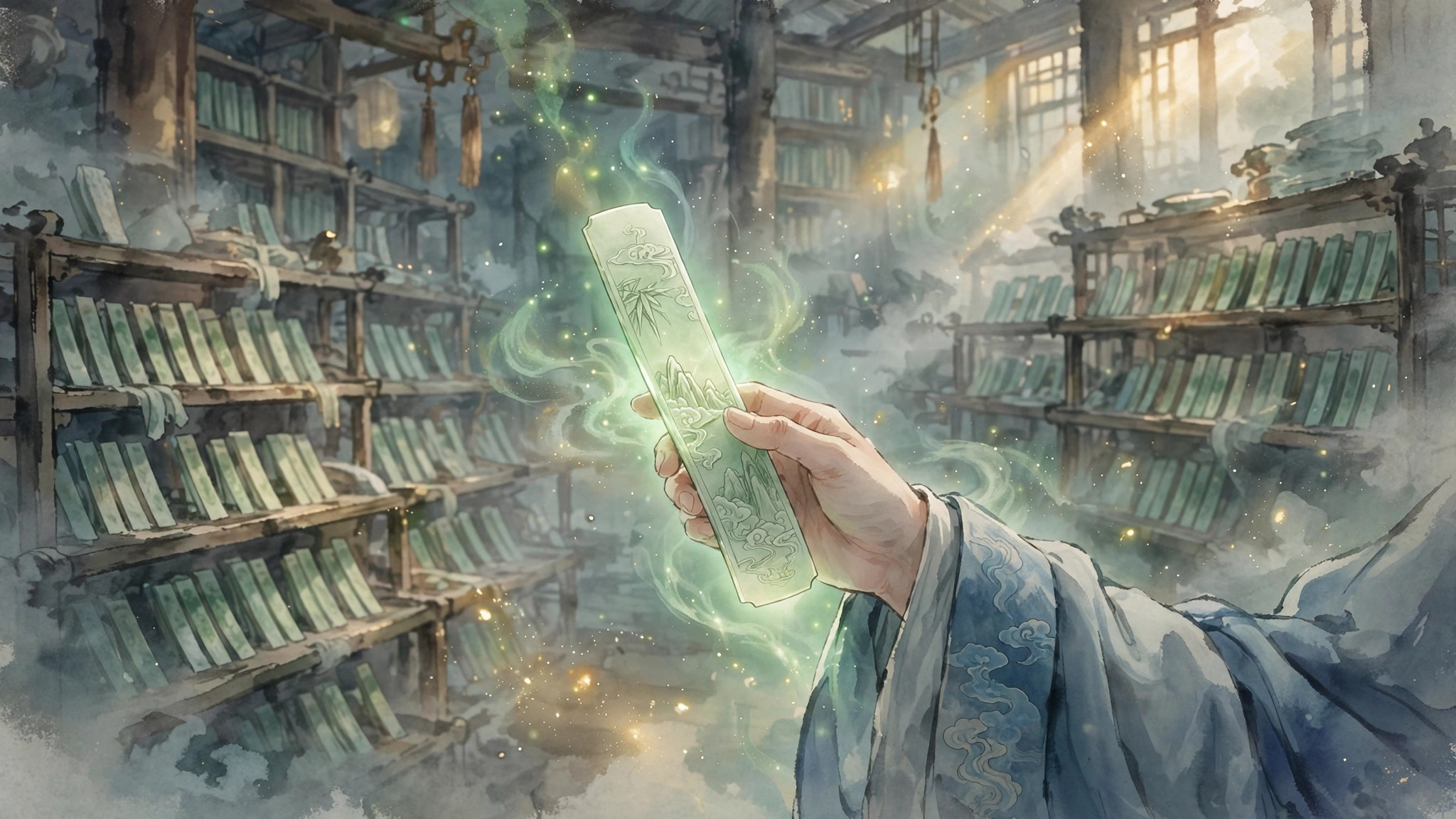
The library has no books. Its shelves hold row after row of pale green strips, each about the length of a hand, cool to the touch and faintly warm with stored power. A disciple picks one up, presses it to his forehead, closes his eyes — and a whole cultivation manual pours into his mind in seconds.
A jade slip (玉简, yùjiǎn) in xianxia and xuanhuan novels is a small strip of jade used to store information magically. Instead of ink on paper, the contents are sealed inside the stone itself — a technique manual, a map, a letter, a pill formula, a sect rulebook — and a cultivator reads it by sending a thread of spiritual awareness into the jade, which delivers the information straight into their mind. Fans commonly describe it as the genre's answer to a USB stick: small, portable, and able to hold far more than its size suggests.
The Chinese name tells you most of what you need. 玉 (yù) means jade, the pale green stone prized in Chinese culture for purity and value. 简 (jiǎn) means a slip or strip — the same character used for the bamboo slips on which ancient Chinese texts were written before paper became common. A jade slip is, in other words, a writing strip upgraded from bamboo to precious stone, and then upgraded again from ink to magic.
That bamboo-slip ancestry is not just a fan theory. Genre glossaries describe the jade slip explicitly as based on the bamboo slips of ancient China, with the magical twist that the information is transmitted directly into the reader's mind rather than read character by character. The real world has its own jade slips, too: the National Palace Museum in Taipei holds a Song-dynasty jade album of slips inscribed with a ritual prayer, dated to 1008, each slip roughly 30 centimetres long and 2 centimetres wide. Novel jade slips are usually imagined smaller and handier than that — something a cultivator can carry in a sleeve or a pouch — but the shape, a long narrow strip, is the same.
Almost anything that can be written down can be sealed into a jade slip, and novels use the full range. The most common contents are the ones a cultivator needs most:
Reading a jade slip is nothing like reading a book. The usual scene goes like this: the cultivator holds the slip, often pressing it against the forehead, and extends their divine sense — the spiritual awareness that lets cultivators perceive the world beyond their eyes — into the jade. The information then flows directly into their mind, sometimes as text, sometimes as images, sometimes as a full sensory impression of the technique being performed.
That directness has consequences authors love to play with. A beginner reading an advanced manual may understand the words but lack the power to practise them. A slip can be sealed so that only someone of a certain cultivation level, bloodline, or sect can open it at all — the genre's version of password protection. And a slip can be booby-trapped: read it without the right preparation, and it may wipe itself, attack the reader's mind, or crumble to dust the moment its message is delivered. The one-time message slip, which destroys itself after a single reading, is a favourite device for villains' secret orders and dying masters' last words alike.
There are gentler variants, too: some slips replay a master's voice and demonstrations like a recorded lecture, while others are reference works consulted again and again. The rules vary from novel to novel — in one story a slip is a disposable message, in another a family heirloom passed down for a thousand years.
Jade slips solve a storytelling problem. A cultivation world needs a way for knowledge to move around — between masters and disciples, between ancient eras and the present, between enemies who would never sit down and talk. Books are fragile, heavy, and easy to steal and copy. A jade slip is compact, durable, and personal: it can be hidden, sealed, inherited, looted, faked, or fought over, and each of those verbs is a plot.
That is why jade slips show up at the genre's turning points. The hero inherits a dead expert's slip and gains a technique nobody else alive knows. A sect's library burns, but its core manuals survive because they were sealed in jade. A spy is caught with a slip she cannot explain. A villain's whole scheme unravels because someone read a slip he thought he had destroyed. Knowledge in xianxia is power in the most literal sense — a better technique means faster breakthroughs, and faster breakthroughs mean survival — so the object that carries knowledge becomes one of the most valuable things in the world.
Jade slips also answer a question readers might otherwise ask: how does a world without printing presses preserve techniques for ten thousand years? Seal the knowledge in jade, hide it in a tomb or a sect vault, and let a later generation dig it up intact. The slip is the genre's archive, post office, and time capsule in one small green strip.
New readers sometimes blur jade slips together with the genre's other small objects, so here is the short version of how they differ. A storage ring holds physical things — swords, pills, spirit stones — while a jade slip holds information. A talisman holds a single spell, ready to fire, while a jade slip holds knowledge that the reader must then learn and practise. A technique manual on paper is the same content in a worse container: heavier, easier to damage, and readable by anyone who picks it up, including the hero's enemies.
The comparison that captures it best is the modern one readers keep reaching for. A book is a printed manual; a jade slip is a file on a drive — smaller, denser, and able to carry not just the text but the demonstration and the author's voice along with it.
For all their usefulness, jade slips have limits, and good novels make those limits matter. First, a slip does not grant understanding. Reading a sword technique into your mind is not the same as being able to perform it; the body still has to be trained, the qi still has to be built up, and the insight still has to be earned. Second, a slip is only as trustworthy as its maker. Fakes exist, and a doctored technique is one of the cruellest traps in the genre — practise it faithfully and it may cripple you at the worst possible moment. Third, a slip can be lost, stolen, or destroyed like any treasure, and unlike a printed book, there may be no other copy in the world.
Those limits are the point. A jade slip is not a cheat code; it is an opportunity. It hands a character the knowledge and leaves the hard part — the practice, the judgement, the risk of trusting it — entirely up to them. That is why the moment a hero presses a strange slip to his forehead is one of the most reliably exciting scenes in cultivation fiction: everything could change, and nothing is guaranteed.
When a jade slip appears in the novel you are reading, pay attention to three things. First, who made it — a slip from a sect founder and a slip from a street peddler are very different propositions. Second, whether it is sealed, and what the seal might cost to break. Third, whether the slip survives its reading. A slip that crumbles after one use has delivered a message meant for one person only, and the story is about to move fast. A slip that can be read again is a resource, and resources in xianxia attract exactly the kind of attention a hero least wants.
Keep those three questions in mind and the little green strip stops being set dressing. It becomes what it is in the story: the most compact and most contested object a cultivator can own — a whole library, a letter from the dead, and a loaded secret, all in the palm of a hand.