Article
What Is a Talisman in Xianxia? Fu, Seals and Paper Magic Explained
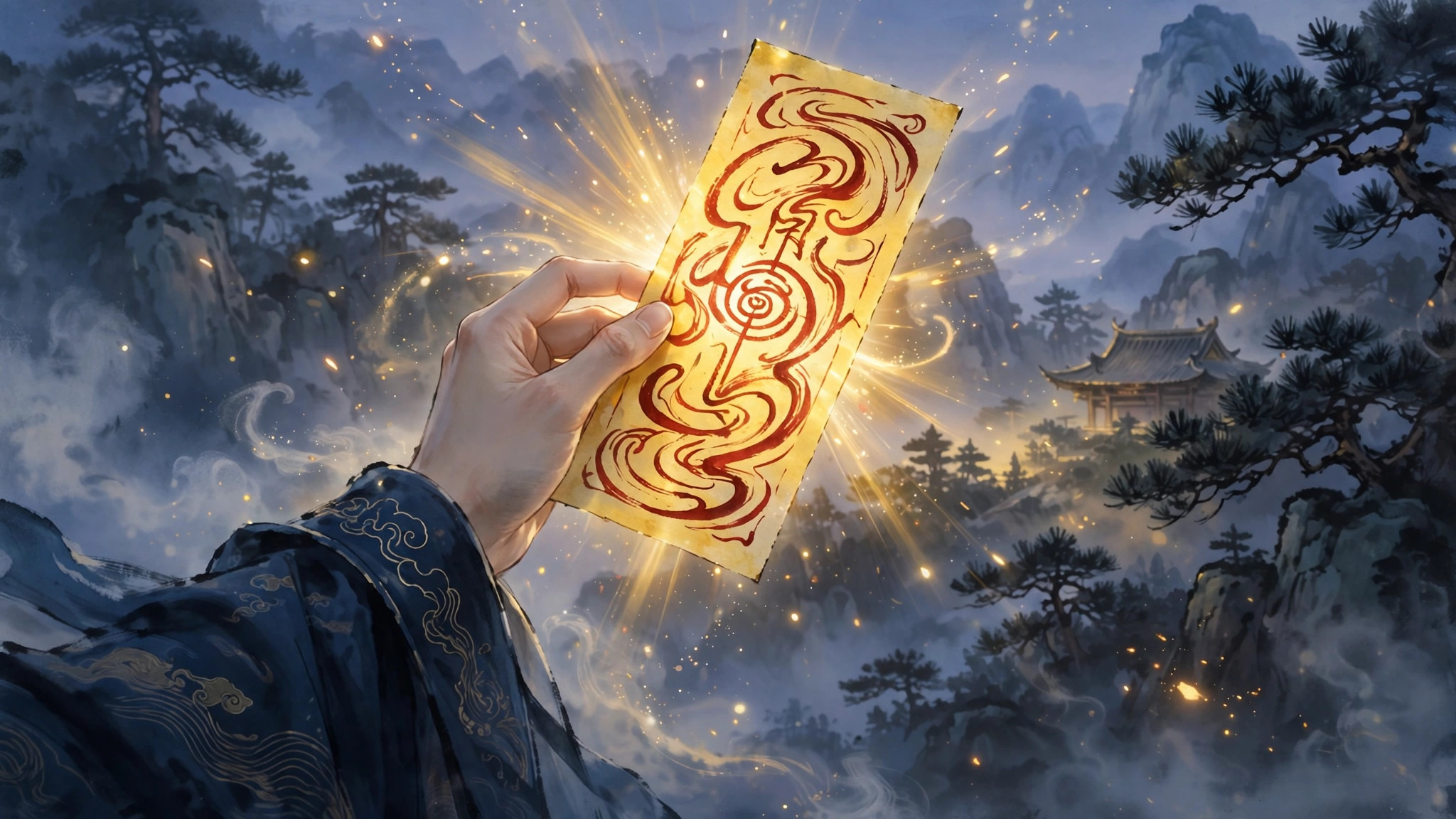
A strip of yellow paper, a few strokes of red ink, and a demon that suddenly cannot move. That is the talisman's entrance in most cultivation novels: no chanting, no drawn-out ritual, just a small object doing a large job. A talisman (符, fú) in xianxia and xuanhuan novels is a spell stored in a physical object — usually a slip of paper — that releases its effect when activated, and is often used up in the process. Stick it to a door to seal it, slap it on an enemy to freeze them, crush it to teleport away, or burn it to call for help. Where a technique lives in the cultivator's body and a treasure can be used again and again, a talisman is closer to a single-use cartridge: prepared in advance, carried in a stack, and spent at exactly the right moment.
That single-use quality is what makes talismans so useful to a story. A hero too weak to fight a stronger enemy can still survive with one good escape talisman bought at ruinous cost, and a villain's plan can collapse the moment a talisman's time runs out. Talismans turn preparation into power, which is why the genre's careful planners and poor-but-clever protagonists love them.
The vocabulary is worth sorting out, because translations use several overlapping words. 符 (fú) is the talisman itself: the written symbol or slip. 符箓 (fúlù) is the fuller term for the talismanic system, combining fu with 箓 (lù), a register or roll — in Daoist practice, a register of divine names and ranks. In novels you will mostly meet fu on its own, sometimes rendered as "talisman," "charm," or "seal," and sometimes left untranslated.
The character's older meaning explains a lot about how novels treat these objects. According to Daoist sources, fu originally meant a tally: a split bamboo token whose two halves matched to prove authority, like a password split in two. A talisman works on the same logic in fiction. It is not merely a picture of a spell; it is a credential claiming an order from a higher power — a god, a sect founder, a master — and the world obeys it because the credential checks out. That is why a forged or damaged talisman is so dangerous in these stories: a flaw in the writing can void it, backfire, or summon the wrong thing.
Real Daoist practice is the obvious ancestor here. Wikipedia's article on fulu describes them as Taoist magic symbols and incantations written or painted on talismans by practitioners, and notes that fu served as instructions to deities and spirits and as symbols for exorcism. Talismans were already in use as a healing method by the Eastern Han dynasty. Novels take that real tradition — written power, divine authority, healing and protection — and scale it up until a slip of paper can level a mountain.
New readers often ask the same question: if a talisman is writing, why can nobody read it? The squiggles look like characters that melted halfway through being written, and that is deliberate in both the real tradition and the fiction. Wikipedia's fulu article notes that talismanic script tends to have irregular strokes resembling Chinese characters, mixed with non-character symbols, and that by the Eastern Jin dynasty (317–420) users were not expected to decipher the writing for a talisman to work. The scholar Ge Hong wrote in his Baopuzi that as long as the inscription was authentic, successful use did not depend on whether the user could read it. The illegibility itself became a sign of divine authority: ordinary writing belongs to ordinary people, so writing from the gods should look like something else entirely.
Novels borrow that logic wholesale. A talisman's script is usually described as "celestial writing" that only its maker fully understands, and a character who copies one by eye produces a dead piece of paper. Conversely, a genuine talisman works even in a child's hands, because the power is in the object, not the reader — which is what lets authors hand world-shaking items to weak characters without breaking their own power system.
Most fictional talismans fall into a handful of jobs. Fans commonly describe these categories:
Attack talismans. The genre's grenades: a lightning talisman calls down a bolt, a fire talisman erupts into flame, a sword talisman releases a stored sword strike. Instant, violent, and gone after one use — which is why a weak cultivator carrying a high-grade attack talisman is a walking threat to people far above their level.
Defence and sealing talismans. The quiet workhorses. A protective talisman worn on the body blocks one fatal blow, then crumbles. A sealing talisman pasted on a door, a coffin, or a demon's forehead holds something shut, and a concealment talisman hides a person's aura from searching senses. The famous image of a yellow paper strip stuck to a hopping corpse's forehead comes from this sealing job, borrowed from Chinese folklore and horror films.
Movement talismans. Teleportation, flight, and escape: a hundred miles in a blink, a one-way door out of a collapsing secret realm. These are usually the most expensive talismans in a story, because an escape that always works is worth more than a weapon that sometimes does.
Communication and summoning talismans. Burn one to send a distress signal to your sect, crush one to summon a guardian spirit or a master's projected avatar.
Healing and purification talismans. The oldest job, inherited from the real tradition: burned and mixed with water, pasted on a wound, or worn to drive out poison or a curse.
Making a talisman in fiction is a craft with three ingredients: materials, skill, and energy. Daoist sources describe traditional talismans as written on yellow paper or silk in cinnabar ink — cinnabar (朱砂, zhūshā) being a red mineral pigment — and novels keep that palette. Yellow paper, red ink, a brush, and sometimes a beast's blood or a rare mineral for higher grades: the recipe reads like calligraphy with consequences.
Skill is the bottleneck. A talisman master (符师, fúshī) studies diagrams the way other cultivators study sword forms, and a single wrong stroke can ruin the whole slip. Fans commonly describe the best makers as people whose steady brushwork channels spiritual energy without a tremor, and whose understanding of the underlying diagram — not just its shape — separates a working talisman from a pretty forgery.
Energy is the fuel. A talisman is charged during its making, usually with the maker's own spiritual energy, and holds that charge like a battery. Using it spends the charge — the core trade-off of the whole category, and the reason talismans never replace techniques: a technique can be practised a thousand times, but a talisman, once burned, is ash. A talisman from a legendary figure might be a sect's heirloom, used once in a century and then mourned like a death.
Activation is simple by design, because the point of a talisman is speed: paste it on a target, tear it, burn it, crush it, or pour spiritual energy into it. In a fight, nobody has time for a ten-minute ritual, and a talisman compresses all that preparation into a single gesture.
Three categories that novels keep carefully separate are worth learning, because the distinction predicts how a scene will play out:
A quick test: if it burns up when used, it is probably a talisman. If it covers an area and stays put, it is probably a formation. If it survives the fight and goes back in the hero's pocket, it is probably a treasure. Some objects blur the lines — a talisman inscribed on jade instead of paper may survive several uses — but the three-way split covers most of what you will meet.
Talisman scenes reward a reader who watches three details. First, the grade: a talisman's rank relative to its user tells you whether it is a routine tool or a desperate gamble — a low-grade fire talisman is a sparkler in a master's hand and a lifeline in a beginner's. Second, the count: when a character checks how many talismans they have left, the author is telling you the stakes. Third, the maker: a talisman signed by a famous master or a dead ancestor carries plot weight far beyond its effect, because using it spends something irreplaceable.
That last point is why talismans endure as a storytelling device. They are the genre's way of letting the past intervene in the present: a master's final gift, a sect's last defence, a dead parent's protection, all folded into a slip of paper small enough to hide in a sleeve. The paper is cheap. What is written on it — and who wrote it — is everything.