Article
Yin and Yang in Xianxia Explained: Balance, Power, and Dual Cultivation
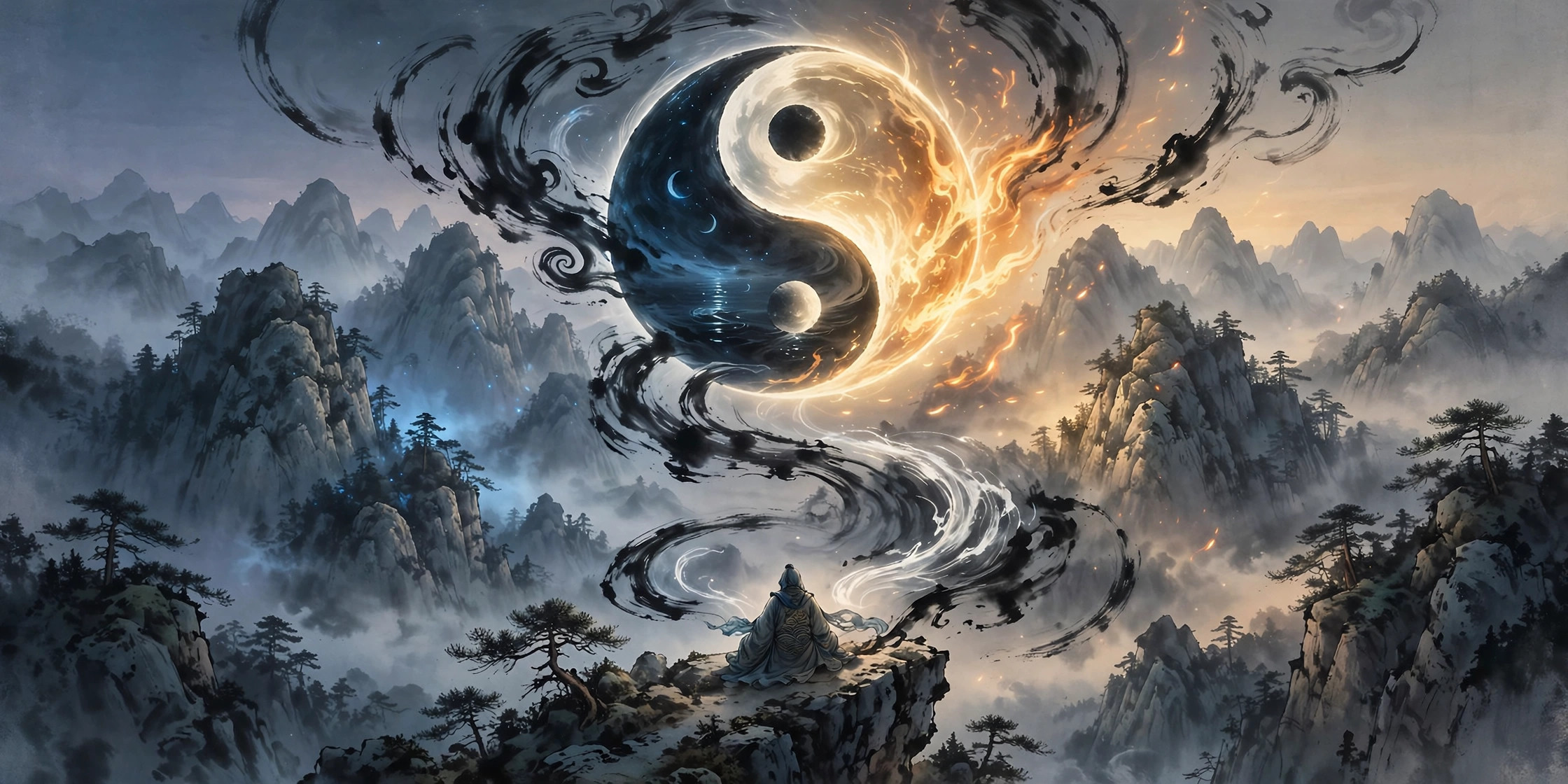
Yin and yang are the two complementary forces that power nearly everything in a xianxia novel: the energy a cultivator absorbs, the techniques they practice, the pills they swallow, and even the disasters that strike when they push too far. Yin (阴) is the dark, cold, still, receptive side of the world. Yang (阳) is the bright, hot, active, expansive side. Neither one is good or evil on its own. A cultivator's real job is keeping the two in balance — because in these stories, losing that balance is how people go mad, freeze solid, or burst into flames.
The idea is not something novelists invented. It comes from ancient Chinese philosophy, where yin and yang describe opposite forces that create, support, and give rise to each other. Xianxia authors borrowed the whole framework and turned it into the operating system of their fantasy worlds.
At its root, yin and yang is a way of describing the world as a dynamic pair. Yin is associated with darkness, cold, stillness, inward movement, and the moon. Yang is associated with light, heat, motion, outward expansion, and the sun. The key point — the one new readers most often miss — is that the two are complementary, not enemies. They need each other. Winter turns into summer, night turns into day, and each contains a seed of the other.
That seed is drawn right into the famous black-and-white symbol, the taijitu (太极图), or "Diagram of the Supreme Ultimate." The black half holds a small white dot, and the white half holds a small black dot: pure yin already carries a spark of yang, and vice versa. The symbol comes from the concept of taiji, the "Supreme Ultimate" — the state of oneness before duality, from which yin and yang split apart.
The idea shows up in some of China's oldest texts. In the I Ching (the Book of Changes), a divination manual from the Western Zhou period (roughly 1000–750 BC), yin and yang are written as broken and solid lines: yin is a broken line, yang is a solid line. In the Tao Te Ching, the founding text of Daoism, the pair appears in chapter 42, which describes the Dao giving birth to oneness, oneness to duality, and duality to the ten thousand things. The material energy that the universe is made from, in this cosmology, is qi — the same energy cultivators spend their lives refining.
In a xianxia world, a cultivator's body is a small universe running on the same rules. The qi they absorb from the world carries yin or yang qualities, and their meridians and dantian — the energy channels and reservoir at the core of the body — have to process both. Healthy cultivation is a balancing act: absorb, refine, and keep the two forces in proportion.
When the balance holds, qi flows smoothly, breakthroughs come easier, and techniques work as intended. When it tips, trouble follows. A cultivator who absorbs too much fiery yang energy without enough yin to cool and anchor it may suffer from feverish meridians, a runaway temper, or a backlash during a breakthrough. One who takes in too much yin may grow sluggish, cold, and spiritually stagnant. Authors use this logic constantly, because it gives every power-up a built-in price: the stronger the energy, the more careful the balancing has to be.
This is also why so many cultivation methods are described as having an alignment. A technique might be a "yang technique" — explosive, aggressive, sun or fire based — or a "yin technique" — cold, shadowy, moon or water based. A cultivator who practices a yang-heavy art usually needs yin-leaning pills, herbs, or environments to compensate, and the reverse. If you want the full picture of the energy itself, our guide to what qi is explains how it works as fuel.
The classic disaster of an unbalanced cultivator is qi deviation — the moment the energy inside the body stops obeying its owner. In many novels, qi deviation is framed directly as a yin-yang failure: the cultivator pushed for a breakthrough with too much of one force and not enough of the other, and the imbalance tears their meridians apart from the inside. Symptoms in the stories range from coughing blood and losing control of techniques to full-blown madness and crippled cultivation.
Authors also invent extreme versions of imbalance as character traits. Fans commonly describe the "Pure Yin Body" trope, for example: a character — usually a woman — whose body holds overwhelming yin energy and almost no yang, giving her enormous talent for water and ice techniques but slowly freezing her to death from the inside unless she finds a cure. The mirror image, the Pure Yang Body, is rarer in the stories but works the same way in reverse: a body burning too hot to sustain itself. These are fiction tropes rather than real Daoist doctrine, but they show how thoroughly the yin-yang logic has been absorbed into the genre's storytelling toolkit.
Because balance is the core problem, entire categories of fictional items exist to solve it. Yin-yang pills are a staple: a pill that restores equilibrium after a dangerous breakthrough, or one that lets a cultivator absorb an energy too extreme for their body alone. Herbs and spirit plants are often sorted the same way — a "yang herb" that burns away cold poison, a "yin herb" that cools a raging dantian. Treasures and formation arrays are sometimes described as harmonizing a location's yin and yang so that it becomes a perfect cultivation spot, rich in balanced spiritual energy.
Some cultivation techniques are built around the pair itself. A "yin-yang technique" typically alternates the two forces in a cycle, using each to temper the other — yang to drive the energy forward, yin to cool and settle it — so that the cultivator can absorb more power than someone running on a single force. These methods are usually portrayed as powerful but difficult and risky, which makes them a natural prize for protagonists: the stronger the method, the more discipline it demands.
The most famous use of yin and yang in xianxia is dual cultivation, in which two cultivators harmonize their energies together. The logic is simple and follows straight from the philosophy: if one partner carries excess yin and the other excess yang, practicing together lets each balance the other, and both grow stronger than they would alone. In the stories, this is why dual cultivation is so often presented as a remedy for an imbalanced body — the other person supplies the missing half.
In practice, novels treat it very differently from one another. Some present it as a solemn meditative discipline between partners. Others use it as romance, comedy, or thinly veiled innuendo. What stays constant is the underlying rule: the pairing works because yin and yang are complementary. For the full treatment of how the genre handles it, see our guide to dual cultivation.
A few misunderstandings show up again and again, so they are worth clearing up early.
First, yin is not evil and yang is not good. The dark half of the symbol is not the villain's side, and the bright half is not the hero's. In Daoist thought, the moral split between good and bad is a human judgment laid over the pair, not something built into it. A demonic cultivator can run on yang energy, and a righteous sect elder can practice a yin technique. What matters is balance, not which side a character favors.
Second, yin and yang are not a power level. A character does not "reach yin-yang stage" the way they reach Foundation Establishment or Golden Core. The pair is a property of energy, not a rank in a hierarchy. When a novel names a realm or a technique after yin and yang, it is describing its nature, not its tier.
Third, yin and yang are not strictly gendered. It is true that the tradition associates yin with the feminine and yang with the masculine, and novels often follow that shorthand — but the association is symbolic, not a rule. Male characters can have yin-aligned constitutions and techniques, female characters can be fiercely yang, and the stories regularly play with exactly that reversal.
Once you know the pattern, it is everywhere. A sect built on a frozen mountain probably teaches yin techniques; a sect on a volcanic island probably teaches yang ones. A protagonist who swallows a fire-attributed pill and starts coughing blood has a balance problem, not a dosage problem, and the cure will be something cold. A mysterious elder who speaks in riddles about "the seed of yang within yin" is usually about to hand the hero a cultivation method that works precisely because it uses both forces at once.
That is the real reason the idea survives across thousands of novels: it is a philosophy, a magic system, and a plot engine all at once. Yin and yang explain why power has a cost, why the strongest techniques are the hardest to master, and why two people can be stronger together than apart. Learn to read the balance, and the genre starts to make a lot more sense.