Article
What Is Dual Cultivation? The Paired Practice Behind Xianxia's Most Controversial Power-Ups
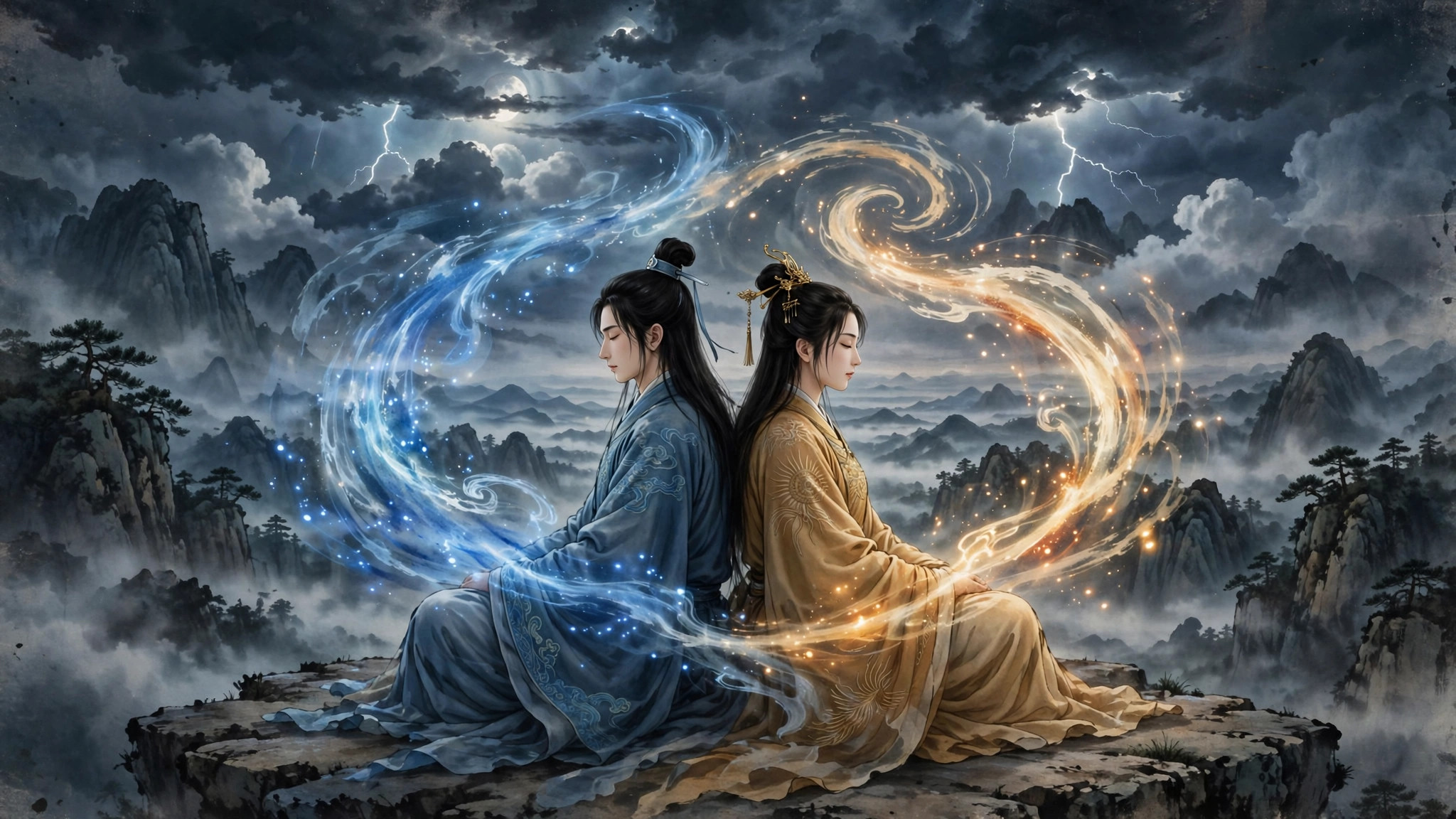
Dual cultivation (双修, shuāngxiu) is a cultivation method in xianxia novels that two people practice together, pooling and amplifying each other's qi. A lone cultivator grinding toward the next realm might need decades of secluded training; a well-matched pair doing dual cultivation can reach the same breakthrough in months. That shortcut is the whole point — and the reason the trope appears in everything from sweet romance subplots to the vilest villain schemes in the genre.
The word itself breaks down simply: 双 (shuāng, "a pair") + 修 (xiū, "to cultivate"). Two people, one path. What the genre does with that pairing, though, ranges from wholesome to horrifying.
Dual cultivation is not something webnovel authors invented. Shuāngxiu is a genuine term from Daoist practice, where certain schools taught that two practitioners could balance each other's yin and yang energies and advance toward longevity together — the counterpart to solo ("single cultivation") practice. Daoist texts describe the underlying theory as an exchange and balancing of the two partners' essences through disciplined practice, alongside more esoteric inner-alchemy work.
Xianxia took that seed and grew a forest. In fiction, the paired practice is mechanized: qi circulates between the partners' dantian in loops, resonates, multiplies, and settles back into both bodies richer than before. The Daoist framework of yin-yang balance becomes a magic system with rules, levels, and — inevitably — ways to cheat it. Almost every genre-specific detail in the rest of this article (special techniques, grades of compatibility, predatory harvesting) is webnovel invention, not historical practice.
The core mechanic is consistent across thousands of stories. Each partner has their own qi, but when the two cultivate in tandem, their energy forms a shared circuit. Two effects follow:
Most stories also require a specific technique (功法, gōngfǎ) — a dual-cultivation manual that dictates how the qi is routed. Some manuals are romantic and mutual; others are predatory, which brings us to the trope's dark side.
The default heroic version. Two people who love or at least deeply trust each other train together, and both grow stronger. This is dual cultivation as relationship made visible: the characters must cooperate, be vulnerable, and synchronize completely — which is why authors use it as a shortcut to intimacy. The power boost is the reward; the trust is the point.
The villainous version flips the exchange into theft. In this telling, one party — the "cauldron" or "furnace" (鼎炉, dǐnglú) — is used up so the other can leap forward. The cauldron partner's qi, or even their whole cultivation base, gets drained through the paired practice, leaving them crippled or dead. Fans commonly call this "harvesting" or "cauldron plundering," and it shows up almost exclusively in stories about demonic cultivation and evil sects.
The cauldron trope does real narrative work: it turns seduction into a weapon, makes romance inherently suspicious (is this partner genuine, or shopping for a furnace?), and gives righteous sects a vivid reason to condemn the practice outright. Some novels even build their central mystery around detecting whether a rising genius is a cauldron-drainer.
A middle ground many novels use for worldbuilding. Here, dual cultivation is simply a legitimate school of cultivation — sects teach paired techniques, partners register as cultivation companions, and the whole thing is as respectable as alchemy. In these stories, the interesting conflicts aren't moral but practical: finding a compatible partner, defending the partnership from rivals, or the old classic of a protagonist stuck with a manual whose requirements are... awkwardly specific.
Dual cultivation is a story engine disguised as a power system. It solves several problems at once:
New readers should know: modern Chinese webnovels are heavily moderated, so the practice is almost always portrayed through implication rather than description. Authors use euphemisms — "cultivating together through the night," "yin-yang harmonization," a fade to black — and much of the detail lives in what readers infer. The historical Daoist versions were philosophical and medical disciplines; the webnovel version keeps the vocabulary (yin, yang, essences, cauldrons) and discards the manual.
That restraint is also why the trope travels well to Western readers: the emphasis is on the consequences — who gets stronger, who gets used, what the partnership costs — rather than on anything explicit.
When the term shows up, ask two questions. First: who benefits? Mutual benefit means romance or worldbuilding; one-sided benefit means you're looking at a villain, a victim, or a mystery. Second: what's the cost? The best stories price the shortcut honestly — sacrificed privacy, binding vows, the risk of a partner who stops being a partner.
Handled well, dual cultivation is one of the genre's most efficient inventions: a power system, a romance subplot, and a moral test, all running on the same two characters. Handled poorly, it's an excuse to skip the training montage. Either way, when you see 双修 on the page, you now know exactly what machinery is being wheeled into the story.