Article
Formation Arrays Explained: The Battle Diagrams That Make Magic Work in Xianxia
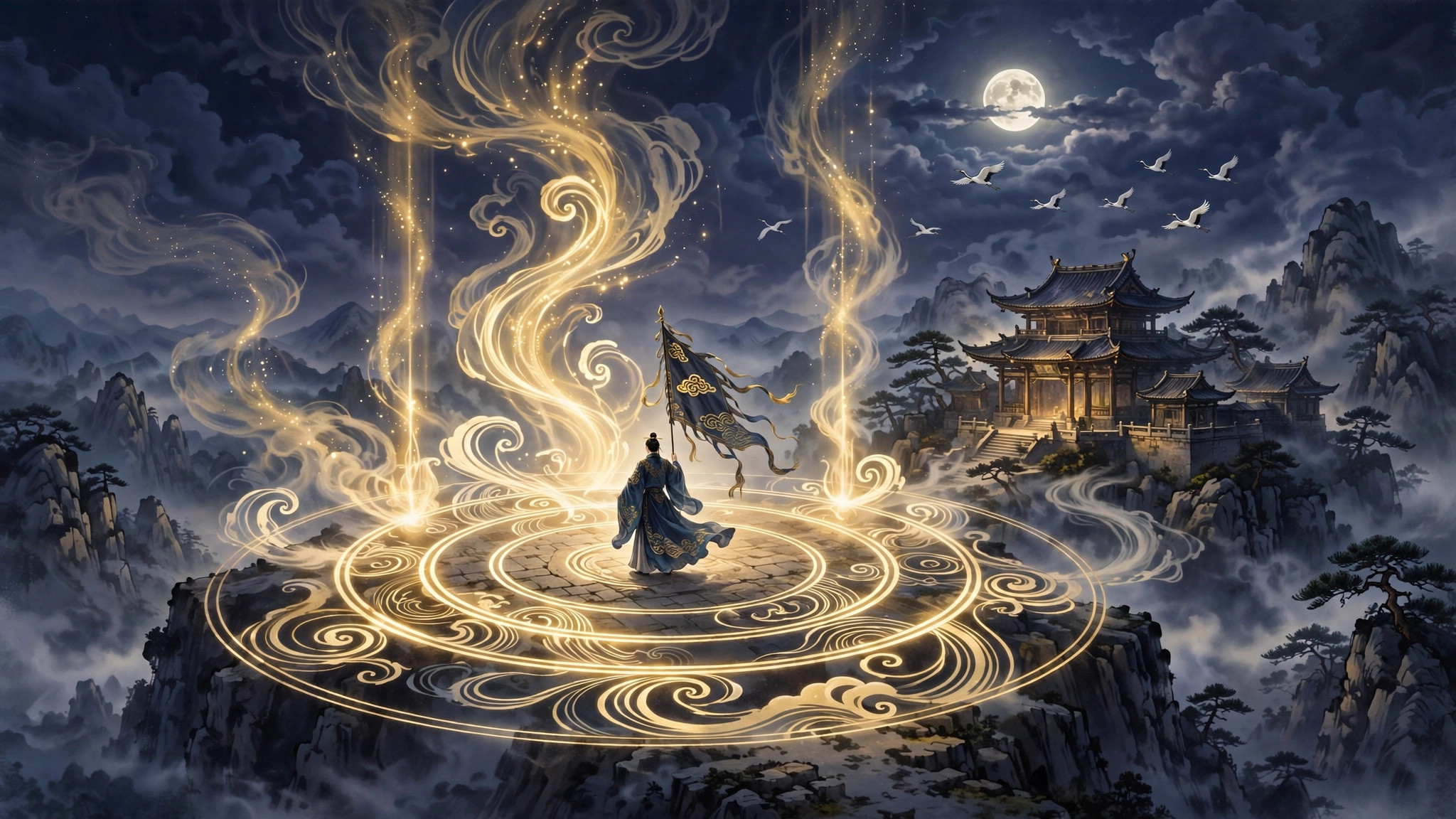
*A formation array (阵法, zhènfǎ) is a diagram that does magic.* In xianxia and xuanhuan novels, cultivators inscribe patterns onto the ground, onto jade tablets, or into the air itself, feed them spiritual energy, and the pattern comes alive: a shimmering wall that turns away armies, a maze that traps travelers in a space no bigger than a courtyard, or an invisible engine that gathers the spiritual energy of a whole mountain into one cultivation chamber. If you want one mental image, think of a military formation drawn on a general's sand table — except the soldiers are made of light and the sand table rewrites reality.
The Chinese term unpacks neatly. 阵 (zhèn) means "battle formation" or "array" — the same character used for troop deployments and for the rows of a chess-like board. 法 (fǎ) means "method," "technique," or "law." Put together, 阵法 is literally "formation method": the method of arranging things in a pattern to get a result.
That plain military root matters. A formation array is not a spell you chant and forget. Novels treat it as an engineering discipline — something closer to architecture or electrical wiring than to sorcery. A formation has parts, it has power requirements, and if you build it wrong, it fails (often explosively). This is why many novels feature 阵法师 (zhènfǎshī), formation masters: specialists who study diagrams the way our world studies circuit design, and who are treated as strategic assets worth more than an army.
This trope has genuine historical roots. Chinese military history includes the baguazhen (八卦阵, "Eight Trigrams formation"), a battlefield deployment based on the principles of the bagua (the eight trigrams) and the divination system Qimen Dunjia. According to the overview on Wikipedia, troops were divided into eight units placed at the cardinal and ordinal directions, surrounding a central commanding unit — a formation prized for its defensive strength and its ability to shift and cover for each unit's weaknesses. It has been attributed to many famous commanders, most famously Zhuge Liang, the legendary strategist of the Three Kingdoms period (220–280 CE).
Zhuge Liang also gets credit for the most famous formation in Chinese folklore: the *Stone Sentinel Maze (八阵图, bā zhèn tú), a pile of rocks and boulders arranged on Yufu Shore by the Yangtze River, near present-day Baidicheng. Wikipedia summarizes the legend: the stones were said to surface from the river every autumn, still sitting in their original positions. And in chapter 84 of the classic novel Romance of the Three Kingdoms*, the general Lu Xun walks into the maze, dismisses it as a "petty display of deception" — and is immediately trapped: wind rises, dust darkens the sky, and the stones seem to turn into swords while waves crash like drums. He only escapes because an old servant leads him out.
Read that scene and you are reading the blueprint of every xianxia formation array: a pattern laid out in physical space, an enemy who walks in confident, and a trap that makes a small patch of ground bigger on the inside than it is on the outside.
Since the word keeps showing up, here is the one-paragraph version. The bagua (八卦) is a set of eight symbols, each made of three lines that are either solid (yang) or broken (yin) — eight possible combinations, from 乾 (three solid lines, heaven) to 坤 (three broken lines, earth). Per Wikipedia, these trigrams are central to divination in the I Ching (Book of Changes), and over centuries they collected correspondences with directions, seasons, family members, and the five elements. Novels borrow this machinery the way Western fantasy borrows alchemy symbols: the author does not need the reader to know the I Ching — the trigrams are there to make the diagram look like it follows real rules, and real rules are exactly what make formation arrays feel different from hand-waving magic.
The specifics vary from novel to novel, but fans commonly describe the same core components:
The important thing is the grammar. A formation is always a tradeoff between three things: how much area it covers, how much power it consumes, and how long it lasts. A portable trap that lasts an hour is cheap; a barrier that has protected a sect for ten thousand years is a priceless national treasure. Once you internalize that grammar, you can predict plot twists: when a character smirks and says the enemy's great formation "only has three days of spirit stones left," you know exactly what happens next.
Almost every formation in the genre does one of four things:
Because formations follow rules, breaking them is a skill — and novels love skill scenes. The usual methods, as fans describe them:
There is one more use worth knowing: formations built to withstand heavenly tribulation. When a cultivator faces the lightning that punishes their breakthrough, a defensive array is often their last line of engineering against heaven itself — which is exactly the kind of hubris the genre loves to reward or punish.
Watch for the three questions every formation raises: What is it covering? What is it burning? Where is the eye? A formation that covers a sect and burns a spirit-stone mine is a fortress; a formation covering a courtyard and burning nothing visible is a trap, and the eye is probably under your feet. Once you start reading them this way, formation arrays stop being background scenery and become one of the genre's most honest systems — a kind of magic that tells you its own rules, then dares its characters to break them.