Article
Heart Demons in Xianxia, Explained: The Invisible Enemies That Destroy Cultivators
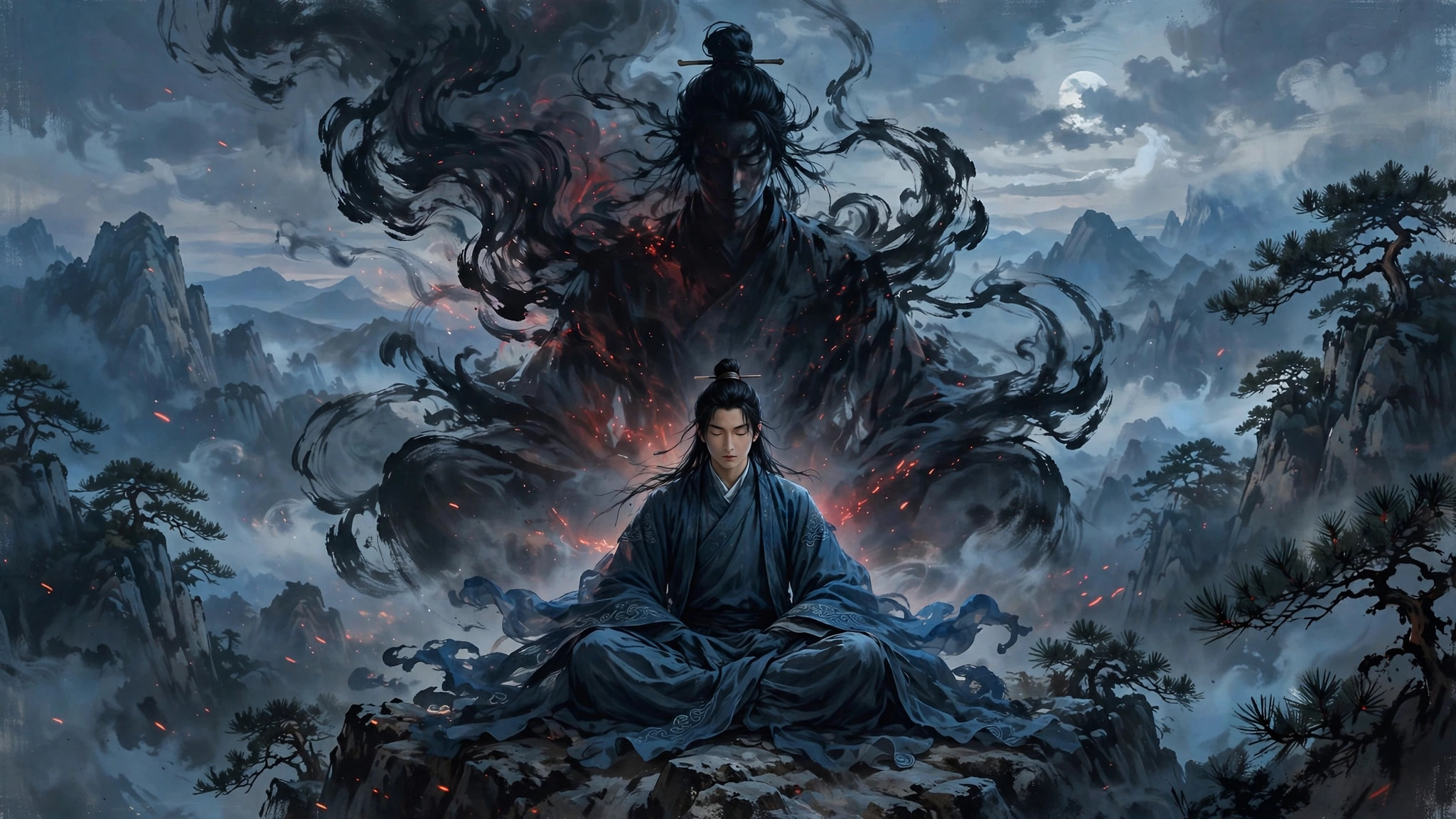
The most dangerous enemy in a xianxia novel is almost never the rival young master or the demonic beast lurking in the forest. It is the protagonist's own mind. Every seasoned cultivator fears the moment when an old guilt, a buried grief, or a craving they refused to face climbs out of the subconscious and takes control — because a sword can be dodged, but a heart demon (心魔, xīnmó) attacks from inside.
In cultivation fiction, heart demons are the negative emotions, obsessions, and unresolved traumas that fester in a cultivator's psyche and sabotage their progress. Left unchecked, they derail breakthroughs, corrupt judgment, and can trigger qi deviation — a complete collapse of body and mind. Authors treat them as the inner counterpart to every outer danger: the hero must conquer monsters and rivals, but just as often must conquer himself.
The name is the definition. 心 (xīn) means "heart" — in classical Chinese usage, the heart is the seat of the mind and emotions, roughly equivalent to "mind" in English — and 魔 (mó) means "demon." Fans commonly translate 心魔 as "heart demon" or "inner demon," and that second rendering is arguably more accurate: no literal demon is involved. A heart demon is a mental barrier — fear, greed, rage, jealousy, guilt, unresolved grief, or an obsession that has grown so strong it has taken on a life of its own.
The core idea is simple and recognizable even outside fantasy: an unexamined wound becomes a puppet master. In stories, this metaphor is made literal. A heart demon can speak to the cultivator in a familiar voice, conjure illusions of dead loved ones or humiliating failures, and twist the cultivator's perception so that enemies look like victims and sacrifice looks like weakness. The stronger the original emotion, the stronger the demon — which is why proud, vengeful, and guilt-ridden characters suffer the worst attacks.
This is also why heart demons scale with power. In genre convention, the mightier the cultivator, the more formidable their heart demons become: a stronger mind produces stronger shadows. A peasant with regrets gets bad dreams; a near-immortal with regrets gets a catastrophe.
The concept did not start with web novels. 心魔 is a genuine term in Chinese Buddhist and Daoist thought, where it describes mental afflictions that obstruct practice — greed, anger, doubt, and obsessive attachment to worldly things were traditionally treated as "inner demons" that meditators had to subdue. Buddhist teachings held that these states of mind were the real obstacles on the path, not external monsters.
Xianxia authors borrowed this vocabulary wholesale and dramatized it. Where a monk's heart demon might be an intrusive thought during meditation, a cultivator's heart demon can shatter a breakthrough, possess their body, or lure them into walking the demonic path. The genre's adaptation keeps the philosophical core — the mind is the true battlefield — while adding the life-or-death stakes fiction demands.
Novels are remarkably consistent about the birth conditions of a heart demon. It almost always grows out of one of these:
Unresolved trauma. A cultivator who watched their clan be slaughtered and never processed the grief carries a heart demon shaped exactly like that night. Guilt over betrayal. The hero who let a friend die — or worse, traded a loved one for power — becomes haunted by the person they failed. Obsessive ambition. The desire for strength is the engine of cultivation, but when it curdles into fixation — revenge at any cost, immortality at any cost — the desire itself becomes the demon. Repressed desire. Love, lust, hunger for status: anything the cultivator refuses to acknowledge has a habit of resurfacing at the worst possible moment, usually mid-breakthrough. Attachment to the mortal world. Family ties, old promises, unfinished business from the cultivator's life before cultivation: severing or resolving these "worldly threads" is a classic plot arc precisely because leaving them intact feeds heart demons later.
The pattern fans commonly point to: a heart demon is almost always something the character chose not to face. The story rewards facing it and punishes burying it.
Heart demons are plot devices as much as they are monsters, and they show up in a handful of classic scenes:
The breakthrough ambush. The most common beat. A cultivator enters secluded meditation to break through to a higher realm, and at the critical moment — when their mind is most exposed and their qi is most volatile — the heart demon strikes. Illusions flood in: the person they failed to save begs for help, the enemy they swore to kill offers a tempting bargain, every doubt they ever had screams at once. If the cultivator wavers, the breakthrough fails, and qi deviation often follows. This is why the genre emphasizes "cultivating the heart" alongside the body: a breakthrough is as much a psychological trial as an energetic one.
The tribulation trial. Some novels fold heart demons into the heavenly tribulation itself, treating the mental assault as one of the lightning bolts. The heavens, in this telling, test the mind as ruthlessly as the body.
The slow corruption. More subtly, a heart demon can steer a character over hundreds of chapters. A simmering grudge becomes cruelty, cruelty becomes massacres, and the reader watches a hero slide toward the demonic path one rationalization at a time. These arcs are often the most memorable in a novel precisely because the villain was, in a sense, the protagonist's own pain.
The possessed ally. A supporting character — the loyal friend, the kindly elder — suddenly turns, and the reveal is that a heart demon had been steering them for years. It is the genre's version of a possession story, and it hits harder because the "demon" is made of the character's own real feelings.
Because heart demons are psychological, the countermeasures are psychological too. Novels have developed a whole toolkit:
Confrontation and resolution. The most narratively satisfying cure. The cultivator returns to the source of the wound — buries the dead properly, keeps the broken promise, faces the person they wronged — and the demon starves. Many "return to the mortal world" arcs exist for exactly this reason.
Heart-tempering meditation. Prolonged stillness, scriptures, and mental discipline meant to strengthen the mind the way body-tempering strengthens the flesh. Buddhist and Daoist-inflected novels give monks and righteous-path cultivators an edge here.
Dao heart (道心). Fans commonly describe the dao heart as the genre's formalized version of psychological resilience: a clear, unshakable conviction about why the cultivator walks their path. A firm dao heart is presented as armor against heart demons — which is why villains' schemes so often target it, trying to shatter the hero's certainty before striking.
External aid. Protective talismans, calming pills, and guardians watching over a breakthrough are all common. In some stories, a trusted person can enter the cultivator's mental world and fight the demon alongside them — one of the genre's most dramatic set pieces.
Letting go. Paradoxically, some novels argue that the way to beat a heart demon is not to fight it but to accept it: acknowledge the guilt, feel the grief fully, and release the attachment. The demon, having nothing left to feed on, dissolves.
New readers often confuse the two, and the qi-deviation article touches on heart demons too, so here is the clean distinction: a heart demon is a cause; qi deviation is an effect. The heart demon is the psychological wound — the guilt, the obsession, the fear. Qi deviation is what happens when cultivation energy spirals out of control, and a heart demon striking at the wrong moment is one of the most common triggers. But qi deviation can also be caused by purely physical factors — forced breakthroughs, unstable foundations, defective techniques — with no heart demon involved at all. Think of it this way: the heart demon is the spark, qi deviation is one of the fires it can start.
Strip away the fantasy, and the heart demon is one of the most honest ideas in the genre. Every xianxia power fantasy is built on the promise that enough effort buys transcendence — but the heart demon is the genre's built-in caveat: power without self-knowledge is a loaded weapon pointed inward. The heroes readers remember longest are not the ones who leveled up the fastest, but the ones who sat down with their worst selves and refused to look away. That is why, in story after story, the final boss is never really the demon lord on the throne. It is the voice in the cultivator's own head, asking the one question no sword can answer: what did you sacrifice to get here, and was it worth it?