Article
Ascension (Feisheng) Explained: What Flying to Heaven Really Means in Xianxia Novels
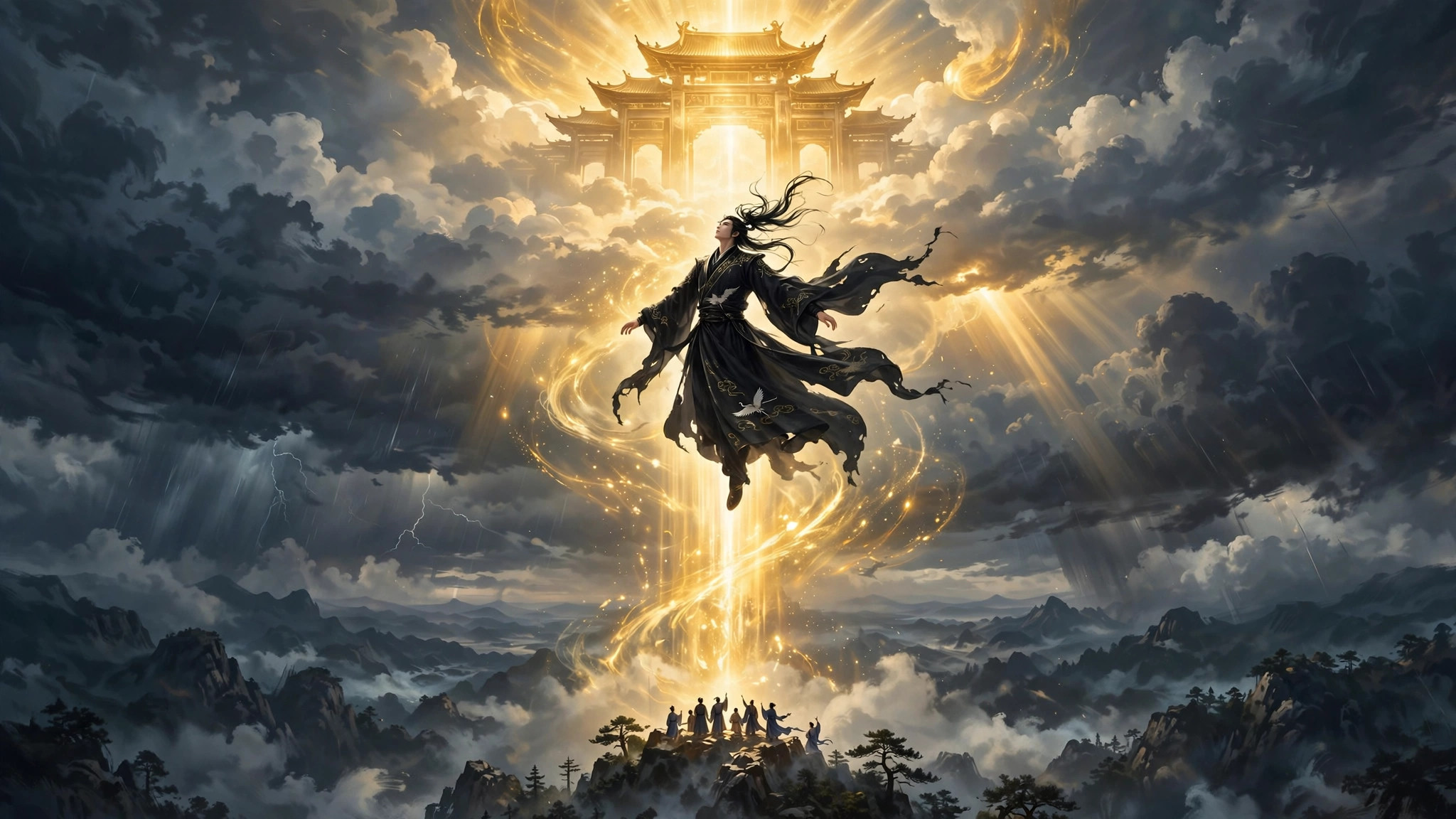
Every cultivation world has a ceiling. No matter how many realms a novel invents — ten, thirty, a hundred — there is always a highest one, a level past which the mortal world simply cannot hold a cultivator anymore. Reaching it takes centuries of grinding, lucky encounters with ancient legacies, and surviving one deadly breakthrough after another. And when a cultivator finally outgrows that ceiling, they don't retire to a mountain and fade away. They ascend.
Ascension (飞升, fēishēng) is the moment in xianxia fiction when a cultivator leaves the mortal world behind and rises, body and all, into a higher realm. It is the genre's ultimate graduation ceremony: the reward for reaching the very top of the cultivation ladder, and usually either the triumphant ending of a story or the starting gun for a much bigger one. The Chinese word paints the picture directly — 飞 (fēi) means "fly," 升 (shēng) means "rise" — and scholars of Chinese religious biography have rendered feisheng in English as being "wafted up to heaven."
Long before webnovels existed, feisheng was already part of the Chinese vocabulary for the miraculous. The set phrase 白日飞升 (báirì fēishēng) — "ascending in broad daylight" — describes someone rising to heaven in front of witnesses, in the middle of the day, with no hiding and no excuses. Readers of the genre will also recognize the old saying 一人得道,鸡犬升天: "when one person attains the Way, even their chickens and dogs ascend to heaven." It started as a joke about nepotism — get powerful and your whole household rises with you — but in cultivation novels it is practically a plot template. When the protagonist ascends, expect their friends, pets, and sworn brothers to catch the same golden light.
The image is always upward motion. Unlike ghosts, who sink, or reincarnated souls, who cycle sideways through new lives, the ascending cultivator goes up — through the clouds, past the sky, out of the world that made them.
Xianxia writers did not invent ascension; they inherited it from more than two thousand years of Chinese religious imagination. The xian (仙) — usually translated as "immortal" or "transcendent" — is the Daoist ideal of a human who refined themselves beyond mortality. According to beliefs recorded in Taoist tradition and summarized on Wikipedia's Xian (Taoism) article, some sects held that a Taoist who became a xian could live a thousand years in the human world before transforming into pure yang energy and ascending to Tian (Heaven). Daoist texts had their own poetic names for the same event, including 羽化登升 — "growing feathers and ascending."
The imagery is already there in the Zhuangzi, from around the 3rd century BCE, which describes a sage who, weary of the world, will "leave it and ascend to the immortals, riding on those white clouds" (in Burton Watson's translation, as quoted in the same article). Flying adepts, feathered robes, clouds as transportation: the religious furniture of ascension was fully stocked centuries before the first webnovel. What xianxia authors did was take this sacred material and turn it into plot mechanics — with rules, requirements, and failure states.
In most cultivation stories, ascension is the capstone sitting on top of the entire realm system. The pattern is remarkably consistent across novels, and fans commonly describe the same sequence of beats:
First, the final tribulation. A cultivator cannot simply decide to ascend. They must break through the highest mortal realm, and that breakthrough summons the last and worst heavenly tribulation — a storm of lightning meant to test whether they deserve to leave. Surviving it is the ticket; failing it is usually death or crippling injury.
Then, the sky opens. Once the tribulation passes, the classic scene unfolds: the dark clouds part, a pillar of golden light descends, and sometimes a gate — the gate of heaven itself — swings open overhead. The cultivator's body is remade on the spot, mortal impurities burned away, and they rise bodily into the light while everyone below watches: sect elders weeping with pride, rivals grinding their teeth, entire cities staring up in silence.
Finally, arrival. The ascended cultivator wakes up (or simply steps out of the light) in a higher realm — usually called the immortal world or the upper realm — where the spiritual energy is thicker, the treasures are richer, and, crucially, everyone around them is stronger. Ascension is not retirement. It is a transfer to a harder server.
Details vary by author — some novels have the heavens "pull" the cultivator up automatically, others require them to fly up under their own power, and a few let powerful figures suppress their ascension to linger in the lower world a while longer — but the skeleton of tribulation, light, and upward departure stays the same.
Here is the narrative genius of the trope. A protagonist who has spent two thousand chapters becoming the strongest being in their world is a storytelling problem — there is nobody left to fight and nothing left to fear. Ascension solves it in one scene. The invincible expert of the lower realm arrives upstairs to discover they are a nobody: a freshly ascended "lower immortal" sweeping courtyards while true experts look down on them. All their status evaporates, but they keep their experience, their cunning, and their reader's affection.
This is why so many long-running series are structured as stacked worlds: mortal world, immortal world, god realm, each with its own ladder, each entered through an ascension. Every ceiling becomes a floor. Readers get the fantasy of starting over with a veteran's brain — the "second playthrough with all your skills" feeling — and the author gets a fresh cast of arrogant young masters to be humbled. It is the cleanest sequel engine the genre ever invented.
Of course, ascension also works as a pure ending. Plenty of stories close on the golden light itself: the protagonist rises, the music swells (metaphorically), and the reader is left with the image of ultimate success. After hundreds of chapters of humiliation, grinding, and narrow escapes, the genre owes its readers that payoff, and ascension delivers it in a single unforgettable picture.
It is worth noting that the novels — and the tradition behind them — allow more than one road to immortality. Daoist texts described "earthly immortals" who never ascended at all but lived on in famous mountains, and the practice of shijie (尸解, "release from the corpse"), in which the adept's spirit slipped free of the body, leaving behind a husk or a token like a sword as proof of transformation. Ascending bodily in a pillar of light was the glorious version; the tradition always had quieter ones.
Individual novels also tinker with the formula. In the fan-documented lore of Heaven Official's Blessing, for example, ascension is how a mortal becomes a Heavenly Official, and it demands three things — ability, hard work, and luck — with a "Heavenly Calamity," usually a great storm, standing at the gate. Strikingly, the calamity can be refused: a person can choose to stay mortal. That detail captures something true about the trope across the genre. Ascension is never just a power-up. It is a choice about what kind of existence you want — and most protagonists, having climbed this far, never hesitate.
Strip away the golden light and the thunder, and ascension is the genre's thesis statement made visible: effort compounds, limits are temporary, and the ceiling of one world is the floor of the next. Every reader who has watched a protagonist crawl from a crippled nobody to a realm-shaking expert gets, in the ascension scene, the receipt for all of it — proof that the grinding meant something.
That is why authors keep writing it and readers keep tearing up at it. In a genre built on the fantasy of self-transformation, no image says it better than a person simply rising, on their own power, out of the world that tried to hold them.