Article
What Is a Jade Beauty in Xianxia? The Trope, the Ideal, and Why It Matters
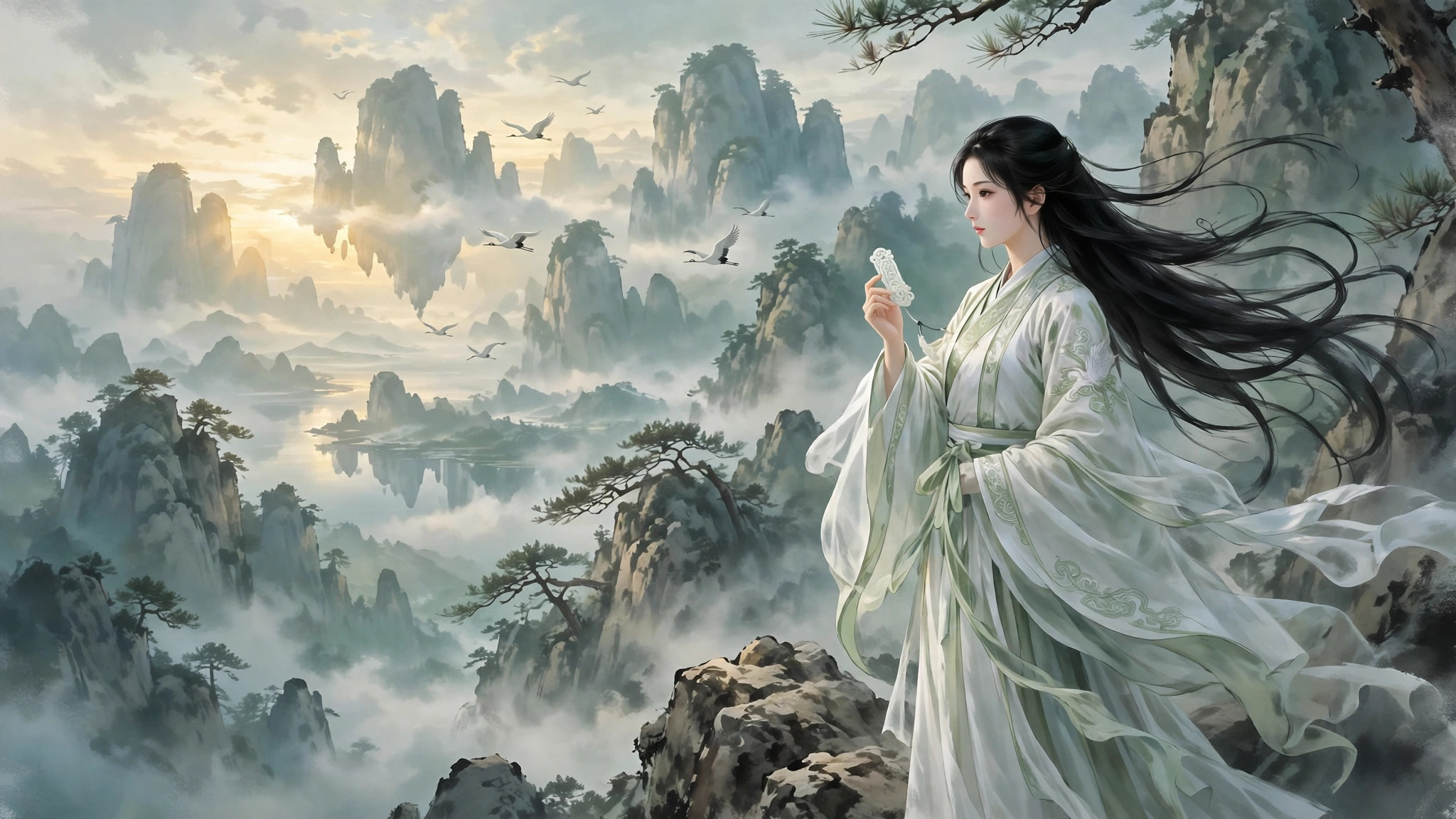
A "jade beauty" in xianxia is a woman — usually a young cultivator, a sect's senior sister, or a clan heiress — whose beauty is described through jade: skin like white jade, a face like carved jade, a bearing as cool and flawless as polished stone. The label is not really about her looks. It is shorthand for a whole package: exceptional beauty, cold dignity, high status, and a purity that other characters treat as untouchable. When a novel calls a woman a jade beauty, it is telling you, in two words, that she is admired, desired, and almost certainly out of the protagonist's reach — at least for now.
The phrase comes from a much older Chinese habit. Jade has been a metaphor for ideal feminine beauty in Chinese literature for well over two thousand years. The Book of Songs, China's oldest poetry collection, already calls a person "beautiful as jade" (美如玉, měi rú yù), and Tang dynasty poets made a whole vocabulary of it for women's beauty — 玉颜 (jade face), 玉貌 (jade features), 玉容 (jade countenance) — each a compact way of saying that a woman's beauty was flawless, luminous, and cool to the touch. Xianxia authors inherited that vocabulary wholesale. When they write "jade beauty," they are borrowing a compliment that Chinese readers have recognized since antiquity.
To understand why jade, of all stones, became the standard, you have to know what jade meant in traditional Chinese culture. It was never just a gemstone. Confucius is recorded as saying a gentleman should behave like jade, and he is credited with listing eleven virtues the stone embodies — humanity, intelligence, justice, ritual propriety, loyalty, sincerity, and others. Jade was hard yet warm, smooth yet unbreakable, beautiful without being showy. That made it the perfect symbol for an ideal person.
The most famous idiom in this family is 冰清玉洁 (bīng qīng yù jié), literally "pure as ice, flawless as jade." Wiktionary glosses it as "irreproachable; incorruptible," and its earliest recorded uses praise moral character, not appearance. Over centuries the phrase drifted toward describing women in particular, until "jade" and "female beauty" became nearly inseparable in the literary imagination. An article on jade culture in Chinese women's literature notes that of the more than a thousand Chinese words built on the character 玉 (yù, jade), roughly a tenth describe women.
So when a xianxia novel calls someone a jade beauty, the compliment carries three layers at once. The first is physical: pale, smooth skin and delicate features, the "skin like snow, face like jade" image that appears in novel after novel. The second is moral: she is assumed to be pure, disciplined, and incorruptible — the kind of person who would never stoop to scheming or cruelty. The third is social: jade is precious and rare, and so is she. She is not one beauty among many. She is the beauty that entire sects compete over, that young masters write poems about, and that elders quietly hope their disciples will marry.
Once you know the signal, you will start spotting the same handful of roles everywhere. The most common is the sect's senior sister (师姐, shījiě) — the cold, talented woman a few years ahead of the protagonist who barely notices him at first. Then there is the clan heiress, raised in luxury and guarded by bodyguards, whose beauty is treated as a family asset in marriage alliances. A third is the "cold fairy" (冷艳仙子), a lone cultivator of great power who answers questions in single sentences and is rumored to have frozen a suitor solid. And a fourth is the destined dao companion — the woman the protagonist will eventually stand beside as an equal, after hundreds of chapters of earning her respect.
These roles are not accidents. Xianxia runs on hierarchy, and a jade beauty is a walking status marker. Her presence at a banquet, a tournament, or an auction instantly tells the reader where the power in the room sits. If a young master insults her, you know he is about to be humiliated. If a villain covets her, you know his fate is sealed. If the protagonist saves her life, you know the story has just made a long-term promise.
That is also why the description is so repetitive. Authors are not trying to be original about her face. The jade imagery is a genre convention, like a knight's shining armor in a Western fantasy novel. Readers do not need a fresh metaphor; they need to recognize the character's function in under a second, and "skin like jade" does that job perfectly.
There is a practical reason the trope survives: efficiency. A xianxia novel might introduce dozens of characters, and a webnovel author publishes thousands of words a day. A two-word label that conveys beauty, virtue, and status in one stroke is an incredibly useful tool. Fans commonly describe the jade beauty as the genre's default heroine precisely because the label does so much work for so little word count.
There is also a cultural reason, and it ties directly into face. In a world where reputation is currency, being seen beside a jade beauty raises a man's standing, and insulting one destroys it. The trope turns female beauty into a public good that men fight over, which is exactly the kind of social fuel a cultivation story runs on. Tournaments are held to win her hand. Auctions are crashed to buy her a gift. Rival sects go to war over a marriage proposal. The jade beauty herself may do very little in these scenes — she is the prize, not the player — and that, depending on the novel, is either the point or the problem.
Not every author plays it straight. Some of the most memorable jade beauties in modern xianxia are the ones who break the mold. The cold fairy turns out to be warm and funny once she trusts someone. The untouchable heiress is secretly the strongest fighter in her generation and tired of being treated as a vase. The senior sister the protagonist idolized turns out to have her own ambitions, and her beauty is the least interesting thing about her.
Satirical novels go further and mock the label outright: a character will be introduced with the full jade treatment — flawless skin, cold gaze, jade-like bearing — and then immediately trip over her own robes, or haggle over spirit stones like a market vendor. The joke only lands because readers know the trope so well. You cannot subvert a convention your audience does not recognize.
This is also where the trope's limits show. Because the label does so much of the characterization work, some jade beauties never get a personality beyond "beautiful and cold." Readers have a name for that failure too, and they are quick to call it out in comments and forums. The best-regarded novels in the genre tend to be the ones where the jade beauty gets a will of her own — where she chooses her dao companion rather than being won like a trophy.
If you are new to xianxia and you meet a jade beauty in chapter three, here is the practical way to read her. First, treat the label as a status badge, not a description — the novel is telling you she matters. Second, watch what she does, not what the narrator says about her skin; her actions in the next fifty chapters will tell you whether she is a real character or set dressing. Third, expect her to be cold at first and warm later; that thaw is one of the genre's most reliable slow-burn arcs, and authors count on you anticipating it.
And if the word "jade" starts to feel overused, that is normal. It is the single most recycled compliment in the genre, and noticing it is a sign you are learning to read xianxia like a native. The stone has carried the weight of Chinese ideals of beauty and virtue for millennia; webnovels just gave it a sword, a sect, and a thousand-year cultivation base.