Article
What Is a Spirit Vein in Xianxia? Lingmai, Sects and Spirit Stones Explained
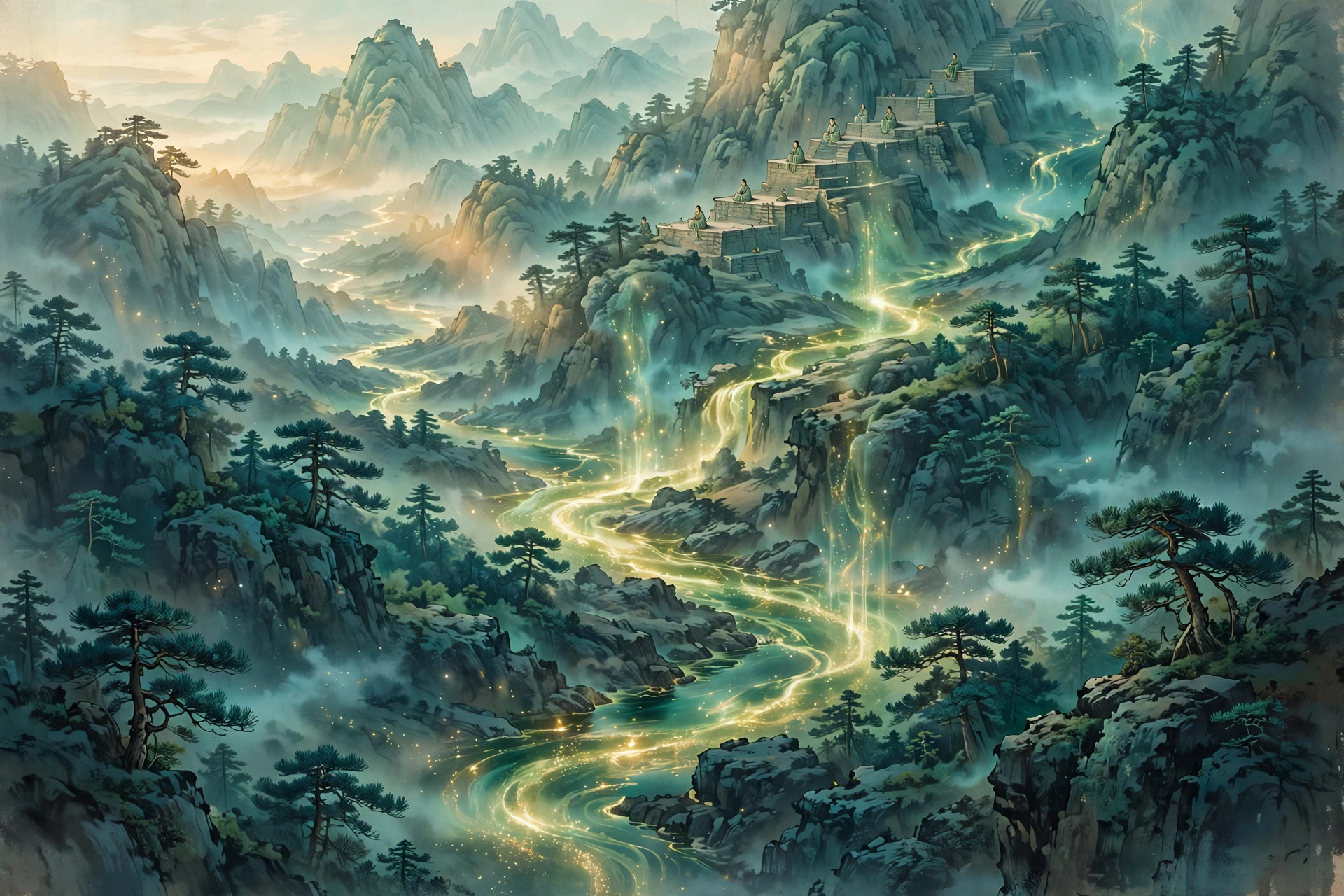
A spirit vein (灵脉, língmài) is an underground current of spiritual energy in xianxia novels — a natural seam of concentrated qi running through the earth, the way a gold vein runs through rock. Wherever a spirit vein surfaces, the air itself becomes thick with energy: herbs grow faster, cultivators train faster, and entire sects rise or fall depending on who controls the ground above it. If a character in a novel suddenly declares that some mountain is "a treasure land," nine times out of ten there is a spirit vein underneath it. Cut the vein off, and the sect slowly starves; find a new one, and a nobody clan can become a power overnight.
The Chinese term is transparent once you split it. 灵 (líng) means "spirit" or "spiritual" — the same character in 灵气 (língqì, spiritual energy) and 灵根 (línggēn, spiritual root). 脉 (mài) means "vein" or "pulse," and it is a word with a long history in Chinese thought: in traditional medicine it names the channels through which qi moves in the body, and in feng shui it describes the ridges of a mountain range as the veins of a sleeping dragon, carrying the flow of energy across the land. The idiom 来龙去脉 (lái lóng qù mài, literally "where the dragon came from and where its veins go") comes from exactly this feng shui usage — and today it just means "the whole story."
Xianxia authors took that old idea — the land itself has veins, and energy flows through them — and made it literal. A 灵脉 is a vein of the earth that carries spiritual energy instead of blood.
A spirit vein does one thing, and everything else follows from it: it makes the spiritual energy in an area denser than the surrounding land. In the logic of these novels, cultivators absorb the spiritual energy around them to grow stronger, so training on top of a vein is like training at high altitude with an oxygen mask — the same effort produces far more progress.
Fans commonly describe the effects in a few consistent ways:
Faster cultivation. A disciple meditating above a vein absorbs energy many times faster than one training in an ordinary town — which is why sects guard their veins jealously and the best training rooms sit closest to the core.
Better resources. Spirit herbs grow larger and more potent near a vein, and spirit stones — the crystallized form of spiritual energy — can be mined from the rock around one. A rich vein is a mine, a farm, and a training ground at once.
Stronger formations. Sects often anchor their defensive formation arrays to a vein, drawing on its energy to power barriers no single cultivator could maintain. Attacking a sect on its home ground means fighting the vein as well as its disciples.
Long-term change. In many novels, a vein slowly reshapes the land around it: ordinary plants become spirit herbs, ordinary animals become spirit beasts, and a barren mountain can turn into a paradise over the centuries.
None of these effects is fixed across the genre — one novel's vein might only speed up meditation, another's might be a living thing that can be refined, moved, or even stolen. The common thread is density: a vein is where the world's energy concentrates, and concentration is power.
This is where the term stops being scenery and starts being politics. In xianxia, a sect is a school, a business, and a small kingdom in one — and a spirit vein is its most valuable asset. Our guide to sects covers how these organizations work; the vein is usually the reason a sect exists where it does.
The pattern repeats so often that readers treat it as a rule. A great sect occupies the richest vein in the region, with the inner disciples closest to the core and the outer disciples further away. A middling sect holds a middling vein. A weak clan clings to a thin, nearly exhausted one and dreams of finding a better one. And when a vein dries up — which, in some novels, they do — the sect built on it declines with it, its disciples drifting away to richer ground.
That is why "a spirit vein has been discovered" is one of the genre's most reliable plot triggers. A newly found vein means a land rush: sects send elders to claim it, rogue cultivators sneak in to absorb energy before anyone notices, and wars start over a patch of mountain that was worthless the week before.
If the vein is the mine, spirit stones are the ore. In most novels, the energy of a vein slowly crystallizes into spirit stones: portable, tradeable chunks of condensed spiritual energy that function as the cultivation world's currency. Sects mine the stones around a vein, sell them, and use the profits to buy pills, treasures, and the loyalty of strong cultivators. A sect that loses its vein loses its income — which is why "destroy the enemy's spirit vein" is a war strategy, not a side quest.
The relationship runs the other way too: spirit herbs — the ingredients for pill refining — grow best in energy-rich soil, so the ground above a vein is prime herb-growing territory. A sect that controls a vein controls both its money and its medicine supply, which is a large part of why the great sects stay great.
There is a catch: in some novels, veins are not renewable — mine the stones too aggressively and the vein weakens or dies. In others, a vein can recover over centuries if left alone, or be "nourished" by burying spirit stones in it. The exact rules are always the author's choice, but the logic stays consistent: a vein is a resource, and resources can be exhausted.
Fans commonly describe veins in grades and sizes, though no ranking is canonical. A "low-grade" or "small" vein might support a village of cultivators; a "high-grade" or "large" one can support a great sect for a thousand years. Some novels add elemental attributes — a fire-attribute vein suits fire techniques — and the five elements often show up here as well.
Other terms appear around veins so often that they are worth knowing:
Spirit spring (灵泉, língquán). A spring whose water is saturated with spiritual energy, often found where a vein surfaces. Drinking or bathing in one is a common shortcut to a breakthrough — and a common reason two characters fight over a pond.
Dragon vein (龙脉, lóngmài). In feng shui, a mountain range that carries the energy of the land; in xianxia, the grandest kind of spirit vein, usually running beneath a mountain range or an empire. When a novel mentions a dragon vein, the stakes are national: emperors and great sects build their capitals on them.
Vein core / vein heart. The densest point of a vein, where the energy is thickest and the best spirit stones form. Sitting on the core is the fastest way to train — and the seat everyone in the sect wants.
Veins show up in storylines in a handful of recurring roles, and recognizing them makes a lot of xianxia plotting click into place.
The discovery. A protagonist stumbles onto an unclaimed vein — in a cave, under a ruined sect, at the bottom of a lake. Suddenly a nobody has something every power in the region wants, and the rest of the arc is about keeping it.
The inheritance. A falling sect's last asset is its vein, and the protagonist inherits it along with the sect's name. Rebuilding the sect means rebuilding around the vein.
The theft. A villain drains a rival's vein, or poisons it. This is the cultivation world's equivalent of burning the enemy's crops — an attack on the foundation rather than on the army.
The breakthrough. A character sits on a vein's core at the moment of a breakthrough, and the concentrated energy pushes them through a bottleneck years of training could not. That is why the best training spots in any novel are always contested.
Notice what all four have in common: the vein itself never acts. It is the most passive object in the genre, and the most fought-over — the purest form of a genre about scarce resources and the people who want them.
When a novel mentions a spirit vein, three questions tell you everything you need to know. How rich is it — a trickle or a river? Who controls the ground above it — and how badly do they want to keep it? And is anyone trying to take it, drain it, or hide it? Answer those three, and you will understand the scene, the stakes, and probably the next five chapters.
The spirit vein is not the flashiest idea in xianxia. It has no lightning, no sword light, no dramatic transformation — just a seam of energy in the ground, quietly making everything around it richer, stronger, and more worth fighting for. That quiet is exactly why it matters: strip away the treasures and the techniques, and what is left is a world where power comes from the land itself, and the people who control the land control everything built on it.