Article
What Is a Kowtow? Why Xianxia Characters Bow Until Their Foreheads Touch the Floor
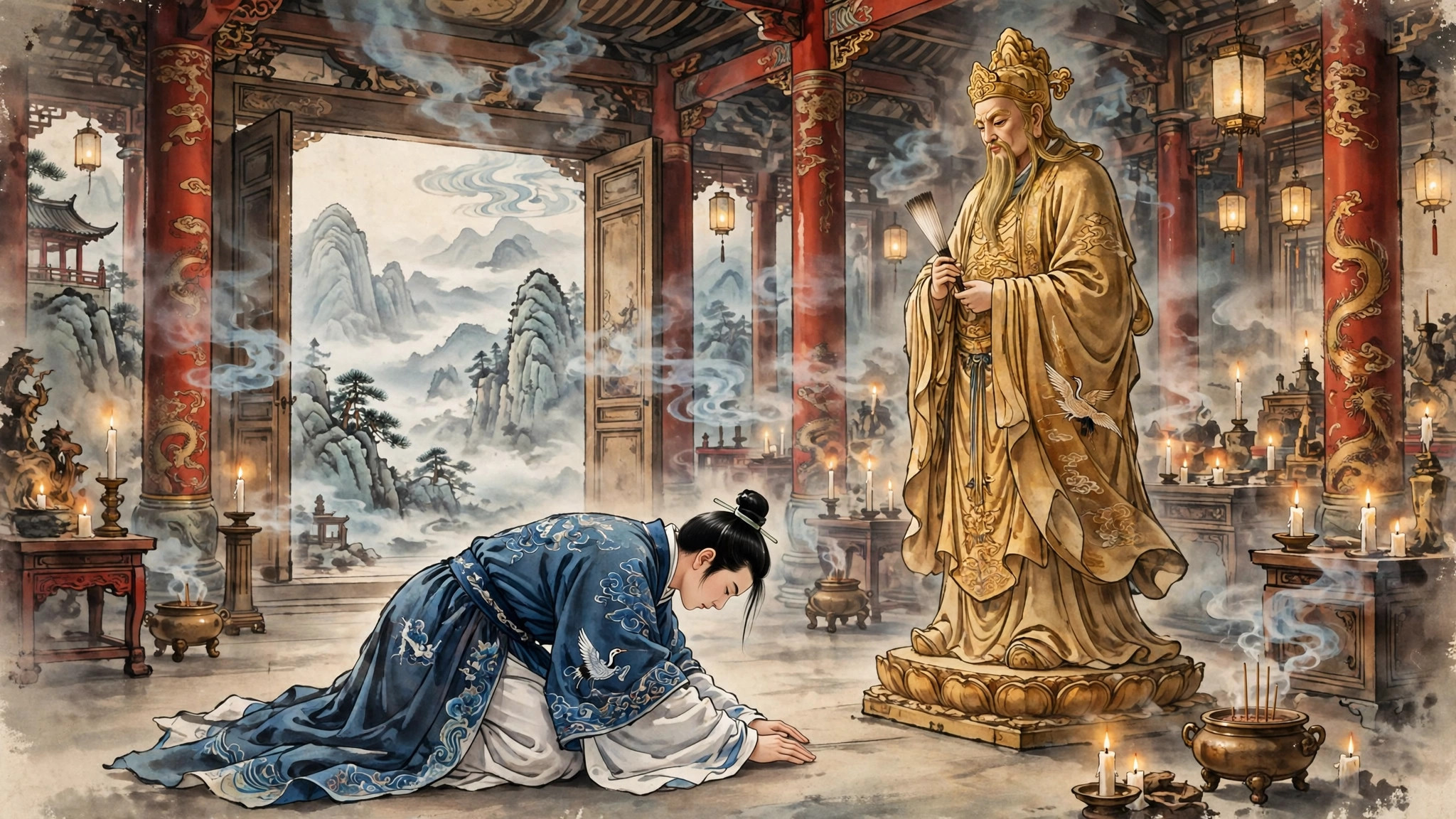
The kowtow is the most physically humbling gesture in the xianxia toolkit — and the one that tells you the most about a character in a single sentence. A kowtow (叩头, kòutóu) is the act of kneeling and bowing so low that your forehead touches the ground, the highest sign of reverence in traditional Chinese culture. In novels, characters kowtow to sect masters, emperors, ancestors, and anyone who has just saved their life. It is not a casual bow. It is a full-body statement: I submit, I am grateful, or I am begging — and everyone in the room understands which one.
The characters tell the story plainly. 叩 (kòu) means "to knock" and 头 (tóu) means "head," so 叩头 is literally "knock head." The English word "kowtow" comes from the Cantonese pronunciation of the same term, kau tau. A closely related word, 磕头 (kētóu), is common in everyday speech and means roughly the same thing, with 磕 carrying the sense of touching or tapping a surface rather than knocking on it.
This is not a gesture the novels invented. According to the Wikipedia entry on kowtowing, the custom probably dates back to the Spring and Autumn period or the Warring States period (771–221 BC), and it was already established by the time of the Qin dynasty (221–206 BC). In imperial China it was used to show reverence for elders, superiors, and above all the emperor, as well as in worship before religious images and the tombs of the dead. Xianxia novels inherited the gesture wholesale and made it a standard piece of stage business: whenever the plot needs a character to show total submission or total gratitude, the kowtow is what they do.
Not every kowtow is the same. In imperial court protocol, the most solemn version was the "three kneelings and nine kowtows" (三跪九叩, sān guì jiǔ kòu): the subject would kneel from a standing position three times, and each time perform the kowtow three times while kneeling — nine forehead touches in total. The historian Immanuel Hsu described it as "three kneelings and nine knockings of the head on the ground." This grand kowtow was reserved for the most formal occasions, such as the coronation of a new emperor, and it was also the ritual demanded of foreign envoys presenting themselves before the throne.
That number — nine — is not random. In traditional Chinese thought, nine was associated with the emperor himself, the highest yang number, the symbol of ultimate authority. So a nine-fold kowtow was not just extra polite; it was a performance of the entire imperial order, with the emperor at the top and everyone else arranged below him.
Ordinary kowtows in novels are usually simpler. A disciple kowtowing to a new master typically performs three kowtows in a row, often before a statue, a portrait of the sect founder, or the master's seat. Three is the standard number for worship and respect in Chinese ritual — you will also see characters kowtow in groups of three before Buddhist statues and tombs. When a translation says a character "kowtowed three times," that is the default respectful form, not a special ceremony.
The gesture shows up in a handful of recurring scenes, and each one means something different:
Accepting a master. The formal master-disciple ceremony almost always involves kowtowing. A character who has been begging a reclusive expert to take them on finally gets a yes, and the first thing they do is drop to their knees and knock their head on the floor — sometimes three times, sometimes nine. The kowtow is the contract: it turns a loose relationship into a binding one, and a disciple who has kowtowed to a master owes them obedience in a way a mere student does not. The scene is often the emotional peak of an early arc, because the protagonist has usually had to grovel, endure humiliation, or prove themselves before earning the right to perform it.
Begging for mercy. When a defeated enemy or a desperate character begs for their life, they kowtow — and they usually do it repeatedly, sometimes until their forehead bleeds. The blood is a deliberate detail in the genre: it shows the character has nothing left to offer but their own body and dignity. A villain who kowtows and is spared anyway has been humiliated twice over, because the kowtow itself is the admission that they are worth less than the person standing over them.
Apology and atonement. A character who has offended a superior, broken a sect rule, or failed a task may kowtow as an apology. This is closely tied to the concept of face — a character who has caused someone to lose face can try to repair it by publicly lowering themselves. The more public the kowtow, the more serious the apology, because everyone watching sees the character surrender their standing.
Gratitude for a life debt. A character whose life has been saved, or whose family has been rescued, will often kowtow to their savior. Unlike the begging kowtow, this one is voluntary and dignified — it says "I owe you everything" without the character having to say a word. In many novels this moment is what binds two characters together for the rest of the story, because a life debt in xianxia culture is not something you repay with money and forget.
Worship and funerals. Characters kowtow before ancestral tablets, sect founders' portraits, and the graves of the dead. This is the religious side of the gesture, and it is the one that survives in real modern China: kowtowing is still performed at traditional funerals and before Buddhist and Daoist images, even though it has largely disappeared from everyday interaction between living people.
If kowtowing is the ultimate submission, then refusing to kowtow is the ultimate defiance — and novels use that refusal as a shorthand for a character's pride. A protagonist who stands upright while everyone else kneels before the sect patriarch is announcing that they do not recognize that authority, or that they consider themselves its equal. The scene works because every reader, in-world and out, knows exactly how much it costs to stay standing.
The most famous real-world version of this refusal happened in 1793, when the British envoy Lord Macartney was received by the Qianlong Emperor. The Qing court expected Macartney to perform the full kowtow, the ritual demanded of foreign envoys as a sign of tributary submission. Macartney refused, arguing that his sovereign George III was the Qianlong Emperor's equal and offering to kneel on one knee as he would before his own king. The compromise — a single-knee genuflection rather than the full prostration — was accepted, and the audience went ahead on September 14, 1793. The mission's trade requests were rejected anyway, and later writers often blamed the kowtow dispute for the failure, though historians now note that a Dutch embassy that did perform the kowtow was rebuffed just the same.
New readers sometimes confuse the two, but they are different gestures with different weights. A bow — bending at the waist, hands clasped — is ordinary politeness. Juniors bow to seniors, students bow to teachers, guests bow to hosts. It costs the character nothing and signals nothing more than good manners. A kowtow, by contrast, puts the character on the ground, forehead to the floor, physically lower than everyone standing. It is a gesture of last resort: gratitude so deep it cannot be expressed standing up, submission so complete it has to be performed with the whole body, or desperation so total that dignity has stopped mattering.
That is also why a character who kowtows to the wrong person, or at the wrong time, creates instant drama. Kowtowing to an enemy's envoy implies accepting their authority; kowtowing in public when the other party has not earned it is a humiliation the character will carry for chapters. And a character who is ordered to kowtow and refuses — in front of witnesses — has just declared a feud.
In English, "kowtow" entered the language in the early 19th century to describe the bow itself, but it quickly took on a second, figurative meaning: to show slavish, grovelling submission to someone in power. When an English speaker says a politician is "kowtowing to" a foreign government, they mean the politician is submitting abjectly, with no dignity left. That figurative use comes straight from the imperial ritual — the image of a person on the floor, forehead to the ground, was so striking to early Western observers that the word became shorthand for the whole idea of abasement.
The next time a character drops to their knees in your novel, ask three questions. Who are they kowtowing to, and is that person worthy of it in the character's own eyes? Are they doing it willingly, or has someone forced them to the floor? And what does it cost them — their pride, their standing, or nothing at all? A disciple kowtowing to a beloved master is a promise. A villain kowtowing for their life is a confession. A protagonist who refuses to kowtow is a declaration of war. The gesture is always the same; the meaning is whatever the character puts into it.