Article
What Are Magic Treasures in Xianxia? Fabao, Flying Swords and Spirit Artifacts Explained
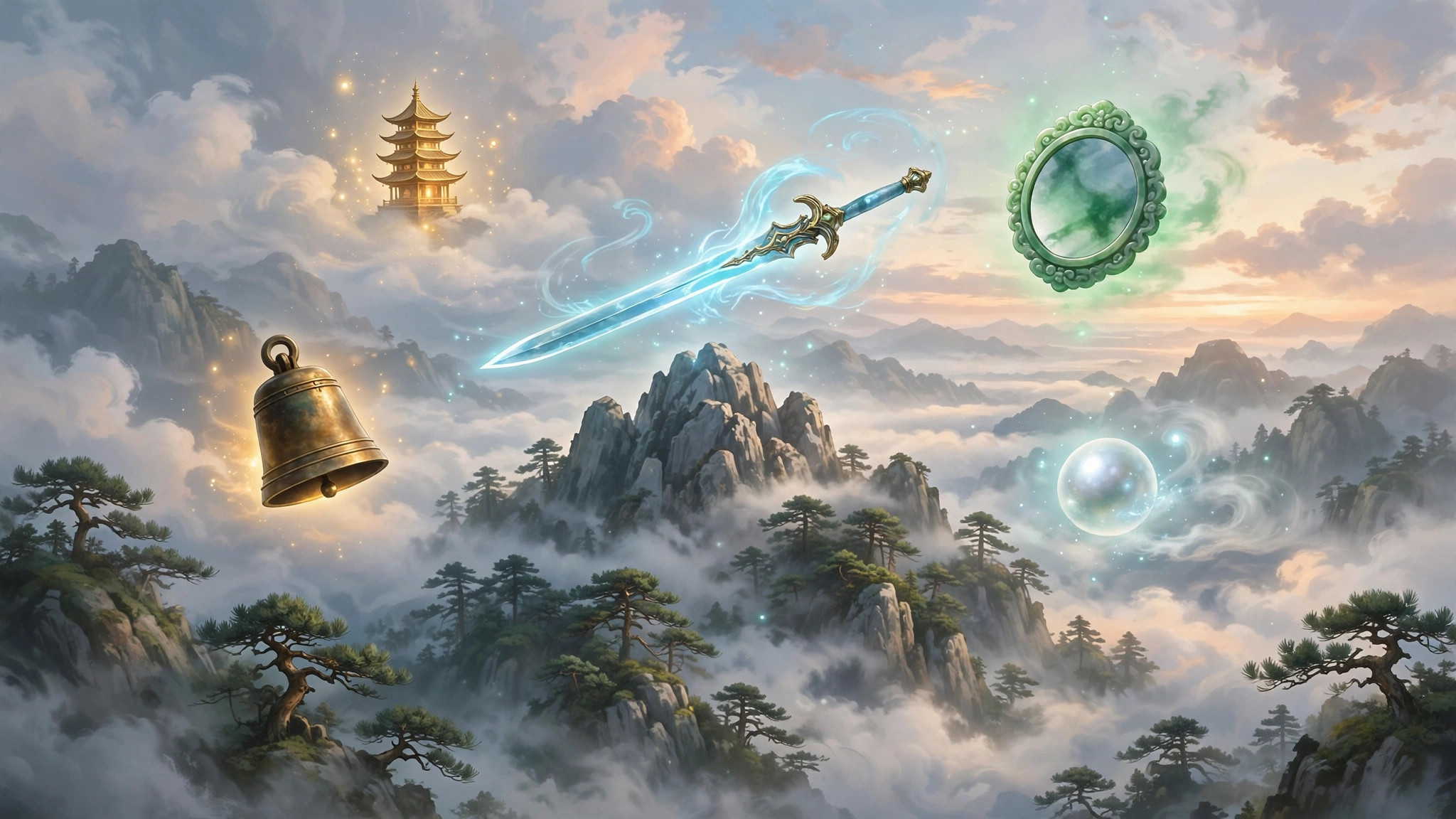
A cultivator without a treasure is a soldier sent to war empty-handed — and in xianxia fiction, the treasure often matters more than the soldier. Magic treasures (法宝, fǎbǎo) are enchanted objects in xianxia and xuanhuan novels: weapons, tools, and artifacts that have been refined with spiritual energy until they carry powers of their own. A flying sword that answers its master's thought, a pagoda that traps enemies inside it, a mirror that sees through disguises — all of these are fabao. Where cultivation techniques strengthen the person, treasures strengthen what the person can do, and losing the right treasure can turn a sect elder into easy prey.
The two characters tell you most of what you need. 法 (fǎ) covers "law," "method," and "dharma" — the rules and techniques by which the world works. 宝 (bǎo) means "treasure" or "precious thing." Put together, a fabao is literally a "method-treasure": an object made precious by the methods worked into it.
That wording has real roots outside fiction. In Chinese Buddhism, 法宝 is one of the Three Jewels, the Dharma treasure — the Buddha's teachings themselves. In Daoist ritual, the related term 法器 (fǎqì, "method-implements") refers to the physical tools priests use in ceremonies: tablets, bells, and scepters, as documented by Daoist reference sites. Xianxia novels borrowed this vocabulary and gave it a new job: in the novels, a fabao is not a symbol of the teachings but a working instrument of power, forged and refined rather than merely blessed.
English translations vary, which is worth knowing when you shop for reading material. You will see "magic treasure," "magical treasure," "dharma treasure," "spirit artifact," and sometimes just "treasure" or "artifact." Fans commonly use "fabao" for the general category and "lingbao" (灵宝, "spirit treasure") for rarer, more powerful items. The exact hierarchy changes from novel to novel, and no single ranking is canonical across the genre.
No treasure is more iconic than the flying sword (飞剑, fēijiàn). In the stories, a sword cultivator refines a blade until it responds to their mind, then rides it through the sky or sends it flashing across a battlefield to strike from a distance. The image is older than the novels — swords that fly under their own power appear in Chinese legend and classical tales — but xianxia made it a daily commute. A cultivator who cannot yet fly on their own rides a sword; a master fights with one while standing still, directing the blade like a second pair of hands.
Flying swords also explain why treasures are personal. A sword is usually refined over years, fed with the owner's spiritual energy until it carries something of them. Fans commonly describe the best blades as semi-aware: they hum when danger approaches, refuse to be drawn by strangers, and grow sharper as their master grows stronger. That bond is why "steal the hero's sword and use it yourself" rarely works in these stories — a treasure tuned to one person's energy resists everyone else. (For the willpower side of swordsmanship, see our guide to sword intent.)
Novels use treasures the way a toolbox uses tools, and most fall into a few recognizable jobs:
Weapons. Swords lead the list, but spears, sabers, fans, needles, bells, and seals all appear. Some weapons attack directly; others attack strangely — a bell that shakes an enemy's soul loose, a needle that slips through armor, a seal that falls from the sky like a mountain.
Defensive treasures. Shields, robes, armor, and talismans that block attacks, shrug off poison, or hide the wearer. A good defensive treasure is often what lets a weaker cultivator survive meeting a stronger one, which is why protagonists are always hunting for one before a big fight.
Storage treasures. Rings, pouches, bracelets, and gourds with space inside far larger than their outside. A storage ring is the cultivation world's backpack, bank vault, and smuggling compartment in one — and the fastest way for a reader to tell how rich a character is. These usually run on spirit stones or the owner's energy rather than anything else.
Flying treasures. Boats, palanquins, carpets, and leaf-shaped craft that carry their owner through the air or across seas. A flying treasure is slower to refine but far more comfortable than riding a sword, and in many novels it doubles as a mobile base, complete with its own defensive formations.
Auxiliary treasures. The miscellaneous drawer: mirrors that reveal hidden enemies, pagodas that imprison them, cauldrons for refining pills, compasses that track spiritual energy, and beads that store a single life-saving strike from a master. These are the treasures that solve problems strength cannot.
Novels describe two paths to a treasure, and the difference drives a lot of plot. The first is forging: a craftsman (a "refiner") gathers rare materials — metals from meteorites, bones of spirit beasts, wood from thousand-year trees — and works spiritual energy into them over days or years until the object wakes up with a power. The second is inheritance: ancient treasures left behind by dead masters, sealed in tombs and secret realms, waiting for someone worthy to claim them.
Claiming matters as much as making. Fans commonly describe a ritual called "blood refinement," in which the new owner feeds the treasure a drop of their blood and a thread of their spiritual energy, binding it to them alone. Once bound, the treasure answers its master's thoughts and resists strangers — which is exactly why the classic scene of a villain seizing a hero's treasure and immediately using it against them almost never happens. A treasure that has not accepted you is, at best, a very expensive paperweight, and at worst it fights back.
Some treasures go further and develop their own spirits. A "treasure spirit" (器灵, qìlíng) is the artifact's own awareness — a childlike voice in a mirror, a proud old soul in a sword — and such treasures can choose, test, or even reject their owners. These are the stories where the treasure is really a character, and the question is not whether the hero is strong enough to wield it, but whether the treasure thinks the hero is worth following.
Almost every novel ranks its treasures, because readers need a quick way to feel the gap between a street-stall blade and a sect's heirloom. A common ladder fans will recognize runs from common implements up through magic treasures, spirit treasures, and then rarer tiers with names like immortal artifacts or divine artifacts. The labels shift between authors — one novel's "spirit treasure" is another novel's mid-tier trinket — so treat any ranking as that novel's house system, not a genre-wide standard.
What stays consistent is the logic behind the ladder. Higher-grade treasures hold more spiritual energy, carry more refined techniques, and survive clashes that would shatter lesser items. They are also harder to bind: a weak cultivator who grabs a treasure far above their level may find it draining their energy, ignoring their commands, or attracting every greedy expert in the region. The genre's running joke is that the most dangerous thing about finding a legendary treasure is surviving the attention it brings.
Treasures are plot engines in a way techniques are not, because they can change hands. A technique lives in one person's body; a treasure can be inherited, stolen, auctioned, gambled away, or found in a ditch. Auction scenes, where rival sects bid mountains of spirit stones for a single item, exist because treasures are the one form of power that can be bought. Inheritance scenes, where a dying master passes a ring to a disciple, exist because treasures are the one form of power that can be bequeathed.
They also solve the genre's pacing problem. A protagonist who trains for a hundred chapters to gain one realm of power can instead find a treasure and jump a tier overnight — and then spend the next hundred chapters dealing with the enemies that treasure attracted. Authors use treasures as shortcuts and as traps in equal measure, which is why veteran readers treat any "free" treasure with suspicion. In xianxia, nothing powerful is ever truly free; the price is just collected later, in rivals, debts, or curses baked into the artifact itself.
When you start a new novel, pay attention to how it treats its treasures, because that tells you how its world works. If treasures are graded, scarce, and fought over, you are in a world where wealth and power are the same thing. If every elder hands out treasures like party favors, the story's real currency is probably favor, lineage, or secrets instead. And if a treasure starts talking, stop skimming — it is about to become one of the main characters.