Article
Sword Intent Explained: The Will Behind the Blade in Wuxia and Xianxia
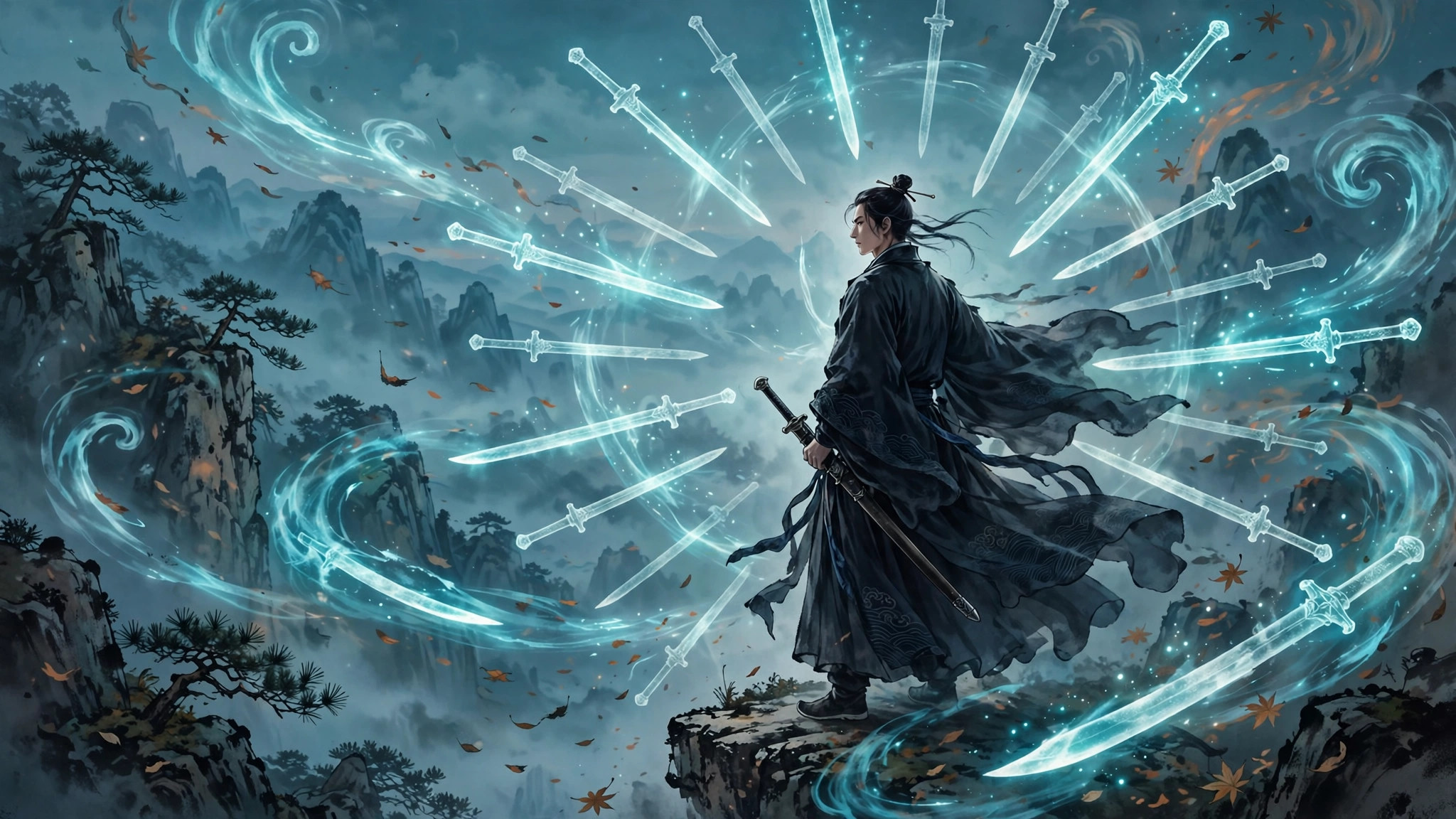
A duelist stands perfectly still in the middle of a crowded arena. He has not drawn his weapon. He has not moved his hands. Yet the veteran swordsman across from him has gone pale — he says he can feel an edge pressed against his throat. The crowd feels nothing but a strange pressure in the air, like the moment before a thunderstorm breaks.
That invisible edge is *sword intent (剑意, jiànyì): the swordsman's will, understanding, and fighting spirit compressed into something so sharp it can be felt before a single strike is thrown. In wuxia and xianxia fiction, it is the mark of a fighter who has stopped merely using a sword and started embodying* one. (If you're still learning the lay of the land, our beginner's guide to xianxia explains where stories like this live.)
The Chinese term unpacks cleanly. 剑 (jiàn) means "sword" — but specifically the double-edged straight sword (jian), the scholar's weapon, as opposed to the single-edged curved saber (dao). 意 (yì) is harder: it covers "meaning," "intention," "thought," "will," and "idea" all at once. Put them together and 剑意 is literally "sword-meaning" or "sword-intention" — the idea the sword carries.
That breadth is the whole point. Sword intent isn't a technique you practice in a courtyard. It's what your swordsmanship means — your resolve, your comprehension of the blade, your refusal to lose — distilled into a force with real effects. Translators and fans commonly render it as "sword intent," and you'll sometimes see it described as the swordsman's "sword will."
Because every author defines the mechanics slightly differently, sword intent is best understood as a spectrum of abilities that all trace back to one source: the swordsman's inner understanding made outer. Fans commonly describe three tiers:
1. Pressure and dread. At its weakest, sword intent is an aura. A master releases it and weaker opponents feel phantom sharpness against their skin — as though blades hover an inch from their necks. Knees buckle. Cold sweat breaks out. No physical attack has happened; the fight is half-won because the opponent's nerves are already defeated. This is why you'll see veteran characters identify a stranger's skill level from across a room: the quality of their sword intent gives them away.
2. Illusion and disruption. Stronger sword intent can manufacture visions — an opponent sees themselves cut down, drowned in a sea of blades, or trapped in a battlefield that isn't there. The classic scene: the hero "sees" ten thousand swords falling from the sky, realizes none of it is real, and must break through the illusion by force of will before the real strike lands.
3. Substantial force. At its peak, sword intent becomes tangible. The swordsman's comprehension condenses into invisible blades — energy shaped like swords that cut flesh, shatter stone, and duel on their own. This is the famous "sword without a sword" moment: the character wins a duel with an empty hand, or with a branch, because the weapon was never the point. The intent is the weapon.
Notice what all three tiers share: the power flows from understanding, not from muscle or magic pills. That's what separates sword intent from raw energy attacks. A fireball burns because it burns. A sword-intent strike wounds because the swordsman knows, in a way no one else does, exactly what it means to cut.
This is the part that matters for understanding the plots. Sword intent can't be bought, inherited, or unlocked by eating a magic fruit. In the logic of these novels, it only arrives through one door: comprehension (领悟, lǐngwù).
The standard arc goes like this. A character practices sword forms for years — stances, footwork, breathing, the mechanics. That's the apprenticeship. Then, usually in a moment of crisis, stillness, or defeat, something clicks. A lifetime of sword practice reorganizes itself in the character's mind, and they grasp the principle behind every technique at once. The sword in their hand changes because they have changed. Authors love the scene where a character "comprehends sword intent" during meditation, after watching falling leaves, or mid-duel against a superior enemy.
Two consequences follow in nearly every story:
Confusion is common here because novels throw several sword terms at readers at once. Here's how they usually relate:
Not every author uses the full ladder, and the terms occasionally trade places between novels — so treat any specific hierarchy as that author's system, not a universal rule.
Sword intent is one of the genre's handiest storytelling tools, and once you see its function, it stops feeling like mystical jargon:
Next time a fight scene pauses on something the swordsman "unleashes" before his first move, check for the fingerprints: invisible pressure that rattles onlookers, opponents who flinch at blades that aren't there, an ordinary stick or branch suddenly behaving like a divine weapon. That's sword intent announcing itself.
And when a character sits alone on a cliff, staring at the moon for three chapters while everyone else prepares for war — don't skim. They're not wasting time. They're comprehending. When they stand up, the sword in their scabbard will have learned something too.