Article
What Is Transmigration in Chinese Novels? Chuanyue, Soul-Swaps and Second Lives Explained
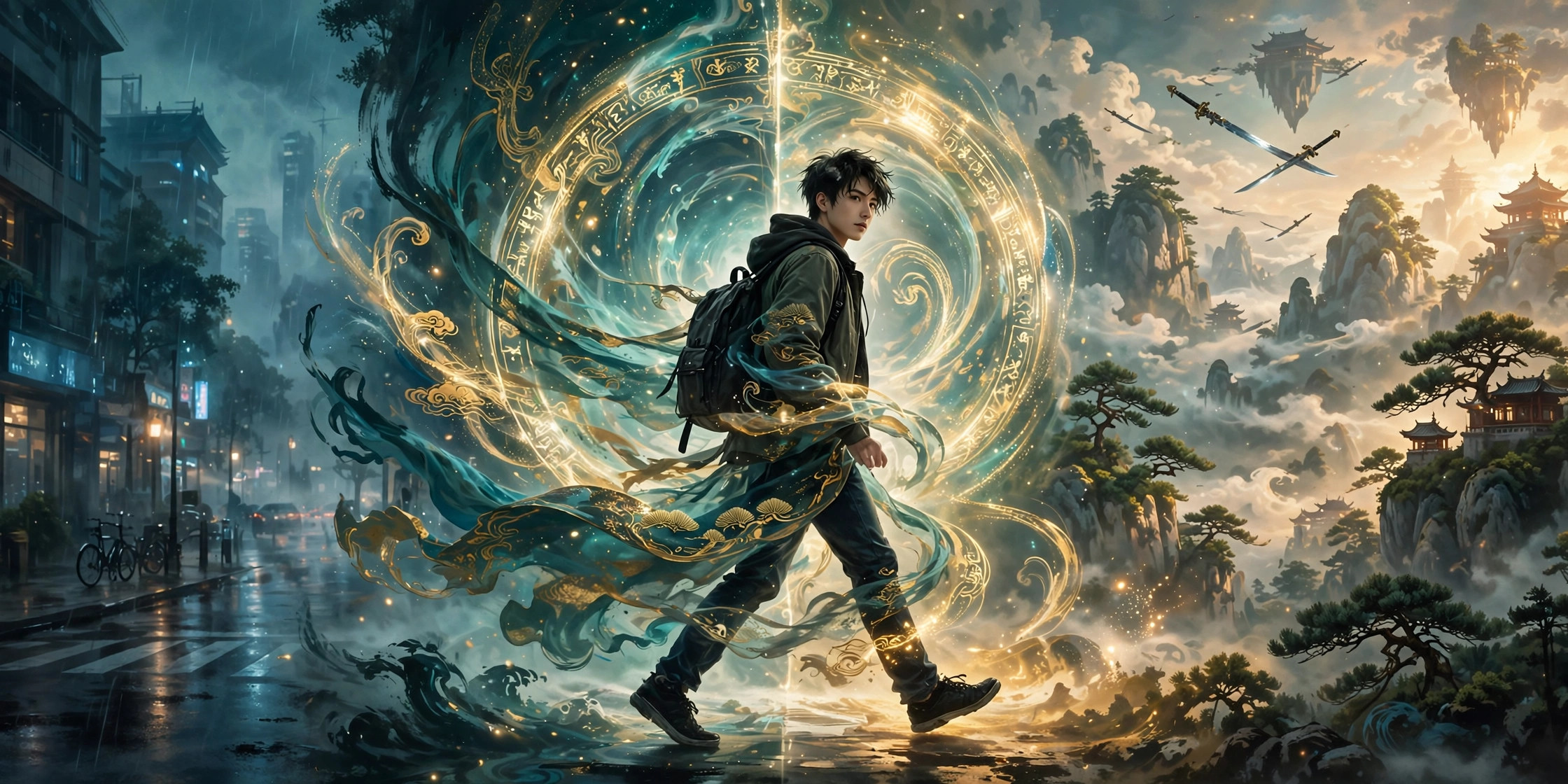
Transmigration (穿越, chuānyuè) is the plot device in which a character from one world ends up living in another — either by traveling there in their own body, or by waking up inside someone else's. In Chinese web fiction, the traveler is usually an ordinary modern person who dies, falls asleep, or simply blinks, and opens their eyes in ancient China, a cultivation world, or a completely invented fantasy realm. From that moment on, they must survive in a place whose rules they do not know, wearing a life that is not theirs.
The word itself is a useful starting point. 穿 (chuān) means to pass through or pierce, and 越 (yuè) means to cross over or exceed. Together, chuanyue literally means "crossing over" — and English-speaking fans have settled on "transmigration" as the standard translation, especially for the version where a soul crosses into another person's body. If you read translated Chinese novels, you will meet transmigrators constantly: they are the single most common way a story gets its hero into the world where the adventure happens.
Not every transmigration works the same way, and fans commonly distinguish between two basic forms. In soul transmigration (魂穿, hún chuān), only the character's soul makes the journey. They wake up in the body of someone who already lives in the new world — often someone who has just died, fallen into a coma, or been discarded by their own story. The transmigrator inherits that person's memories, debts, enemies, and reputation, whether they want them or not. This is the most popular form in modern web fiction, because the mismatch between the newcomer's modern mind and the body's old life generates instant conflict.
In body transmigration (身穿, shēn chuān), the whole person crosses over: body, clothes, phone and all. These heroes arrive as obvious outsiders. They cannot explain their accent, their clothes, or their habit of talking about electricity, and the story's tension comes from hiding how strange they are. Body transmigration is less common in cultivation novels and more common in historical and survival stories, where the hero's modern knowledge itself is the advantage.
Neither label is an official literary term. They are fan shorthand, coined by readers to sort a sprawling genre — but translators and fan wikis use them consistently enough that knowing the two words will help you follow discussions and recommendations.
New readers often mix up transmigration with two neighboring ideas, and the differences matter because they change what kind of story you are reading.
Rebirth (重生, chóngshēng) keeps the character in their own world and their own body, but sends them back in time — usually to their younger self. A reborn merchant does not need to learn a new world; they need to avoid the mistakes that ruined their first life. The drama comes from foreknowledge: knowing which investments pay off, which friends betray you, and which disaster is coming next year.
Reincarnation is broader and older, rooted in Buddhist and Daoist ideas about the cycle of lives. A reincarnated character may remember nothing of their past life at all. Transmigration, by contrast, is defined by the crossing: the character remembers where they came from, and the clash between their old identity and their new circumstances is the engine of the story.
A useful rule of thumb: if the hero thinks "where am I, and whose body is this?" you are reading transmigration. If they think "I get to do my life over," you are reading rebirth.
Chuanyue as a named genre of Chinese fiction has roots in time-travel romance and historical drama, and one of its earliest popular landmarks is Huang Yi's Tales of Seeking Qin (Xun Qin Ji, 寻秦记), a story about a modern man sent back to the Qin dynasty, which was adapted into a television series in 2001. From there the idea spread through online fiction platforms in the 2000s, where amateur authors discovered that transmigration solved a practical storytelling problem: it lets a hero — and a reader — learn the rules of a fantasy world at the same time, because both are newcomers.
That newcomer status is exactly why transmigration pairs so naturally with xianxia. A transmigrator dropped into a cultivation world has to learn what qi is, how sects work, and why everyone is so obsessed with face, and the reader learns alongside them. The hero's ignorance is not a flaw in the writing; it is the tutorial. It also explains why transmigrators so often receive a golden finger — a system, a relic, or a hidden talent that compensates for arriving late, weak, and friendless in a world that rewards power above all else.
Transmigration survives because it does several jobs at once. First, it gives the hero an unfair advantage that still feels earned: a modern doctor in an ancient world knows germ theory; a modern engineer understands alloys; a modern reader of cultivation novels knows which herbs are priceless and which "trash" disciple is secretly a genius. Second, it creates a built-in source of comedy and tension. The hero says the wrong thing at a banquet, misreads a social rule, or tries to explain a concept nobody in the new world has words for — and every slip risks exposure. Third, it lets the story ask a quiet question underneath the adventure: if you woke up in someone else's life, with their family, their enemies, and their unfinished business, how much of you would still be you?
That question is why the best transmigration stories spend time on the body's original owner. Did they die willingly? Did they leave a grudge the newcomer must now settle? Does the newcomer owe the dead person's mother an apology, or a revenge? The stories that treat the borrowed body as a real person with a real history tend to last longer in readers' memories than the ones that treat it as an empty costume.
One subgenre deserves its own mention because its name confuses everyone at first: quick transmigration (快穿, kuài chuān). In these stories, the protagonist does not settle into one world. They hop from world to world — sometimes a dozen or more in a single novel — completing a mission in each before moving on. One chapter they are a palace maid; the next, a starship captain; the next, a villain's discarded fiancée. The appeal is variety and speed: if one setting bores you, another arrives within a few chapters. Quick transmigration is hugely popular in romance and female-led web fiction, and its episodic structure has made it one of the most translated corners of the genre.
Readers coming from Japanese anime and manga will recognize transmigration's close cousin, isekai — literally "another world." The two genres share the same skeleton: an ordinary person transported to a fantasy world. The differences are mostly matters of emphasis. Japanese isekai often leans on game-like systems, stats, and reincarnation as a god's gift; Chinese transmigration leans on historical settings, cultivation worlds, and the social puzzle of living someone else's life. Neither tradition invented the idea — stories of people carried to other worlds are far older than either — but each has shaped it into something distinct, and fans of one usually enjoy the other.
If you are browsing for something to read, a few signals give the subgenre away before chapter three. The opening chapter is set in the modern world — an office, a hospital, a bedroom — and ends with a death, an accident, or a strange dream. The second chapter opens with confusion: an unfamiliar ceiling, unfamiliar clothes, a servant calling the hero by a name they do not recognize. The hero then does one of three things: hides what they know, uses what they know to solve a small problem and impress someone, or accidentally reveals too much and has to talk their way out of it. From there, the story is off, and the borrowed life becomes the real one.
Transmigration is, at heart, a fantasy about starting over with your memories intact — keeping everything you have learned while shedding everything that holds you back. That is a powerful daydream, and Chinese web fiction has spent two decades finding new ways to stage it: into emperors and beggars, into villains and side characters, into beasts, artifacts, and once, memorably, into the body of the story's own antagonist. The settings change, the missions change, and the bodies change. The question underneath stays the same: given a second life in a world that runs on different rules, what would you do with it? As long as readers keep answering that question for themselves, transmigrators will keep waking up in strangers' beds.