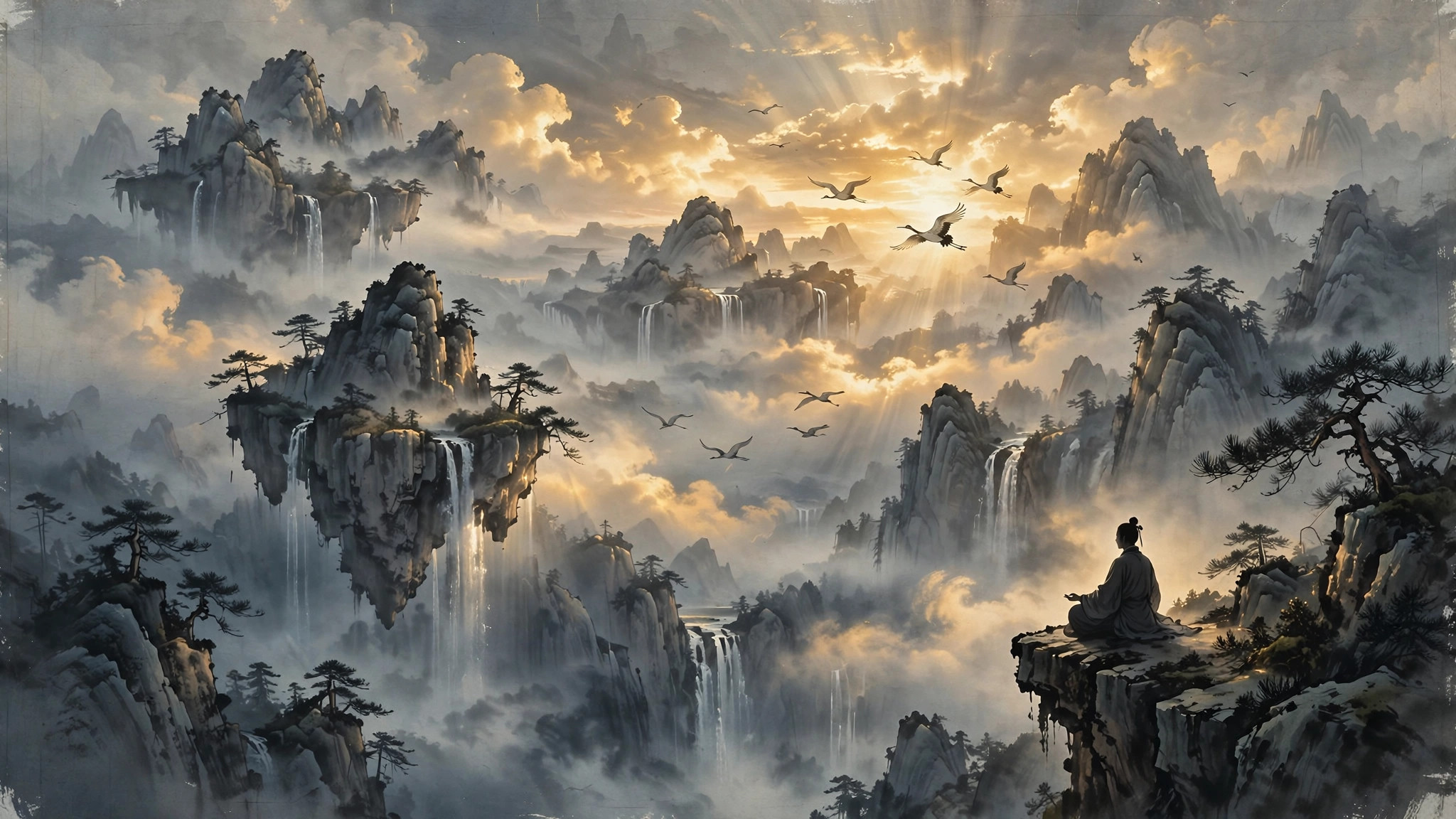
Xianxia (仙侠, literally "immortal heroes") is a genre of Chinese fantasy about mortals who cultivate — training body, mind, and spirit — to transcend humanity and become immortals. Its stories follow protagonists who absorb the spiritual energy of heaven and earth, climb ranked stages of power called cultivation realms, survive lightning strikes sent by the heavens themselves, and battle demons, rival sects, and scheming aristocrats across thousand-chapter journeys toward godhood. If wuxia is martial arts realism, xianxia is martial arts mythology — and it is one of the most-read fiction genres on the planet.
Where xianxia comes from
Xianxia did not appear out of nowhere. Its roots run through more than two thousand years of Chinese culture:
- Taoist philosophy. The core fantasy — that a disciplined mortal can achieve immortality — comes straight from Taoism. Texts like the Daodejing and Zhuangzi describe aligning with the Dao, and later Taoist traditions developed neidan (inner alchemy): concrete meditation and breathing practices meant to refine the body into something deathless. Cultivation novels are, in a sense, power fantasies built on real religious ideas.
- Shenmo ("gods and demons") fiction. Ming-dynasty epics like Journey to the West and Investiture of the Gods gave xianxia its cosmology: jade emperors, heavenly courts, demons, reincarnation, and tribulations. When a modern protagonist "ascends," they are walking a road Sun Wukong paved centuries ago.
- Wuxia fiction. The 20th century's "martial heroes" genre — Jin Yong, Gu Long, Liang Yusheng — supplied the sects, the jianghu underworld, the honor codes, and the serialized storytelling habits. Xianxia took wuxia's skeleton and grafted Taoist magic onto it.
- The webnovel explosion. In the 2000s, sites like Qidian let anyone serialize a novel chapter by chapter, with readers paying per chapter. Cultivation stories — with their endless power ladders and cliffhanger-friendly breakthroughs — were perfectly shaped for the format. Hits drew hundreds of millions of readers.
- The English wave. Fan translations took off in the mid-2010s (Wuxiaworld launched in late 2014), followed by official licensing, donghua adaptations, and live-action dramas. Today "cultivation" is a recognized tag on Royal Road and a staple of English web fiction.
The core tropes of a xianxia novel
Almost every xianxia story is built from the same kit of parts. Learn these and no cultivation novel will ever confuse you:
- Weak to strong. The protagonist almost always starts at the bottom — a crippled young master, a servant disciple, a mortal with "trash" talent — and rises through luck, talent, and ruthless effort. The entire genre is an engine for underdog satisfaction.
- The cheat (金手指, "golden finger"). A mysterious ring containing an ancient expert's soul, a heaven-defying cultivation manual, a small bottle that ages spiritual herbs overnight. One impossible advantage separates the hero from everyone else grinding the same ladder.
- Cultivation realms. Power is ranked in explicit stages — Qi Condensation, Foundation Establishment, Golden Core, Nascent Soul, and beyond — each divided into early, middle, and late phases. A single small realm's gap is usually unbridgeable in a fair fight, which is why breakthroughs are the genre's biggest set pieces. See our full breakdown of cultivation realms.
- Sects, clans, and academies. Cultivation schools with outer disciples, inner disciples, elders, and sect masters — part university, part mafia family, part corporation. They provide training resources, political intrigue, and most of the villains.
- The arrogant young master. A stock antagonist: the talented, connected heir who humiliates the protagonist in chapter 3 and spends the next 300 chapters regretting it. "Face-slapping" — publicly defeating such a figure — is the genre's signature catharsis.
- Tournaments and secret realms. Regular competitions and ancient ruins full of treasure keep the plot moving and give the hero legitimate reasons to fight stronger opponents in public.
- Heavenly tribulation. Break through to a major realm and the heavens answer with lightning — a literal exam administered by the universe. Fail it and you die; survive it and you're transformed. We explain the mechanics in heavenly tribulation explained.
- Qi deviation. Push too hard, cultivate the wrong technique, or let your heart demons win, and your cultivation backfires — crippling or killing you. It's the genre's built-in cost for reckless power-seeking, covered in qi deviation explained.
- Face, karma, and grudges. Reputation is currency, insults demand repayment, and a slight in chapter 10 can fuel a revenge arc in chapter 1,000. Actions echo across lifetimes because reincarnation is real.
How cultivation actually works
Strip away the spectacle and cultivation follows a consistent logic. Everything in the universe is saturated with qi (also called spiritual energy) — the raw material of immortality. A cultivator absorbs qi through breathing exercises and meditation, refines it in the dantian (an energy reservoir in the abdomen), and uses it to temper the body, extend life, and eventually reshape the soul itself.
Progress is measured in realms, and each realm is a qualitative transformation, not just a bigger number. Reaching Foundation Establishment might mean a lifespan of two hundred years; forming a Golden Core could mean five hundred. The higher you climb, the less human you become — which is exactly the point, and exactly the danger. Many novels frame the central tension as a question: what does the protagonist sacrifice of their humanity to touch the heavens?
For the full ladder — what each classic realm means, why breakthroughs are so dangerous, and how different novels remix the system — read cultivation realms explained.
A xianxia glossary: 16 terms you'll meet in chapter one
- Qi (气) — spiritual energy; the fundamental resource of cultivation.
- Dantian (丹田) — the energy center in the abdomen where cultivators store refined qi.
- Meridians (经脉) — the body's energy channels; "blocked meridians" usually means crippled talent.
- Spirit stones (灵石) — crystallized qi used as currency. Everything has a price in spirit stones.
- Pills / elixirs (丹药) — alchemical medicines that heal, boost cultivation, or enable breakthroughs. An alchemist ally is worth an army.
- Talismans (符箓) — paper charms inscribed with spells; consumable magic for emergencies.
- Flying swords (飞剑) — the iconic weapon; high-level cultivators travel standing on them.
- Jade slip (玉简) — a jade token that stores information, read by pressing it to the forehead. The USB stick of the cultivation world.
- Dao (道) — the Way; ultimate truth. Every cultivator follows a personal Dao (sword Dao, alchemy Dao, ruthless Dao), and comprehending it is often the key to the highest realms.
- Heart demon (心魔) — inner demons born of guilt, fear, or obsession; they strike during breakthroughs and can cause qi deviation.
- Nascent Soul (元婴) — a classic mid-late realm where the cultivator forms a miniature self inside the body — a second life, literally.
- Tribulation lightning (天劫) — heavenly punishment/testing delivered as lightning; see heavenly tribulation explained.
- Sect (宗门/门派) — a cultivation school and power faction.
- Rogue cultivator (散修) — a cultivator with no sect; free, but starved of resources.
- Dao companion (道侣) — a partner on the cultivation path; the genre's version of a spouse, bound by shared pursuit of the Dao.
- Face (面子) — social standing and dignity; losing face demands redress, giving face builds alliances.
Where to start reading xianxia
A short list of well-regarded entry points, all available in English translation:
- **I Shall Seal the Heavens (Er Gen)** — the classic starter: complete, funny, and structurally perfect. If you read one cultivation novel, make it this one.
- **A Will Eternal (Er Gen)** — a comedy-first xianxia about a cowardly protagonist who desperately wants to live forever. Ideal if the genre's earnestness worries you.
- **Coiling Dragon (I Eat Tomatoes)** — fast-paced, straightforward, and one of the first Chinese webnovels translated into English. Leans toward xuanhuan but teaches you every cultivation reflex.
- **Renegade Immortal (Er Gen)** — darker and more ruthless; for readers who want the genre's philosophical edge.
Practical tips for your first novel:
- Prefer completed translations. Many serials run past 2,000 chapters; an unfinished machine translation is a special kind of heartbreak.
- Don't memorize the realms up front. The story re-teaches the power system every arc. Our realms guide is there when you want the full picture.
- Embrace the formula. Xianxia runs on tropes the way mysteries run on murders — the pleasure is in the execution, not the surprise.
- Sample the cousins. Still unsure whether you want immortals, mortal swordsmen, or system-based power fantasy? Our xianxia vs wuxia vs xuanhuan comparison will point you to the right shelf.
Xianxia is, at bottom, a fantasy of self-transformation: the belief that discipline and will can carry an ordinary person past every limit, including death. Once that clicks, the thousand-chapter journeys start to make sense — and the lightning starts to feel earned.
Frequently asked questions
Is xianxia the same as cultivation? Nearly. "Cultivation" (修炼) is the mechanic — the training system — while xianxia is the genre built around it. Xuanhuan novels also use cultivation mechanics without being xianxia.
Do I need to know Chinese to read xianxia? No. Thousands of chapters are professionally translated on sites like Wuxiaworld and Webnovel, and the community maintains glossaries for the terms translators leave untranslated.
Why are xianxia novels so long? The serialized pay-per-chapter model rewards length, and the realm system provides a near-infinite ladder to climb. Length is a feature: fans describe the best novels as "a second life you live alongside the protagonist."