Article
What Is Dao Comprehension? Enlightenment in Xianxia Novels, Explained
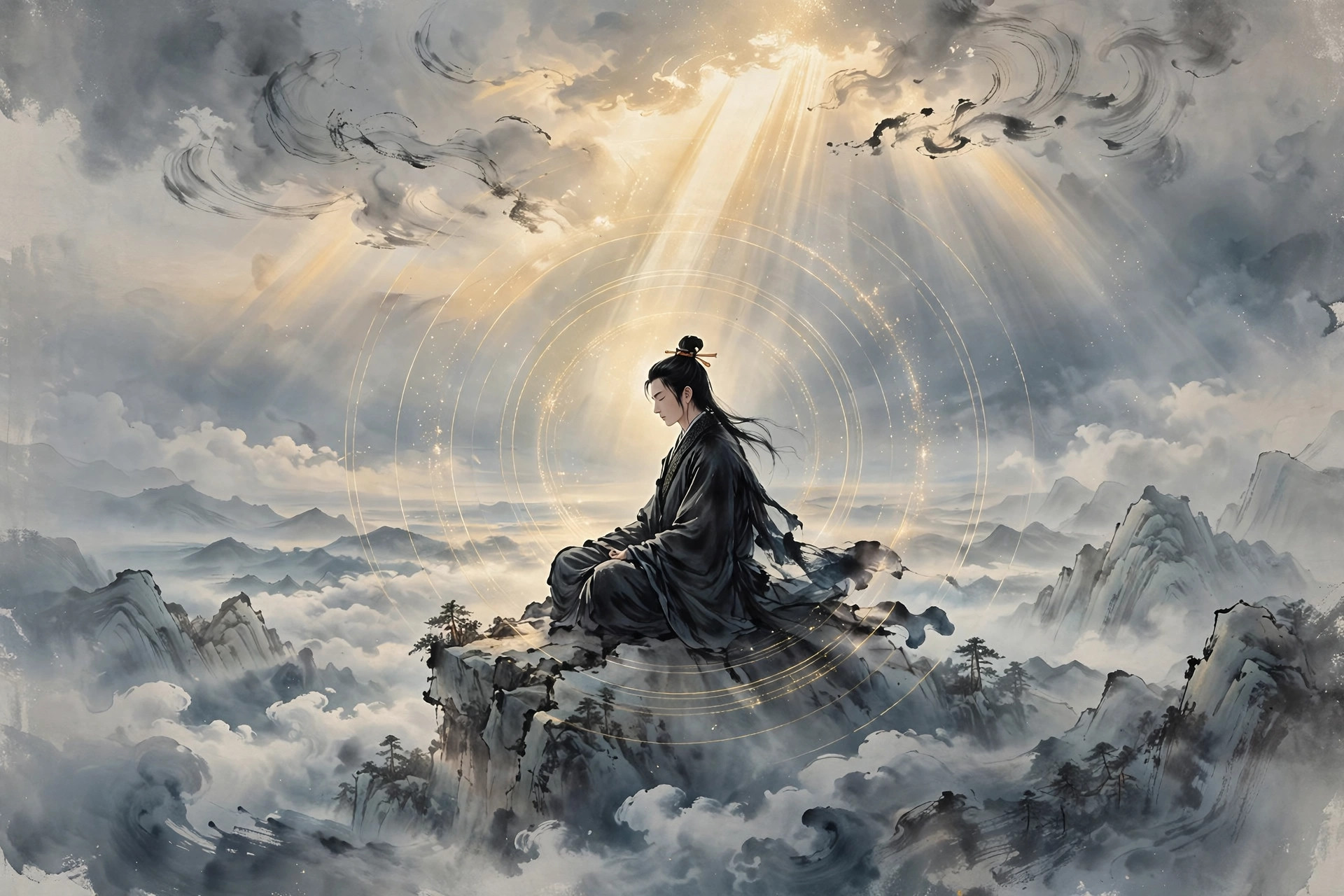
The Daodejing opens with a warning: "The Tao that can be told is not the eternal Tao." Thirteen centuries later, xianxia novels turned that warning into a game mechanic. Dao comprehension (悟道, wùdào) is the moment a cultivator suddenly understands something — the nature of fire, the meaning of a sword stroke, the way a river bends around stone — and that single flash of insight shatters the ceiling that raw power could never break. In the logic of these stories, enlightenment is not a personality trait. It is a resource, as real as spiritual energy, and the heroes who collect the most of it rise the fastest.
The word itself splits in two. Wù (悟) is the same character Chan Buddhists use for awakening — the sudden "getting it" that the Japanese call satori. Dào (道) is the Dao, the underlying Way of how things work. Put together, wudao literally means "to awaken to the Way": the moment a cultivator's mind aligns with how some corner of the universe actually operates, and the universe, in a manner of speaking, opens the door.
The template for every breakthrough-by-insight scene in xianxia was written roughly thirteen centuries ago, and it is a real story. According to the Platform Sutra of Chan Buddhism, the Fifth Patriarch announced a poetry contest: whoever demonstrated the deepest wisdom in verse would inherit his robe and become the Sixth Patriarch.
The head monk Shenxiu wrote the expected answer:
The body is the Bodhi tree, The mind is like a clear mirror. At all times we must strive to polish it, And must not let the dust collect.
His point: enlightenment is a project. Keep polishing, stay disciplined, and the dust of delusion stays off.
Then Huineng — an illiterate lay worker who pounded rice in the monastery's barn — asked someone to write his reply on the wall beside it:
Bodhi originally has no tree. The mirror has no stand. The Buddha-nature is always clear and pure. Where is there room for dust?
Huineng's point was the opposite: if your true nature is already pure, there is nothing to polish and no dust to remove. Seeing that truth all at once — in a flash rather than through years of grinding — is what later tradition called dùnwù (頓悟), sudden enlightenment, as opposed to jiànwù (漸悟), gradual enlightenment. The Patriarch secretly passed him the robe that night, and Huineng became the Sixth Patriarch at twenty-four. Modern scholars of the sutra note that the "gradual versus sudden" framing is partly a later interpretation — Shenxiu's verse was really about constant, disciplined practice — but the dramatic contrast is what the novelists inherited.
Xianxia borrowed this structure wholesale: the diligent senior who grinds for decades (the Shenxiu figure) versus the unlikely junior who sees the truth in one blinding moment (the Huineng figure). If you have ever watched an underdog protagonist leapfrog a genius rival after a single meditation scene, you have watched this thirteen-hundred-year-old argument play out with swords.
In story terms, dao comprehension is not vague philosophy. It is usually pinned to something concrete: a cultivator "comprehends the dao of fire" or "gains insight into sword intent." Authors treat the Dao as layered — there is the grand cosmic Heavenly Dao, and then there are its countless small truths, one for every phenomenon. Comprehension means mastering one of the small ones.
That is why comprehension scenes read like the opposite of training montages. A training montage accumulates: more reps, more qi, more power. A comprehension scene subtracts: the character stops forcing, watches something ordinary — rain striking a lake, an ant carrying ten times its weight, a master pouring tea — and a pattern they have stared at a thousand times suddenly reorganizes itself in their mind. Fans commonly describe this as the "coin drop" moment, and it is deliberately written to feel unearned in effort but inevitable in hindsight.
Most novels follow a handful of unwritten rules about what comprehension can and cannot buy.
It breaks ceilings, not walls. When a cultivator is stuck at the peak of a cultivation realm — drowning in spiritual energy but unable to break through — a flash of comprehension is usually the key that turns the lock. Authors are fairly consistent about this: energy gets you to the door; insight opens it.
It can be arranged, but not transferred. Masters love to stage comprehension for their disciples — sending them to watch the sea, fight a hopeless battle, or sit in a cave for a decade. But no master can hand over their own insight the way they might hand over a pill. A borrowed realization is a contradiction in terms: if you did not see it yourself, you did not see it.
It is personal. Two cultivators can contemplate the same thunderstorm and walk away with different truths — one comprehends lightning's speed, the other its silence before the strike. This is the fictional echo of the Daodejing's opening line: the Dao that can be neatly named and handed around is not really the Dao.
It cannot be faked for long. Some stories feature characters who try to shortcut comprehension with drugs, stolen memories, or demonic rituals. The genre's verdict is nearly unanimous: borrowed insight collapses under pressure, usually at the worst possible moment — mid-duel, with everything on the line.
Once you know the trope, you can spot the staging. The most common triggers:
Life-or-death pressure. Cornered by a stronger enemy, the hero's mind stops chattering and sees the fight with terrible clarity. The genre's logic: fear burns away everything but the essential, and the essential is where the Dao lives.
Stillness after chaos. The mirror image of the above. After weeks of secluded meditation — or the famous "ten years facing a wall" — a character who has stopped trying to understand suddenly understands. This one has a real ancestor: the Daoist practice of zuòwàng (坐忘), "sitting and forgetting," described in the Zhuangzi some 2,300 years ago. In a famous dialogue, the disciple Yan Hui tells Confucius: "I slough off my limbs and trunk, dim my intelligence, depart from my form, leave knowledge behind, and become identical with the Transformational Thoroughfare." Confucius, astonished, asks to become his student. Novelists turned this ancient meditation ideal into a plot device: empty the mind completely, and insight rushes in to fill the vacuum.
Witnessing nature. Waterfalls, thunderstorms, a spider rebuilding its web — the genre's favorite classroom is the natural world. The theory, borrowed from real Daoist thought, is that the Dao is on display everywhere; the cultivator's job is to learn to look.
Grief and loss. A master's death or a friend's sacrifice dissolves the stories the character told themselves about what matters, and in the cleared space, comprehension sometimes arrives. This is also why heart demons and comprehension are often two sides of one event: the same crisis that could shatter a cultivator can also complete them.
Here the genre is strict, and beginners should know it: comprehension without a foundation is useless. A nobody at the lowest realm who suddenly comprehends the dao of the stars does not become a god — he becomes a weakling with an interesting opinion. Insight determines how high you can go; accumulated energy determines whether you can stand the climb. Authors use this rule to keep their power systems honest: it is why the diligent-but-uninspired senior (the Shenxiu figure) is still dangerous, and why the enlightened junior still has to train.
This balance is also what makes comprehension scenes fair to the reader. When the hero breaks through, the novel has usually spent chapters showing the accumulation — the injuries, the failed attempts, the years of stagnation. The epiphany is the payoff, not the cheat code.
The deepest idea the trope carries is also the simplest: nobody comprehends the same Dao twice. The Daodejing's opening line is not decoration — it is the trope's thesis statement. The moment comprehension could be fully explained, written down, and taught in a classroom, it would stop being comprehension. That is why the most powerful characters in these novels are often the least able to explain themselves, why masters answer questions with riddles and tea, and why the hero's final insight almost always arrives in a scene with no dialogue at all — just rain, or wind, or the sound of a sword being sheathed.
Strip away the fantasy, and dao comprehension is the genre's love letter to a universal human experience: the moment confusion becomes clarity. Everyone has lived a small version of it — the math problem that untangles itself in the shower, the argument you finally understand years later. Xianxia just takes that private click of the mind and makes it move mountains. The next time a protagonist closes their eyes in the middle of a losing battle and the chapter ends on a single line — he understood — you will know exactly what the author is doing. They are staging the oldest enlightenment story in Chinese literature: not the grinding, not the polishing, but the flash. The verse on the wall. The dust that was never there.