Article
Heavenly Dao Explained: The Cosmic Rulebook Behind Every Cultivation Story
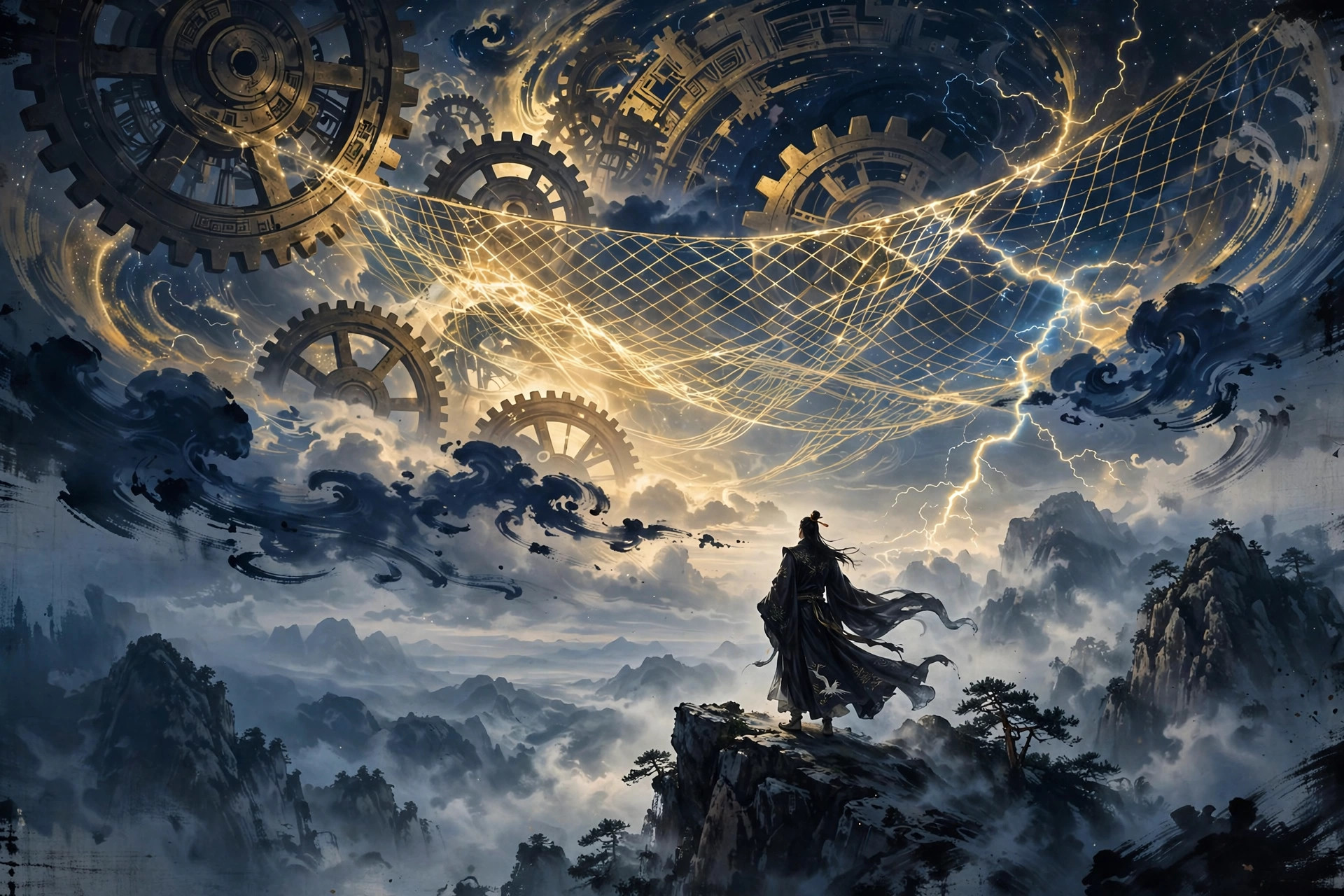
The Heavenly Dao (天道, tiāndào) — literally the "Way of Heaven" — is the ultimate authority in cultivation fiction: an impersonal cosmic force that writes the rules of the universe, decides who breaks through and who falls, and sends lightning down on cultivators who try to grow too powerful. Think of it as the universe's operating system. It has no face, no temple, and usually no body, but every major event in a xianxia novel happens with its permission — or in defiance of it.
If you have ever wondered who is really in charge when a novel says "the heavens" did something, the answer is usually the Heavenly Dao.
The Heavenly Dao is not an invention of webnovels. It comes from classical Chinese thought, where Tiān (天, "Heaven") is one of the oldest terms for the cosmos — described in sources like Wikipedia's entry on Tian as everything from a supreme power and an impersonal cosmic force to destiny itself, or even a holy world beyond this one.
The "Dao of Heaven" (天之道) appears by name in the Daode Jing, the founding text of Daoism, where it is described in very specific terms:
Chinese theology, as summarized on Wikipedia's Chinese theology page, draws a sharp distinction worth knowing: tiāndào (天道, "Way of Heaven") is Heaven's governing will — the Book of Historical Documents says "the Way of Heaven is to bless the good, and make the bad miserable" — while tiānmìng (天命, "Mandate of Heaven") is the more specific "mandate" by which rulers are judged. Novels borrow the first concept constantly and the second one occasionally, and they are not the same thing (more on that below).
In short, classical China already imagined Heaven as a rule-enforcing, balance-keeping power. Cultivation novels just gave it a job title.
In xianxia and xuanhuan stories, the Heavenly Dao is best understood as the universe's administrator — the thing that keeps the cosmic server running. Different authors flavor it differently, but its core responsibilities are remarkably consistent across stories:
1. It writes the laws of cultivation. Every setting's rules — how spiritual energy works, what the cultivation realms are, how long each stage takes — exist because the Heavenly Dao permits them. When a novel opens with "three thousand years ago, the Heavenly Dao changed and cultivation became harder," that is the author patching the system settings.
2. It tests cultivators with tribulations. The lightning strikes that hit cultivators during breakthroughs (see our guide to heavenly tribulations) are usually described as the Heavenly Dao's exam: a lethal quality-control check that kills those who do not measure up. This is the Dao's most visible job in any given novel, and it is why characters talk about the heavens as an active judge rather than a distant sky.
3. It maintains balance. Remember the bow metaphor from the Daode Jing — lowering the high, raising the low. In fiction, the Heavenly Dao routinely intervenes (or lets others intervene) when one person or faction grows too powerful. Ancient, overwhelmingly strong experts are often said to be "suppressed by the Heavenly Dao," which conveniently explains why they cannot just solve every problem for the protagonist.
4. It can be partial, broken, or replaced. Here the novels diverge most from philosophy. Some stories present the Heavenly Dao as fair and impartial. Others depict it as biased, corrupted, or outright hostile — a tyrant running a rigged game. And in the most ambitious stories, the protagonist's ultimate goal is to comprehend the Heavenly Dao so completely that they can step beyond it, or even become its replacement. That is the endgame of cultivation: going from a rule-follower to a rule-maker.
New readers often confuse the Heavenly Dao (天道) with the Mandate of Heaven (天命), and novels sometimes blur them. Here is the clean distinction:
In a cultivation novel, a sect elder defying the Heavenly Dao is a cosmic event. An emperor losing the Mandate of Heaven is a dynasty's problem. The two rarely share a plotline — though a very grand story might have both.
One of the most common phrases in the genre is 逆天 (nìtiān), "defying the heavens." Fan translators and English-speaking readers sometimes treat it as mere swagger — the hero shouting at the sky. It means something more precise.
Cultivation itself is, in the genre's own logic, an act of defiance: ordinary mortals were not meant to live for thousands of years or wield the power of gods. Every breakthrough that extends a lifespan is a small theft from the natural order, and the Heavenly Dao pushes back — with tribulations, with heart demons, with fate itself. To "defy the heavens" is not just an attitude; it is the job description of a cultivator. When a protagonist declares they will go against Heaven, they are naming the central conflict of the entire genre: a mortal will versus the cosmic rules.
This is also why surviving a tribulation is treated as such a triumph, and why ascension — leaving the mortal world entirely — is framed as the ultimate victory over the system rather than just a promotion.
You do not need a philosophy degree to follow it. In practice, the Heavenly Dao shows up in a handful of recognizable ways:
Once you notice these patterns, you will see the Heavenly Dao everywhere in the genre — as antagonist, referee, background radiation, and final boss.
Understanding the Heavenly Dao unlocks the genre's deepest theme. Beneath the power levels, the spirit stones, and the lightning, most cultivation stories are asking one question: can a single person's will outlast the rules of the universe? The Heavenly Dao is the embodiment of "the rules" — ancient, patient, and crushingly powerful. The protagonist is the embodiment of refusal.
That is also why the concept has survived from bronze-age philosophy to thousand-chapter webnovels. Classical China asked what Heaven wanted; cultivation fiction asks what happens when someone says no to Heaven. The Heavenly Dao is simply the name both eras gave to the biggest "yes" in the room — and the biggest target in the genre.