Article
What Are the Five Elements in Xianxia? The Wu Xing System Explained
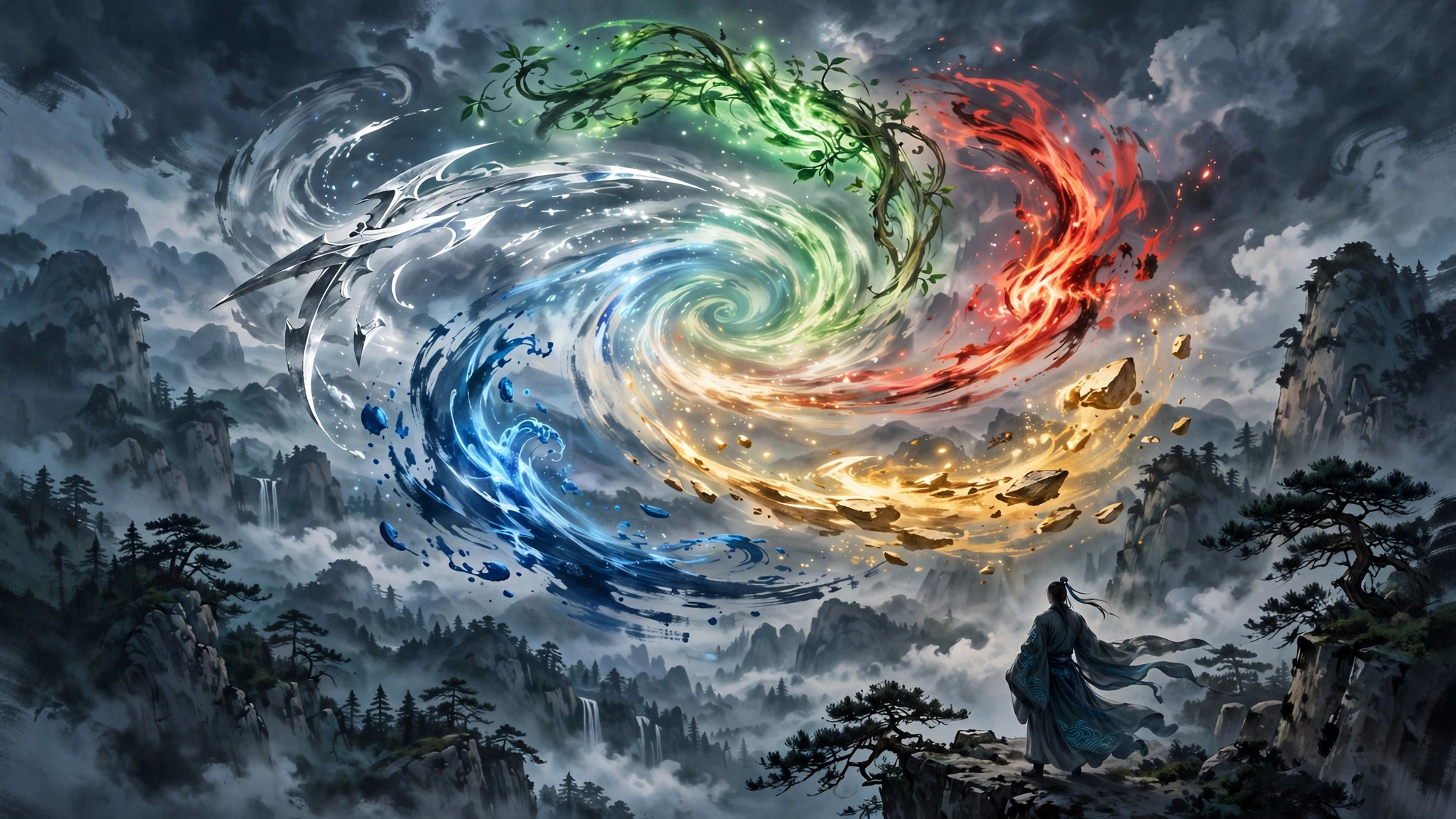
A fire cultivator's sword art fizzles against a water technique. A wood-rooted healer regrows a shattered arm in minutes. An earth cultivator shrugs off a lightning strike that would flatten anyone else. None of this is random. Underneath most xianxia power systems sits one old idea doing quiet structural work: the five elements, or wuxing (五行, pronounced "woo-sheeng"). In short, the five elements in xianxia are wood, fire, earth, metal, and water — five phases of energy that decide what kind of qi a cultivator can use, which techniques suit them, and who has the advantage in any given fight. Once you can read the five elements, whole scenes that looked like spectacle start reading like strategy.
The wuxing is not an invention of webnovels. It is a classical Chinese philosophical scheme — often translated as the "five elements" or, more precisely, "five phases" — that was formulated into a single system during the Han dynasty, in the second or first century BCE, and went on to shape Chinese medicine, astrology, martial arts, and cosmology (Wikipedia: Wuxing (Chinese philosophy)). The key insight of the original scheme is that the five are not five kinds of stuff. They are five kinds of process: wood is growth, fire is burning and ripening, earth is stabilizing, metal is contracting and refining, water is flowing and storing. Xianxia authors borrowed the scheme wholesale and turned it into a power system.
That borrowing matters because it explains why the elements show up everywhere in the genre at once. They appear in spiritual roots as talent, in techniques as flavor, in pills and treasures as materials, and in duels as matchup logic. One scheme, many jobs.
Each element carries a bundle of associations that novels draw on, often loosely:
Novels vary in how strictly they honor these associations — some treat them as flavor, others as hard rules — but the five names and their basic personalities stay remarkably consistent from one story to the next.
The real engine of the system is not the five elements themselves but the two cycles connecting them. In the classical doctrine, the generative cycle (相生, xiāngshēng) runs wood feeds fire, fire produces earth, earth bears metal, metal collects water, and water nourishes wood. The destructive cycle (相克, xiāngkè) runs wood grasps earth, earth contains water, water dampens fire, fire melts metal, and metal chops wood (Wikipedia: Wuxing (Chinese philosophy)).
In a novel, this turns every fight into elemental rock-paper-scissors. A fire cultivator facing a water cultivator is at a disadvantage before either of them moves — which is exactly why the scene is interesting. The underdog has to win despite the cycle, usually through a better technique, a higher realm, a treasure, or a trick. Fans commonly describe the cycles as the genre's shorthand for tactical intelligence: a protagonist who notices that his enemy's fire art is fed by wood qi, then destroys the wood source instead of blocking the flames, is showing the reader he thinks like a cultivator.
The cycles also explain why multi-element cultivators are feared. Someone who commands two or three elements can pick the one that counters whatever they face, and someone who commands all five can chain the generative cycle into itself — feeding each element with the last — which is why "five-element" constitutions and techniques are usually written as rare, overpowered, or both.
The five elements touch almost every decision a character makes:
This is why the elements feel so load-bearing even in novels that never explain them. The author does not need a lecture: tag a technique "fire," tag the enemy "water," and the reader already knows who is in trouble.
English-speaking readers sometimes assume the five elements are a Chinese version of the Greek four elements — earth, air, fire, and water. They are not. The Greek scheme is about substances that make up the world; the Chinese scheme is about phases and transformations, which is why scholars often prefer translating wuxing as "five phases" rather than "five elements" (Wikipedia: Wuxing (Chinese philosophy)). That difference is visible in the fiction: Greek-style elements would be ingredients, while xianxia elements behave like weather systems — they feed each other, restrain each other, and shift from one into another. There is also no "air" element and no "lightning" element in the classical five; lightning in xianxia is usually treated as a variant of fire or a heavenly-tribulation phenomenon, not a sixth element, though some novels add rarer attributes like lightning, wind, or ice as mutations of the basic five.
For a newcomer, the practical payoff is simple. When a novel introduces a character, watch for the element attached to them — their root, their technique, their weapon. That one word predicts their fighting style, their allies, their weaknesses, and often their whole arc. A water cultivator who keeps losing to fire opponents is not unlucky; the story is telling you something about persistence. A metal cultivator who learns a wood technique is not collecting powers; the story is telling you they are breaking their own limits.
The five elements are, in the end, the genre's shared vocabulary for power. They let a thousand different authors write a thousand different magic systems that still feel like they belong to the same world. Learn the five names, learn the two cycles, and the next duel you read will stop looking like a light show — and start looking like a chess match where you can see three moves ahead.