Article
Pill Refining Explained: How Alchemy Works in Xianxia Novels
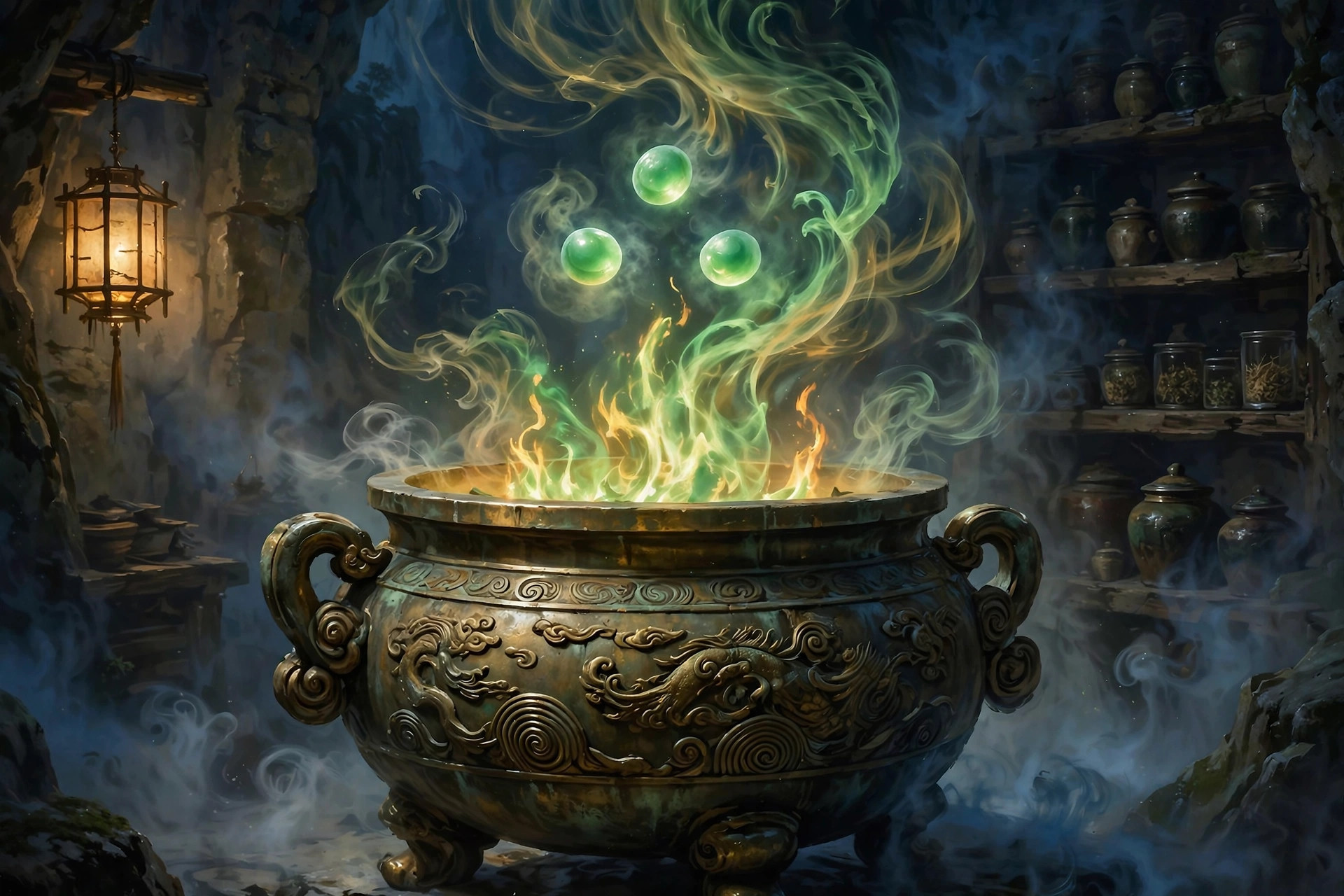
Two thousand years ago, real emperors swallowed experimental elixirs hoping to live forever. Today, in xianxia and xuanhuan fiction, the hero does the same thing — except this time the pills actually work. *Pill refining (炼丹, liàndān) is the art of concocting medicinal pellets in a furnace, a central skill in cultivation fiction: alchemists roast spiritual herbs, beast cores, and rare minerals into pills that heal wounds, restore energy, or shove a cultivator across a bottleneck into the next realm. When a novel mentions an "alchemist" (炼丹师, liàndānshī*), it means a craftsman whose entire job is turning plants into power.
The two characters are plain. 炼 (liàn) means "to refine" or "to smelt," the same verb used for refining metal. 丹 (dān) means "pill" or "cinnabar," the red mineral that sits at the heart of real Chinese alchemy. So 炼丹 is literally "refining pills" — and the English translation "alchemy" is the same idea readers know from Western fantasy, filtered through Taoist tradition.
This is one of the rare genre terms with a documented real-world origin. Early Chinese alchemy, called waidan (外丹, "external alchemy"), was exactly what it sounds like: practitioners heated minerals, metals, and other substances in a luted crucible to compound elixirs of immortality. According to the historical record summarized on Wikipedia, the practice began in the early Han dynasty (206 BCE–220 CE), peaked under the Tang (618–907) — when several emperors reportedly died of elixir poisoning — and declined by the Ming. Qin Shi Huang, the first emperor of unified China, famously dispatched expeditions searching for such a pill. The later neidan (内丹, "internal alchemy") school moved the furnace inside the body, treating meditation itself as refinement.
Fiction simply kept the furnace and threw out the poison. In novels, the elixir always works, and the alchemist who brews it is a celebrity. The clearest bridge between history and fantasy is Journey to the West (c. 1592, Ming dynasty, traditionally attributed to Wu Cheng'en), where the Supreme Lord Lao (太上老君) tends a heavenly elixir furnace — the famous scene in which Sun Wukong is locked inside the Eight Trigrams Furnace to be refined. Novel alchemists are his literary descendants: furnace, flame, and a batch of pills that can make or break a cultivator's fortune.
Every author invents their own rules, but fans commonly describe a shared toolkit that shows up across the genre:
*The furnace (丹炉, dānlú).* A pill refiner's most precious possession is usually a cauldron or furnace, and better furnaces make better pills. Novels love ranking furnaces the way they rank swords — an ancient bronze cauldron pulled from a ruin will outperform a sect-issued iron one, and the difference shows up in the final product. The furnace controls temperature with unusual precision, because a flame a hair too hot can turn a batch of precious herbs into slag.
The flame. Fire matters as much as ingredients. Ordinary cultivators use ordinary flame; elite alchemists hunt for special ones — beast flames tamed from fire-type demonic beasts, earth flames drawn from volcanoes, or inherited "true fires" passed down a lineage. Fans commonly describe the flame as the alchemist's signature: you can tell a master's work from a novice's by the fire that made it.
The ingredients. Recipes call for spiritual herbs (灵草), often graded by age — a thousand-year ginseng is not just a stronger ingredient, it's a plot event. Higher-end recipes add demonic beast cores, rare minerals, and once-in-a-novel treasures. The scarcity of ingredients is what makes alchemists rich: the recipe is knowledge, but the herbs are capital.
The process. A refinement is usually written as a tense multi-day sequence: sort the herbs, warm the furnace, add ingredients in a precise order, manage the flame through stages with dramatic names, and finally "form the pills" (成丹) — the moment of truth when the furnace lid opens. Explosions are common in bad batches, and fans know that a refinement scene ending in a pillar of light means something extraordinary just came out.
Because fiction loves hierarchies, pills are graded. The exact ladder varies by novel, so treat the following as the common convention rather than a fixed rule — fans commonly describe it like this:
Within a grade, many novels add a further split by quality: pills of the same recipe come out low, mid, or high quality depending on the refiner's skill — and "perfect quality" (or "flawless") pills with no impurities at all are the mark of a genius alchemist. This is the detail that makes protagonists famous: anyone can follow a recipe, but the hero's pills come out flawless.
Pill refining isn't just set dressing — it's an economic engine that drives plots. Three facts about the fictional profession explain why:
Alchemists are the richest non-combatants in any novel. Every cultivator needs pills and almost nobody can make them well, so master alchemists charge what they like. A single grandmaster can be wealthier than a small sect, and the auction-house scenes where rival factions bid on his newest breakthrough pill are a genre staple. Status follows money: even arrogant sect elders speak politely to the alchemist whose pills they need.
Pills are how underdogs cheat the talent gap. A poor protagonist can't out-cultivate a young master with a sect's resources — but if he stumbles into an alchemy inheritance, he can. The classic arc goes: nobody, pill furnace, fortune. It's no accident that "accidentally became an alchemist" is one of the most reliable power-up routes in the genre: alchemy converts luck into repeatable advantage. That pill which pushed a desperate breakthrough is often the same kind discussed in our guide to Golden Core — the stage authors love to gate behind a rare pill.
Pills have a dark side: pill poison (丹毒). The novels kept one grain of historical truth — not every pill is good for you. Fans commonly describe pill poison as the impurities that accumulate in a cultivator who swallows too many low-quality pills: it clogs the meridians, slows future cultivation, and can trigger qi deviation at the worst moment. This is why "perfect quality" pills command insane prices and why smart characters ration their consumption. The rule is elegant: the shortcut has a cost, and the cost scales with how greedy you get.
Now you know the vocabulary, the refinement scenes write themselves — but a few patterns reward attention. When a novel introduces an alchemist character, check whether the story treats alchemy as his whole identity or as a side skill; the latter almost always means he's going to upstage the "real" alchemists later, and that's the point. When a pill is described in lavish detail — its fragrance, the lightning it attracted, the bidding war it started — the author is telling you this object will change the plot within a few chapters. And when a character casually pops pills like candy, brace yourself: the pill-poison bill always comes due, usually at the worst possible breakthrough.
Pill refining endures because it turns the genre's biggest theme — the slow, punishing work of cultivation — into something you can hold in your hand. Meditating for a hundred years is abstract. A glowing pill that smells of orchids and promises one breakthrough is a story.