Article
What Is an Immortal in Xianxia? Xian, Ascension and the End of Cultivation Explained
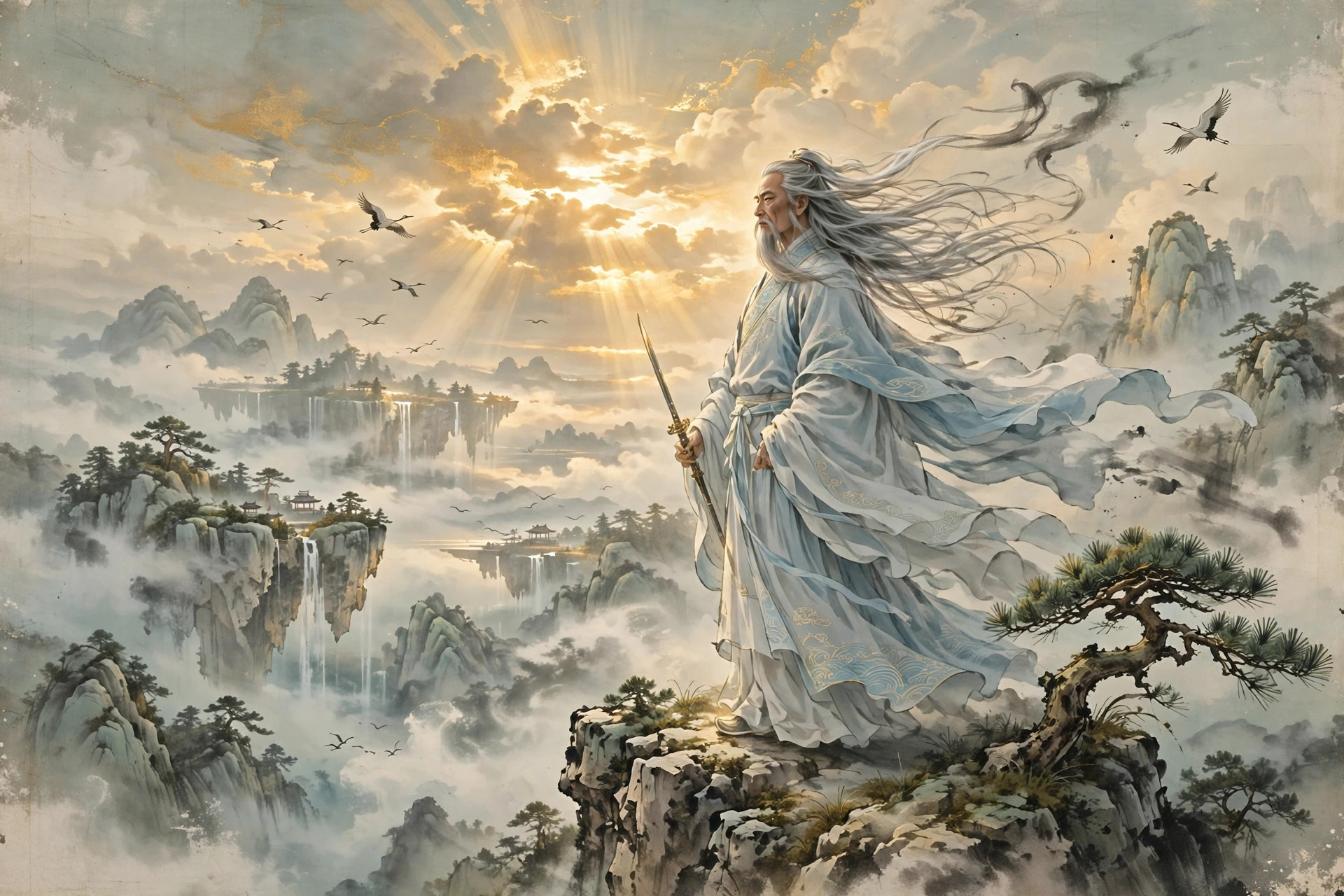
Every cultivation novel is, at heart, a story about a deadline that never arrives. An immortal in xianxia is a person who has escaped death entirely: a cultivator who, after centuries of training, has broken through the limits of the mortal body and become a 仙 (xiān) — a being who no longer ages, no longer sickens, and can command powers that look like magic to everyone below them. Immortality is not a metaphor in these stories. It is the finish line of the whole genre, the reason characters meditate in caves for decades, swallow pills that could kill them, and risk being struck by lightning. A novel's hero may spend a thousand chapters chasing it, and the day they finally become an immortal is usually the day the story's first great arc ends — or its last one begins.
The Chinese word for an immortal is 仙, pronounced xiān. English translations usually render it as "immortal," but "transcendent" is closer to the original flavor: a xian is someone who has transcended the ordinary human condition. The character itself is a small piece of poetry. A folk etymology recorded in early dictionaries reads it as a compound of person (人) and mountain (山) — a person who has gone to live high in the mountains, beyond the reach of ordinary life. The image stuck: for two thousand years, Chinese stories have placed their immortals on remote peaks, misty islands, and heavens above the clouds.
The idea is far older than the novels. References to xian appear in Chinese texts as early as the third century BCE, and early works such as the Zhuangzi, the Chuci, and the Liezi used immortal figures allegorically, as images of spiritual freedom. Later Taoist texts took the idea literally and built an elaborate hierarchy of physically immortal beings with supernatural powers. Xianxia novels inherited that whole tradition and turned it into a career ladder: in fiction, becoming a xian is not a matter of luck or divine favor but the predictable result of enough correct practice.
Becoming an immortal is the top of the cultivation system, and the path is the same one readers follow through every novel: absorb spiritual energy, refine it in the body, and break through one realm after another. A beginner gathers qi; a master forms a golden core; a great master nurtures a nascent soul. Each breakthrough extends the lifespan — decades at first, then centuries, then millennia — and each one brings the cultivator closer to the threshold where the body stops being mortal at all.
The final step has its own name and its own ceremony: ascension (飞升, fēishēng), the moment a cultivator leaves the mortal world and rises to a higher realm. Most novels place a heavenly tribulation immediately before it — a storm of lightning that tests whether the cultivator deserves to cross over — and surviving that storm is what separates the immortals from the corpses. For the full mechanics of that final leap, see our guide to ascension.
Two things are worth noting about this process. First, it is earned, not granted. Gods in these stories are often born divine or appointed to an office; an immortal is a person who climbed there, which is why readers root for them. Second, it is reversible in the worst way. An immortal who is killed stays dead, and in some novels a fallen immortal can be reduced to a wandering soul or forced to start over as a mortal. Immortality means you will not die of old age — it does not mean you cannot be murdered.
New readers often use "immortal" and "god" interchangeably, and the novels themselves sometimes blur the line, but the distinction is real and worth learning. In Chinese tradition, gods (神, shén) and immortals (仙, xiān) are often mentioned together as shenxian (神仙), yet they are different kinds of beings. According to the standard account, gods are deities — beings who hold cosmic offices, answer prayers, and were often divine from the start — while a xian is a person who became immortal through cultivation, alchemy, or worship. A god is born or appointed; an immortal is self-made.
In xianxia fiction this maps onto the story's social order. The Jade Emperor and the heavenly court, when they appear, are gods: bureaucrats of the cosmos, ruling from above. The wandering swordsman who flies between mountains and answers no one's orders is an immortal: powerful, free, and fundamentally outside the system. That is why so many protagonists aim for immortality rather than godhood — godhood means a job in heaven, while immortality means nobody can tell you what to do. When a novel's hero finally becomes an immortal and promptly refuses a heavenly appointment, that is the genre's version of a declaration of independence.
Powers vary wildly between novels, but the core package is consistent. An immortal does not age, does not hunger in the ordinary way, and heals from wounds that would kill a mortal outright. They fly without tools, cross continents in moments, and perceive the world through divine sense rather than ordinary eyes and ears. Their techniques — the same cultivation arts they practiced as mortals — operate on a scale that reshapes landscapes: a sword strike that splits a mountain, a palm that dries a river, a formation that seals a whole city.
But raw power is rarely the point. The more interesting immortal abilities in fiction are the quiet ones: the freedom to go anywhere, the patience that comes from having forever, and the detachment that comes from watching dynasties rise and fall. A good novel uses immortality to change the character, not just their stat sheet — the hero who becomes an immortal and realizes their old enemies no longer matter has understood it.
Becoming an immortal is the end of the mortal journey, but most novels treat it as the beginning of a longer one. Above the ordinary immortal, authors stack further ranks, because a story needs somewhere left to go. A Song dynasty Taoist compendium, the Zhonglü Chuandao Ji, lists five classes of immortals — ghost immortals, human immortals, earth immortals, spirit immortals, and celestial immortals — and modern novels echo that habit with their own ladders: earth immortals, heavenly immortals, golden immortals, great golden immortals, and beyond.
Each author's ladder is different, and no single ranking is canonical across the genre, so do not try to memorize one list. What matters is the pattern: the titles get grander, the powers get stranger, and the stakes move from "can I survive this fight" to "can I survive this universe." Some novels even push past immortality into something else entirely — a being beyond the heavens, a creator, a wielder of the Dao itself. For how the lower rungs of this ladder work, see our breakdown of cultivation realms.
No discussion of immortals is complete without the Eight Immortals (八仙, Bā Xiān), the most famous group of xian in Chinese mythology. The standard eight are Lü Dongbin, Zhongli Quan, Zhang Guolao, He Xiangu, Han Xiangzi, Lan Caihe, Cao Guojiu, and Li Tieguai. Most are said to have lived during the Tang or Song dynasties, and they are said to dwell on a group of five islands in the Bohai Sea, including Mount Penglai — the legendary isle of the immortals. Lü Dongbin, the scholar with the sword, is generally considered their leader.
Each of the eight carries a signature object — Lü Dongbin's sword, Zhongli Quan's fan, Li Tieguai's iron crutch and gourd, He Xiangu's lotus — and each comes from a different walk of life: scholar, general, official, musician, beggar, and the group's only woman. That variety is the point. The Eight Immortals are folk heroes, not a celestial committee, and their story says that transcendence is open to anyone: the rich and the poor, the learned and the illiterate, the respectable and the disreputable. Xianxia novels took that message and ran with it — their heroes are usually nobodies, and that is exactly why they can become immortals.
Strip away the pills, the swords, and the sect politics, and every xianxia novel is asking one question: what would you give up to live forever? The genre's answer is always "everything, eventually." Characters abandon their families, their hometowns, and their mortal lives; they watch everyone they loved as a mortal grow old and die while they stay young. The best novels never let the reader forget that price. Immortality is the prize, but the cost is the story.
That is also why the word xian carries weight beyond the novels. In everyday Chinese, 仙 still means something like "transcendent" or "otherworldly" — a beautiful person can be called xiān nǚ, a fairy maiden; an extraordinary talent can be called xiāncái, an immortal talent. The novels did not invent the word; they inherited two thousand years of meaning and gave it a plot. When a reader opens a xianxia novel and meets their first immortal, they are meeting a figure who has haunted Chinese imagination since before the first emperor — a person who looked at death, said no, and meant it.