Article
Spiritual Roots Explained: The Talent System That Decides a Cultivator's Fate
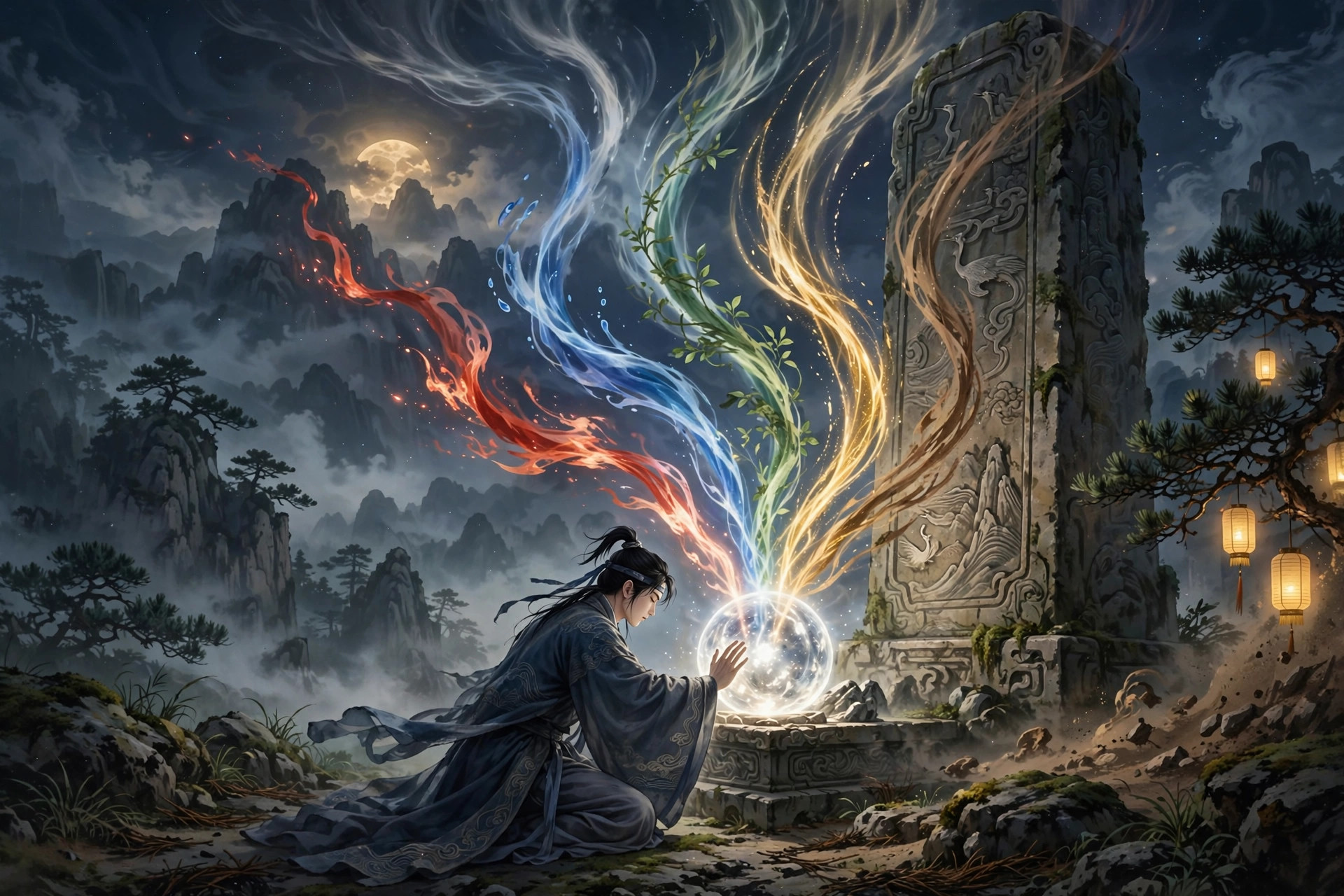
Before a xianxia hero ever wins a duel, the novel usually decides whether they deserve to win — by measuring something called their spiritual roots (灵根, línggēn). In short, spiritual roots are a person's inborn talent for cultivation: they determine whether someone can sense the spiritual energy of heaven and earth at all, how fast they can absorb it, and which kind of techniques will come naturally to them. A child with a single "heavenly" root is a sect's treasure; a child with no roots is told to go home and farm. Almost every talent-test scene, sect entrance exam, and underdog origin story in the genre turns on this one concept.
Think of spiritual roots as the body's antenna for spiritual energy. Cultivation — the core activity of every xianxia story — means drawing qi from the world into the body and refining it, usually storing it in the dantian. Without spiritual roots, a person simply cannot perceive or channel that energy; the door is shut. With them, the door opens — and its width and shape decide everything about the cultivator's future speed, ceilings, and affinities.
Fans commonly describe the practical effects like this:
One important note: spiritual roots are a genre convention, not a fixed ruleset. Different novels define, rank, and use them differently. What follows is the shared framework most stories draw from — when in doubt, the novel you're reading is the authority.
The most common version ties spiritual roots to the five elements: metal, wood, water, fire, and earth. This comes straight from the classical Chinese concept of the wuxing (五行), the five phases — metal, wood, water, fire, earth — that have structured Chinese philosophy, medicine, and cosmology since the Han dynasty (Wikipedia: Wuxing (Chinese philosophy)). Xianxia authors borrowed the scheme wholesale and turned it into a talent chart.
A cultivator's roots determine which elemental qi they absorb most easily, and their techniques usually match: fire roots favor flame arts and alchemy, water roots favor healing and ice-adjacent arts, metal roots favor sword and weapon techniques, wood roots favor vitality and poison arts, earth roots favor defense and body-tempering. In some stories the elements interact through the wuxing's generating and overcoming cycles — water nourishing wood, fire melting metal — which can make matchups between cultivators a game of elemental rock-paper-scissors.
This is the part that confuses beginners, because it runs backward from intuition: in most novels, fewer roots is better. The standard grading fans recognize across countless stories looks roughly like this:
The logic, such as it is: purity beats breadth. One clean channel moves energy without turbulence; five channels create static. Authors invented this rule because it manufactures drama — a trash-root nobody who rises anyway is a more satisfying hero than a heavenly root who simply wins.
Some novels add mutated spiritual roots — lightning, ice, wind, darkness, light, or similar variants — which sit outside or alongside the five elements. These are usually treated as one-in-a-million gifts: extremely powerful, but with a catch. Lightning roots might devastate in combat yet be nearly impossible to find matching techniques for; ice roots might grant formidable control at the cost of fragile meridians. When a story wants its hero to be special without making them a plain heavenly root, a mutated root is the usual tool.
If you've started more than one cultivation novel, you've met this scene: the sect elder holds up a crystal, a stele, or a mirror-like artifact, the child presses a hand to it, and the room watches the light. Fans joke that this is the genre's version of the sorting hat — and like the sorting hat, it's really an exposition device. In a few paragraphs, the author establishes the hero's talent level, the sect's social ladder, and usually a sneering young master who'll regret his arrogance three hundred chapters later.
Spiritual roots do heavy lifting for xianxia storytelling. They give the world an instant, legible hierarchy (everyone can read a talent test), they make the entrance-exam chapter exciting, and they set up the genre's favorite tension: talent versus effort. Purists grumble that the system makes destiny look fixed — the born-genius always outruns the hard worker — while others point out that half the genre's beloved protagonists start with crippled, mixed, or "trash" roots and beat the system anyway. The roots don't decide the story; the beating of the roots does.
They also explain a lot of story mechanics once you notice them. Why does the sect favor one disciple over another? Roots. Why can the villain's technique never quite hurt the hero? Complementary elemental roots, perhaps. Why is the alchemist always a fire root? Because pills need flame.
| Term | What it means |
|---|---|
| Spiritual roots (灵根) | Inborn talent for sensing and absorbing spiritual energy |
| Heavenly spiritual root | Single pure element; the fastest, rarest talent |
| Mixed / false roots | Four or five elements; slow, "trash" talent — classic underdog setup |
| Mutated root | Rare variant (lightning, ice, wind…); powerful but hard to train |
| Root test | The sect-exam scene where a crystal reveals a child's roots |
Spiritual roots are, in the end, xianxia's answer to a question every fantasy asks: who gets to be special, and why? The genre's answer is refreshingly blunt — you're born with it, it's measurable, and everyone can see the reading. But the best stories in the genre aren't about the reading. They're about the kid with five muddy roots who decides the chart is wrong.
For the next layer of the system, see how cultivation realms structure the path upward — and where all that absorbed energy actually goes, inside the dantian.