Article
What Is the Heavenly Court in Xianxia? The Jade Emperor, the Celestial Bureaucracy, and Why Cultivators Fear It
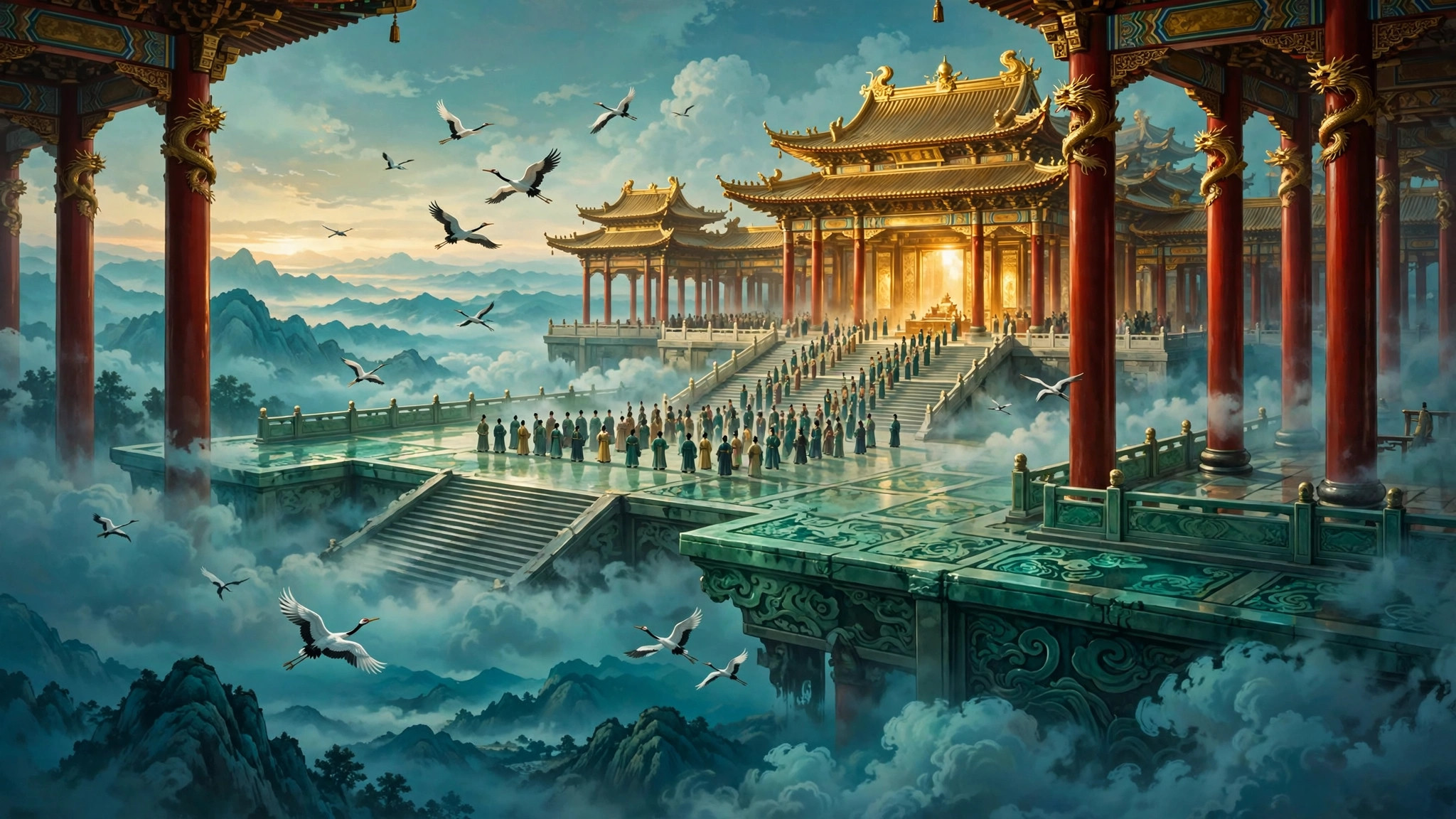
Somewhere above the mortal world in a xianxia novel, there is a palace with golden roofs, jade floors, and a throne room full of officials who all look extremely busy. It is not a paradise of idle clouds. It is a government. The Heavenly Court (天庭, tiāntíng) is the celestial government of the Chinese cosmos in xianxia and Chinese mythology — a vast bureaucracy ruled by the Jade Emperor, staffed by ranked gods and immortals, and responsible for everything from the weather to the length of your life. When a cultivator ascends to immortality, this is the administration they are joining, answering to, or trying to escape.
That last part is the key to understanding the trope. In Western fantasy, heaven is usually a reward. In xianxia, heaven is an employer — and a strict one. The Court keeps registers, issues edicts, hands out posts, and punishes anyone who steps out of line. A cultivator who finally becomes an immortal does not simply gain freedom; they gain a place in the org chart, somewhere between the lowest clerk and the throne.
The idea comes from real Chinese religious thought, not from a single novel. In Chinese popular religion, the cosmos has three domains — Heaven, Earth, and the Underworld — and the Heavenly Domain is ruled by the Jade Emperor, who presides over a court of important deities. Scholars have long noted that the Chinese conception of the gods is modelled on the Chinese bureaucracy: the social organisation of the human government is the template people use when imagining the gods. At the apex of the divine bureaucracy stands the Jade Emperor, corresponding to the human Son of Heaven who rules over Earth.
The resemblance is detailed and deliberate. The Court has a palace and an audience hall, ministries with defined portfolios, officials of graded rank, memorials submitted upward, edicts issued downward, seals, registers, inspections, and personnel decisions. There are ministries for thunder, rain, wind, and fire; departments that keep birth records and death tallies; and local officials who report upward through the chain. The City God watches over one locality, the Kitchen God watches over one household, and the gods believed to dwell inside each person's body carry records of their good and evil deeds. It is, in effect, a civil service that happens to be divine.
This is why the Heavenly Court feels so different from a Western heaven. Nobody in the Court is there to contemplate eternity. Everyone has a job, a rank, and a supervisor — and the paperwork never ends.
The Jade Emperor (玉皇大帝, Yù Huáng Dàdì) is the ruler of the Court and the sovereign of the Three Realms: Heaven, the mortal world, and the Underworld. He is not a creator god and he is not the highest being in Daoist theology — the Three Pure Ones stand above him as abstract manifestations of the Dao and, in the words of one modern Daoist source, "do not run anything." The Jade Emperor holds the mandate to administer the visible cosmos: weather, water, disease, longevity, wealth, and moral accounting.
He is usually depicted seated on a throne in imperial robes, wearing the flat-topped ceremonial crown of an emperor with strings of jade beads hanging before his face, holding a tablet of office. Around him stand ranked attendants with brushes, tablets, and registers — the clerical staff that marks him out as a governing deity rather than a transcendent one.
He was not always at the top. The idea of Heaven as an impersonal moral authority predates organised Daoism by centuries, and the Jade Emperor is, in effect, that abstraction given a court and a face. His decisive elevation came in the Song dynasty, in the early eleventh century, when Emperor Zhenzong conferred grand titles on him and promoted his cult with state backing. Daoist scripture tells that the future Jade Emperor spent thousands of lifetimes in cultivation before attaining the throne — a backstory that makes him, fittingly, the ultimate successful cultivator.
The Court's most feared instruments are not its armies but its books. Two registers matter most in xianxia stories:
The Register of Life and Death (生死簿, shēngsǐ bù) records the lifespan of every mortal. When your name is in the book, your death is scheduled. In Journey to the West, Sun Wukong famously storms the Underworld and crosses his name — and those of all his fellow monkeys — out of the register, effectively making them immortal.
The Immortal Register (仙籙, xiānlù) records the names of transcendent beings and designates official appointments in Heaven. Getting your name written into this book is what it means to be recognised as an immortal of rank. An appointment in the register is what turns a wild, self-taught cultivator into a god with a post — and a post means duties, superiors, and rules.
Fans commonly describe these registers as the reason the Court can feel so oppressive in novels: a cultivator can become strong enough to shatter mountains and still be a name on someone else's list. The drama comes from the tension between personal power and institutional control.
No story explains the Heavenly Court better than the opening chapters of Journey to the West (西遊記), the Ming-dynasty novel printed in 1592 and traditionally attributed to Wu Cheng'en. When the Jade Emperor hears that Sun Wukong, the Monkey King, has been causing chaos — raiding the Dragon King's palace, erasing names from the Register of Life and Death — he does not send an army first. He sends a job offer.
The Court appoints Sun Wukong as Bimawen (弼馬溫), keeper of the heavenly horses. The monkey takes the job seriously, tending the stables day and night, until he discovers that the post is so low it does not even carry an official rank. Humiliated, he quits, declares himself the Great Sage Equal to Heaven, and starts a rebellion that the Court can only end by calling in the Buddha himself. The whole episode is a satire of bureaucracy: the Court's first instinct is to absorb a problem by giving it a desk, and its great failure is assuming that a title without real rank would satisfy a being who has already tasted freedom.
That pattern repeats across xianxia. A rogue cultivator grows too strong to ignore, the Court offers a post to bring them inside the system, and the story's conflict comes from whether the cultivator accepts the leash or breaks it. The Court is the establishment; the protagonist is the disruption.
In modern webnovels, the Heavenly Court usually plays one of three roles, and often all three at once:
The employer. A cultivator who ascends — see our guide to ascension — may be given a post in the Court: a minor god of a river, a star official, a general of the heavenly armies. The post comes with status, resources, and immortality, but also with duties and a chain of command. Many protagonists spend long stretches of a novel trying to climb this ladder, and just as long trying to avoid being trapped by it.
The judge. Because the Court keeps the registers and the moral accounts, it decides who is punished and who is rewarded. The Kitchen God, in folk tradition, ascends to Heaven on the twenty-third day of the twelfth lunar month each year to report on a household's behaviour, and the family's fortunes for the coming year are decided on that report. In novels, this accounting logic scales up: the Court's tribulations and punishments are framed as the enforcement of cosmic law. Our article on the Heavenly Dao explains the impersonal force behind that law; the Court is the institution that applies it.
The villain. In many stories, the Court has grown corrupt. Officials abuse their posts, the Jade Emperor is distant or compromised, and the registers are manipulated for factional gain. The protagonist's rebellion then has a clear target: not chaos, but a government that has stopped serving the cosmos it was built to run. This is why the Heavenly Court is such a durable antagonist — overthrowing it is not an act of destruction, it is a regime change, and the reader gets to watch the hero decide what should replace it.
The Heavenly Court works as a story device because it turns the biggest question in xianxia — what does it mean to become an immortal? — into a practical one. The answer is not a glowing light or an eternity of bliss. It is a desk, a rank, a register entry, and a supervisor who can be petitioned, bribed, defied, or overthrown.
That is also why the Court is so recognisable to readers outside China. Every reader has dealt with a bureaucracy: a form that must be stamped, a queue that must be waited in, an official who holds a power they did not earn. The Heavenly Court takes that everyday experience and raises it to the level of myth. The heavens are not above administration. They are administration — and in xianxia, the bravest thing a cultivator can do is not to reach the top of the ladder, but to ask who built the ladder in the first place.