Article
Meridians Explained: The Energy Highways Behind Every Cultivation Breakthrough
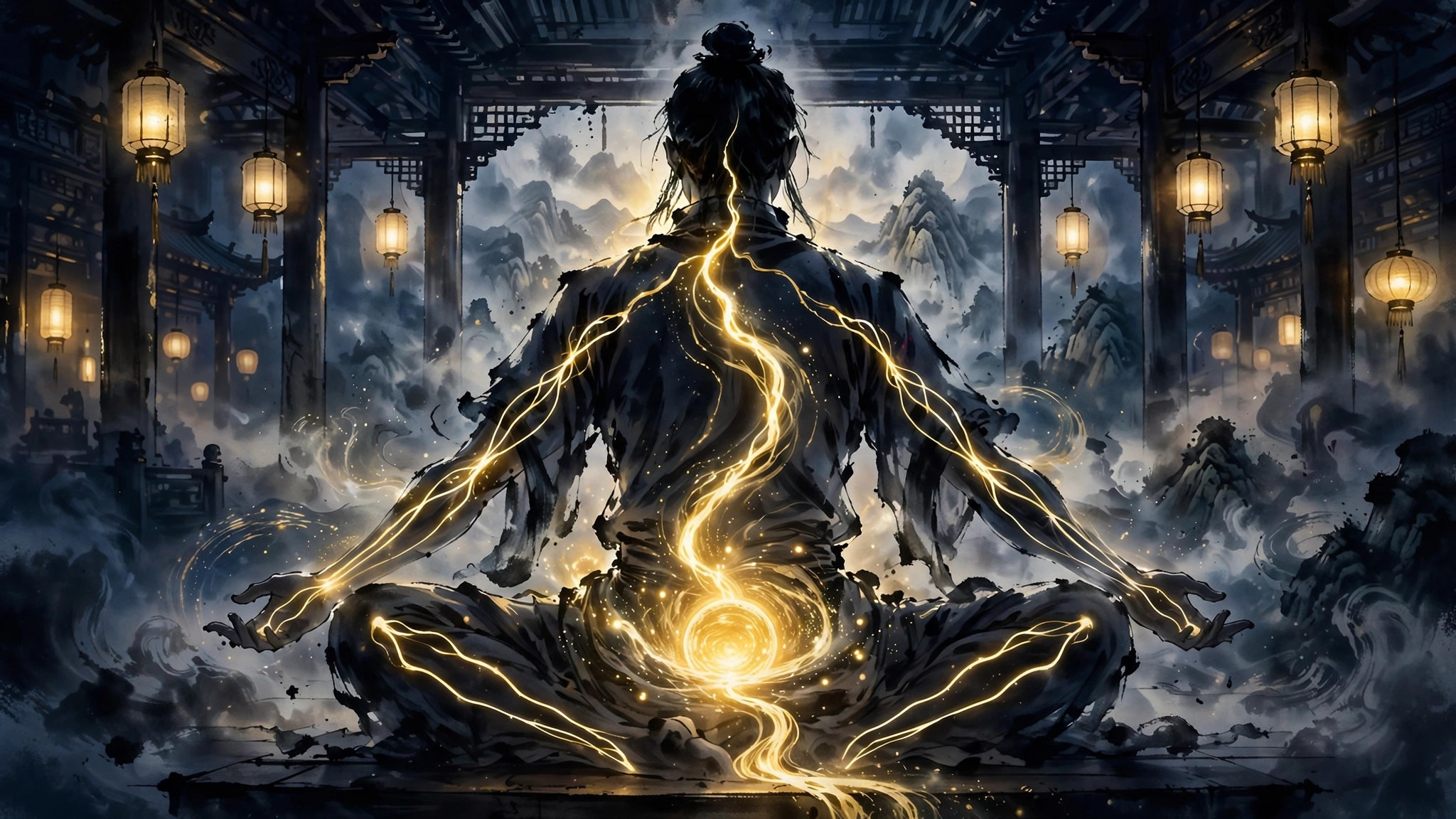
Every cultivation novel has a scene that translators render with a single suspicious word: the hero "opens" something inside their body, and suddenly everything changes. What they opened were the meridians (经络, jīngluò) — the network of invisible channels that carries qi through a cultivator's body. In xianxia fiction, meridians are the energy highways of the human body: every wisp of qi a cultivator absorbs must travel through them to reach the dantian, every technique draws its power along them, and every bottleneck, blocked channel, or shattered meridian reshapes a character's fate. Wide, clear meridians make a genius; blocked or narrow ones make a cripple. The entire cultivation economy of pills, baths, inheritances, and "fortuitous encounters" exists, in large part, to widen these roads.
Think of qi as water and the body as a landscape. The dantian is the reservoir; the meridians are the rivers, streams, and irrigation channels connecting everything. In the novels, qi absorbed from the environment (through the spiritual roots acting as the intake valves) doesn't teleport to storage — it circulates through the body along fixed routes, gets refined as it flows, and is deposited in the dantian. When a technique is cast, the process runs in reverse: qi floods out of the dantian and races along the meridians to the hands, the sword, or the throat, and the technique's power is partly a question of how much energy the channels can carry at once.
That "how much" is why meridians matter so much to the plot. A cultivator's meridians have a carrying capacity — width, toughness, and clarity. A hero with broad, resilient channels can absorb qi faster, cycle it through more revolutions per meditation session, and unleash stronger techniques without burning out. A hero with narrow or clogged channels hits a ceiling no effort can cross. This is the quiet engine beneath the genre's favorite underdog arc: the supposedly talentless protagonist whose first miracle isn't a powerful technique but simply cleared pathways — and who then cultivates at shocking speed because the pipes are finally open.
When the novels talk about meridians in the plural, they are borrowing from a very real system. In traditional Chinese medicine, there are twelve primary (or "regular") meridians, each associated with an internal organ — the lung meridian, the heart meridian, the kidney meridian, and so on, running along the arms and legs (Wikipedia: Meridian (Chinese medicine)). Qi and blood are said to circulate through them continuously, and acupuncture works by stimulating points along these routes.
Xianxia authors adopted the skeleton of this system and repurposed it. In the novels, the twelve meridians form the baseline circulation grid: the routes every cultivator's qi must travel, the channels a basic cultivation manual teaches you to cycle through. They are the "standard equipment" — everyone has them, and nobody becomes a master by memorizing them. What separates mortals from monsters is what lies beneath.
Above the twelve meridians sits a smaller, more mysterious set: the eight extraordinary vessels (奇经八脉, qí jīng bā mài) — Conception, Governing, Penetrating, Girdle, the two Linking vessels, and the two Heel vessels (Wikipedia: Meridian (Chinese medicine)). In TCM these are described as storage reservoirs of energy that don't belong to any single organ — "oceans, fields, or reservoirs" that regulate the whole network.
Fiction seized on two of them in particular:
In novel after novel, these two are the bottleneck that separates the mundane from the extraordinary. "Opening the ren and du" (打通任督二脉) is one of the genre's oldest and most beloved tropes: a single dramatic event — a master's palm strike, a burning pill, a near-death crisis — punches through the barrier between these two vessels, linking front and back into one unbroken circuit. The payoff is instant and total: qi flows faster, reserves deepen, and the hero's strength jumps a visible tier. If you've ever wondered why an otherwise invincible protagonist suddenly gets much stronger in chapter fifty, there is an excellent chance they just opened these two channels.
Note, though, that this is fiction dressing up tradition. The idea that uniting the ren and du vessels unlocks superhuman power is a genre invention — traditional medicine never claimed these channels turn people into flying swordsmen.
Because everything flows through the meridians, they are also the genre's favorite point of failure. A few of the classics:
Notice the pattern: every one of these is a plumbing problem. The novels treat the body like an irrigation empire, and the drama flows from the pipes.
Given that meridian quality decides so much, it should surprise no one that much of a xianxia protagonist's career is spent upgrading them. The methods are formulaic — and readers love them anyway:
The meridian system in the novels is not an invention — it is a dramatization. The twelve meridians and eight extraordinary vessels come directly from traditional Chinese medicine and the acupuncture tradition, where the jingluo network has been mapped and debated for centuries (the Wikipedia article on the topic traces detailed discussion back to classical medical texts and a 1578 study of the eight vessels). Fans commonly describe the novels' version as taking this framework and adding three things: making the channels carry power, making them upgradeable, and making them breakable in ways that serve the plot.
One honest caveat, which the novels never mention: modern anatomy has found no physical structure corresponding to meridians (Wikipedia's List of acupuncture points notes there is "no anatomical and physiological basis" for the system). That doesn't matter for the fiction — the genre borrows the poetry of the system, not its medicine. But it's worth knowing the line between the tradition the novels honor and the superpowers they invent.
When you're reading a xianxia novel and a character is described by their meridians, you're being given a one-line power profile. "Blocked meridians" means underdog; "opened the ren and du" means a power spike is coming; "shattered meridians" means someone's career just ended violently. The dantian is where power is stored, but the meridians are where it's decided — and once you see the plumbing, the genre's favorite miracles start to make perfect, hydraulic sense.