Article
What Is Xuanhuan? A Beginner's Guide to Mysterious Chinese Fantasy
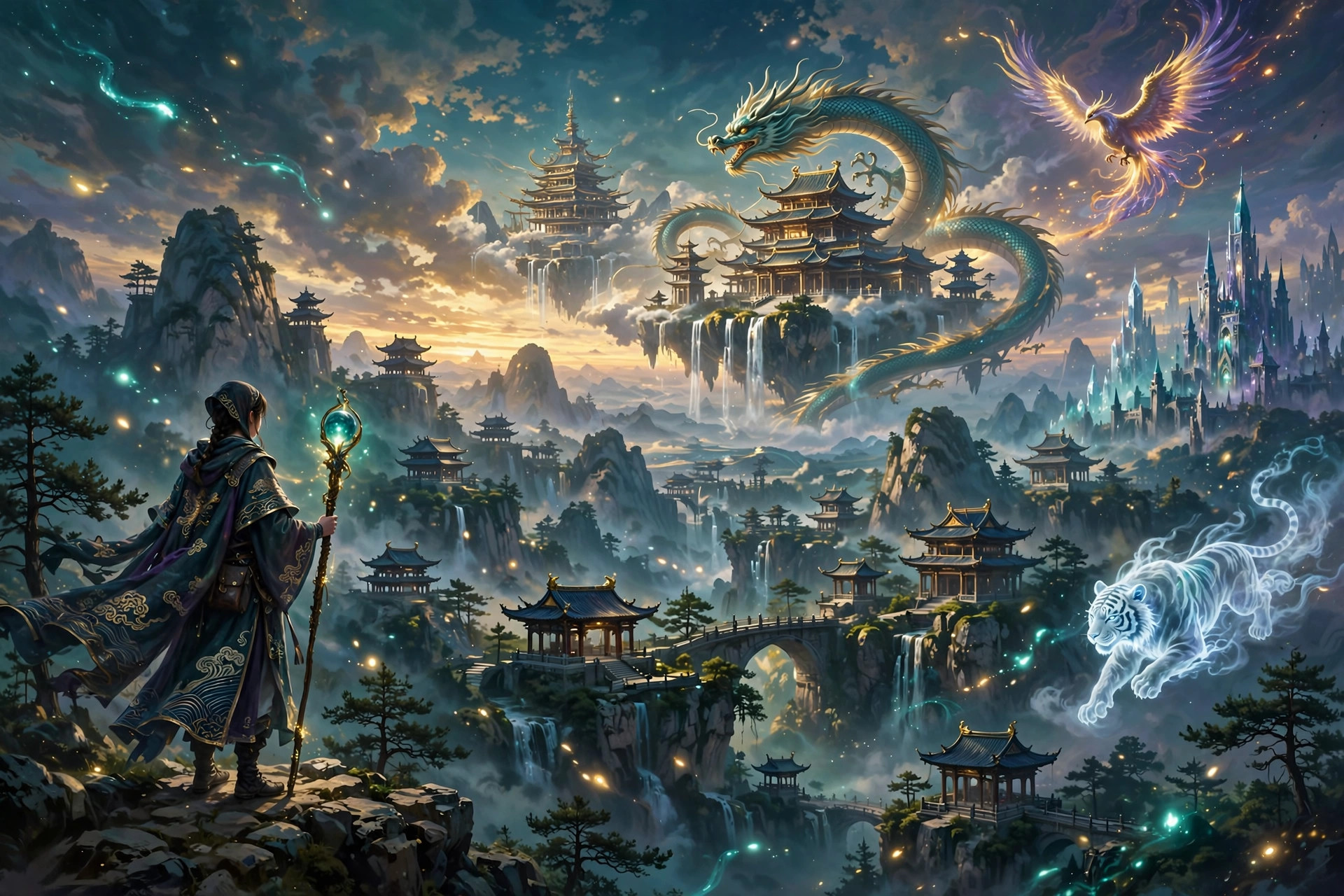
Xuanhuan (玄幻, xuánhuàn) is a genre of Chinese fantasy that fans commonly translate as "mysterious fantasy" and Wikipedia renders as "Eastern fantasy." It is rooted in Chinese culture and mythology but is not limited to them: xuanhuan freely absorbs Western fantasy elements — mages, dragons, elves-style races, magic academies — and drops them into worlds built on Chinese narrative logic. It is also, by sheer volume, the biggest genre in Chinese web fiction.
As of 2025, the platform Qidian hosted more than 700,000 xuanhuan works — over twice as many as the next-largest category, urban fantasy, according to figures cited on Wikipedia. If you have ever clicked through English-language translations of Chinese web novels and wondered why some feel like Lord of the Rings with Chinese storytelling bones, you were probably reading xuanhuan.
Beginners often confuse the two, because both feature swords, sects, and power levels. There is a practical rule of thumb that readers use: if a story is soaked in Daoist philosophy — the Dao, yin and yang, immortals, the goal of transcending mortality — it is xianxia; if it reads as fantasy without that Daoist core, it is probably xuanhuan. That test comes from the reader community rather than any official standard, and scholars describe the boundary more carefully: Wikipedia defines xuanhuan as a genre "rooted in but not limited to Chinese culture and mythology," one that draws on Chinese folklore's aesthetics while alluding to literary classics and importing foreign influences.
A few concrete contrasts help:
For a full side-by-side, see our breakdown of xianxia, wuxia, and xuanhuan.
Three forces explain the genre's dominance.
1. Creative freedom. Because xuanhuan is not anchored to Daoist cosmology or any historical period, authors can build anything: floating continents, steampunk-infused empires, worlds where cultivation and gunpowder coexist. That freedom keeps the genre from going stale, which matters when thousands of new chapters appear every day.
2. The coming-of-age engine. Scholarship on the genre notes that the coming-of-age story is one of xuanhuan's defining characteristics. The typical hero is a nobody — a clan outcast, a servant's son, a crippled talent — who stumbles onto a secret inheritance and claws his way upward. It is the same underdog engine that powers most popular fiction, tuned to maximum.
3. A young audience. Wikipedia notes that xuanhuan is frequently written for young-adult readers, and the genre's mix of martial arts, romance, and spectacle is engineered for readers who want plot momentum over literary restraint. When your audience binge-reads on phones, pacing is everything.
Pick up any xuanhuan novel and several of these will appear within the first chapters:
Two nearby labels are easy to mix up. Wuxia (武侠, "martial heroes") stays at human scale: swordsmen train real martial arts, fly across rooftops on qinggong, and settle debts of honor in the jianghu — no spells, no monsters, no gods. If a story has mages and dragons, it has left wuxia behind.
The subtler distinction is mohuan (魔幻, "sorcery fantasy"), the Chinese word often used for Western fantasy itself. A piece in The World of Chinese magazine captured the difference through a writer's eyes: where mohuan is about the bright side of humanity overcoming darkness and humans becoming one with gods, xuanhuan is about cultivating body and soul toward personal power and enlightenment through practice. In other words, mohuan asks "how does the fellowship defeat evil," while xuanhuan asks "how does the hero become strong." Chinese readers keep the two shelves separate for a reason — the story engine is different even when the monsters look similar.
Start with the genre contrast: our beginner's guide to xianxia gives you the Daoist-flavored half of the picture, so you will feel the difference immediately when you open a xuanhuan novel. From there, the title English readers most often recommend as a gateway is Coiling Dragon (Panlong) by I Eat Tomatoes — note that genre labels are blurry here, and even catalogs disagree about which shelf it belongs on, which is itself a useful lesson about how readers actually use these terms. Community genre tags on sites like NovelUpdates are your best map: look for "xuanhuan" alongside tags like "magical beasts," "mystery," and "adventure."
One more thing worth knowing: xuanhuan dramas and donghua (Chinese animation) adaptations are enormous in China and increasingly licensed abroad, so if 2,000-chapter novels intimidate you, a series adaptation is a legitimate way in. The genre may be called "mysterious fantasy," but the entry point is simple — pick a story where the world feels new, watch the underdog climb, and let the ranking system do the rest.