Article
Golden Core Explained: The Jindan That Marks the Real Start of Immortality
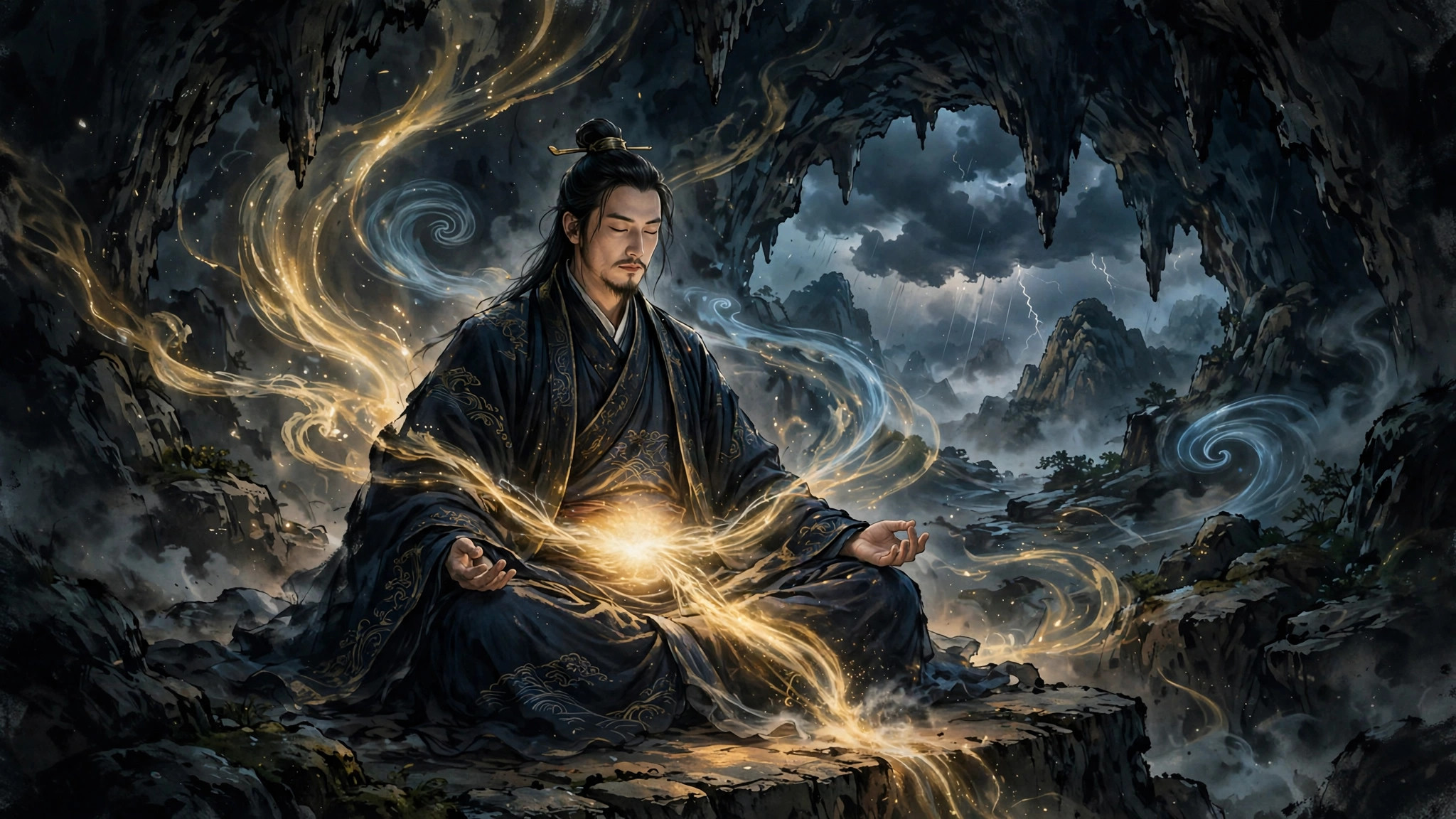
Sooner or later, every xianxia protagonist stops collecting power and starts building something with it. In the stillness of a cave, a sect's forbidden chamber, or mid-battle with death approaching, years of absorbed spiritual energy collapse inward into a single dense sphere of light — and when it holds its shape, the cultivator is no longer a talented mortal. *A golden core (金丹, jīndān) is exactly that sphere: the cultivator's lifetime of refined spiritual energy compressed into a solid, golden pill-like core seated in the dantian.* It is the single most famous milestone in cultivation fiction — the moment the hero becomes a genuine player in the immortal world, earns the right to fly, and starts living on a scale of centuries rather than decades.
Think of it as the cultivator's second heart. Before this point, spiritual energy (qi) sloshes loosely through the body in gas-like or liquid form. After this point, it has a permanent, solid home. The golden core acts as a furnace, a battery, and an engine all at once: it stores energy far more densely than loose qi ever could, it continuously refines the energy passing through it, and it becomes the seat from which the cultivator's power is drawn. Damage to it is damage to everything the cultivator has ever built — a shattered core usually means crippled cultivation, and many villains aim for exactly that.
This is also why novels treat the golden core as a person's true identity on the path. Qi Condensation disciples are interchangeable foot soldiers; Foundation Establishment cultivators are promising talents. A Golden Core cultivator is a somebody — a sect elder, a city lord, a figure whose name gets carved on stone tablets. In most realm systems, it is the first stage where the novel stops calling the character a cultivator-in-training and starts calling them an immortal-in-waiting. The standard realm ladder is mapped out in our guide to cultivation realms.
Most novels describe core formation in three broad phases, a progression fans often summarize as gas to liquid to solid:
Novels love to dramatize the formation itself: the sky darkens, thunder rolls, rival sects send assassins because they know a breakthrough in progress is a defenseless one, and the protagonist's core typically forms just in time — mid-battle, at dawn, or with the enemy at the door. This is dramatic license, but it exists in every story because the stakes are real within the fiction: a failed formation is one of the few setbacks a protagonist cannot simply punch through.
Before the golden core, cultivation is preparation. After it, cultivation is life. Almost every novel grants Golden Core cultivators three things that redraw the story's boundaries:
This is also where the genre's villains start taking the protagonist personally. A Qi Refinement nobody can be ignored; a newly ascended Golden Core cultivator with an unusual core is a threat worth sending assassins after. Readers feel this shift even if they can't name it — the story gets bigger, faster, and more dangerous the moment the core is formed.
Not all golden cores are equal, and authors know readers enjoy a hierarchy within the hierarchy. Common variations you will see across novels include:
Treat these rankings as house rules, not canon. Every author invents their own grading system, and arguing about which novel's nine-grade core scale is "correct" is a fan hobby, not a solvable question. The shared part — the one every novel agrees on — is simply this: a better-formed core means a higher ceiling, and the protagonist's core is always special.
Unlike most cultivation concepts, which authors invented freely, the golden core has a genuine historical root. *Jindan (金丹) literally means "golden elixir," and it comes from neidan (内丹), the Taoist practice of internal alchemy — an array of meditation and energy-cultivation techniques through which Taoist practitioners sought to prolong life and forge an immortal spiritual body (Wikipedia: Neidan). In neidan theory, the practitioner's own body becomes the alchemical cauldron, and the "ingredients" are the body's own Three Treasures: jing (essence), qi (vital energy), and shen* (spirit), refined and combined toward immortality.
The name itself is borrowed from an older tradition. Before internal alchemy, there was waidan (外丹), "external alchemy" — the literal brewing of elixirs and pills in furnaces, which the two traditions separated into during the Tang dynasty (618–907). Novelists kept the old vocabulary — elixir, furnace, cauldron, refinement — and turned the inner alchemical process into a literal glowing sphere in the hero's belly. The fiction is not how Taoists actually practiced; but the words on the page, the idea that essence, energy, and spirit can be condensed into something golden and deathless, come straight from this history.
The core is a beginning, not a destination. In the classic progression, the golden core's job is to nurture what comes next: the cultivator's spirit grows within the core until it outgrows the shell, and the core cracks open to release a Nascent Soul (元婴) — a miniature, conscious energy-body that can survive even the death of the flesh. Because each leap insults the natural order a little more, the heavens tend to object: breakthroughs at this level often attract heavenly tribulation, the lightning trials that punish cultivators for stealing fate.
If you are new to the genre and want to understand what all the fuss is about, watch for the core-formation arc — it appears in nearly every long cultivation novel, and authors treat it as the story's first true climax. Everything before it is training; everything after it is the immortal world proper. When the sky darkens and the rival sects start moving, you will know exactly what is happening: someone down there is condensing a lifetime of effort into something golden, and nothing will be the same afterward.