Article
What Are Spirit Herbs in Xianxia? Lingzhi, Ginseng and the Plants That Power Cultivation
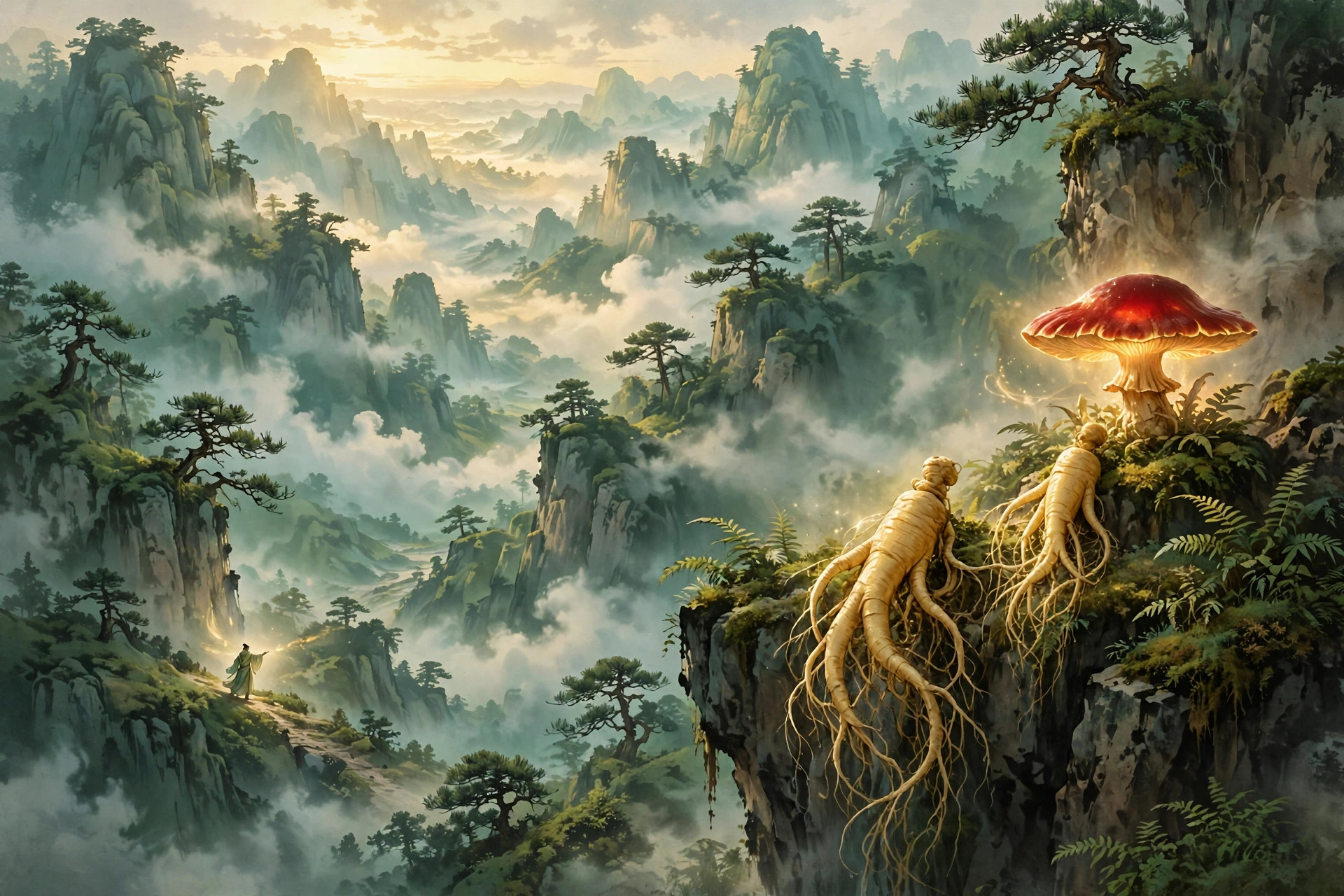
Spirit herbs (灵草, língcǎo — literally "spirit grass") are plants in xianxia and xuanhuan novels that have absorbed spiritual energy over years, decades or centuries, turning an ordinary root, flower or mushroom into a treasure that can heal wounds, break through cultivation bottlenecks, or poison an enemy just as easily. The longer a herb has grown undisturbed, the more potent it is: a ten-year herb is a useful ingredient, a hundred-year herb is worth fighting over, and a thousand-year herb can start a war between sects. They are the raw material of the entire cultivation economy — alchemists refine them into pills, cultivators eat them raw in emergencies, and sects guard the valleys where they grow like banks guard vaults.
Cultivation novels run on resources. Talent gets a character started, but talent alone does not carry anyone past the middle stages — that takes pills, and pills take herbs. This is why so many story arcs begin the same way: the hero hears about a rare herb growing in a dangerous place, fights rivals and beasts to claim it, and returns to have it refined into something that pushes their cultivation forward. The herb is the excuse for the adventure, and the adventure is the excuse for the herb.
Fans commonly describe spirit herbs as the most democratic resource in the genre. Spirit stones are mined and controlled by sects, techniques are locked behind libraries and bloodlines, but a herb can grow anywhere — a cliff face, a swamp, a cave no one has entered for a thousand years. That is why the poor, talentless, or exiled protagonist keeps stumbling over them: a spirit herb is the one treasure that luck, rather than status, can deliver.
Almost every novel grades spirit herbs by age, and the scale is one of the most consistent conventions in the genre:
The age rule has a real-world echo. In traditional Chinese medicine, older ginseng roots were historically prized above young ones, and the Shennong Bencao Jing — one of the earliest Chinese herbals, compiled around the 1st century CE — already listed ginseng among its most valued medicines. Xianxia simply takes that respect for age and turns the dial to eleven: age does not just improve the herb, it transforms it into something supernatural.
A handful of herbs recur so often that readers learn to recognize them on sight, even across novels by different authors:
Lingzhi (灵芝, língzhī). The mushroom of immortality. In the real world, lingzhi — also known as reishi — is a glossy, fan-shaped bracket fungus of the genus Ganoderma, used in traditional Chinese medicine and recorded in the Shennong Bencao Jing, which listed six kinds of zhi in its highest grade. In Chinese art it symbolizes health and longevity, and the goddess Guanyin is sometimes depicted holding one. Novels borrow all of this and add a glow: a spirit lingzhi might pulse with light, heal a shattered dantian, or extend a cultivator's lifespan by a century. When a character finds a lingzhi in a cave, experienced readers know the story is about to change gear.
Thousand-year ginseng (千年人参, qiānnián rénshēn). The archetype. Real ginseng is the root of plants in the genus Panax, used in Chinese and Korean traditional medicine for centuries; the Bencao Gangmu, Li Shizhen's great herbal of 1596, described the root's shape as resembling the human body. Novels take that humanoid shape literally — a thousand-year ginseng may run away, scream when pulled from the ground, or even transform into a small child. It is the herb that announces "this protagonist is about to get lucky," and it is so iconic that other novels parody it.
Poisonous herbs. Not every spirit herb helps. Some are so saturated with spiritual energy — or with yin energy, demonic energy, or corpse energy — that eating one raw will kill an unprepared cultivator. Demonic cultivators, covered in our guide to demonic cultivation, prize these, and the line between medicine and poison in xianxia is often just a matter of dosage and preparation.
A raw spirit herb is rarely the end of the story. In most novels, the herb is only valuable once someone does something with it, and there are three usual fates:
Eaten raw. The fastest and crudest option. A desperate cultivator chews a herb mid-battle to recover spiritual energy, or swallows one to survive a poison. Fans commonly describe this as wasteful — most of the herb's energy burns off unused — but when a character is bleeding out in a cave, waste is a luxury problem. The classic scene is the hero eating a herb they barely understand and spending the next three chapters digesting its power while enemies hunt them.
Refined into pills. The proper use. An alchemist combines the herb with other ingredients in a pill furnace, concentrating and stabilizing its energy. This is the whole subject of pill refining, and it is why alchemists are among the most respected — and most protected — figures in any novel's world. A single hundred-year herb might become ten pills, each worth more than the raw herb alone.
Planted and cultivated. The long game. Sects maintain spirit herb gardens, growing herbs in soil rich with spiritual energy and guarded by formation arrays. A herb garden is a sect's savings account: it produces wealth slowly and reliably, which is why attacking one is an act of war.
Almost no valuable herb grows unguarded. The logic is simple: a plant that has been soaking up spiritual energy for centuries is exactly as delicious to a beast as it is to a human. Spirit beasts nest near rare herbs, eat the weaker ones, and guard the strongest for themselves. This is why herb-hunting is never just botany — it is a boss fight with a gardening problem attached.
Spirit herbs are not pure invention. They grow out of a very old Chinese tradition in which certain plants were treated as more than medicine — as conduits of longevity itself. The Shennong Bencao Jing placed its most valued herbs in a "superior" grade, credited with lightening the body and extending life when taken over long periods. The Bencao Gangmu of 1596 catalogued ginseng and lingzhi alongside hundreds of other substances, recording their traditional uses in careful detail. Daoist seekers went further, hunting for the herbs of the immortals — plants that grew only on sacred mountains or in hidden valleys, far from ordinary people.
Xianxia takes that tradition and makes it literal. Where the old herbals spoke of herbs that "extend life," the novels show a herb that adds a hundred years to a lifespan. Where the tradition said lingzhi symbolized longevity, the novels make a lingzhi that actually grants it. The fantasy is an exaggeration of a real belief, not a replacement for it — and that is why the idea feels so grounded even at its most extravagant.
New readers can get buried under the Latin names, the ages, and the grades. Three shortcuts help:
That is the real function of spirit herbs in xianxia. They are not set dressing for a fantasy world — they are the fuel that keeps its characters moving, fighting, and growing. Take the herbs away, and the cultivators would have nothing to quest for, nothing to refine, and no reason to leave their caves. Give a nobody a thousand-year ginseng, and you have the first chapter of a novel.