Article
What Is Jianghu? The Martial-Arts World Behind Every Wuxia and Xianxia Story
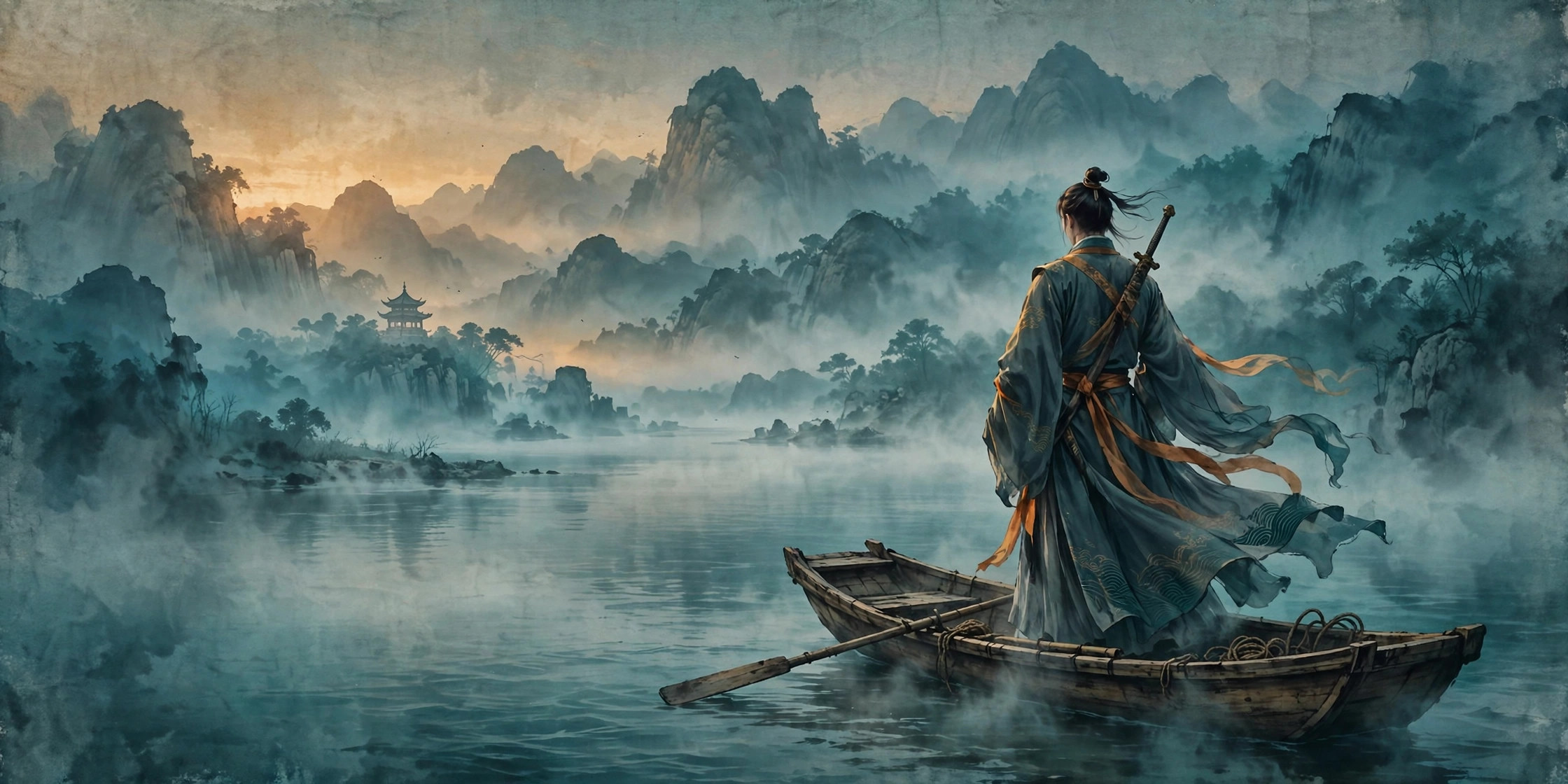
Ask a wuxia fan what "jianghu" means and you'll usually get a grin and the words "rivers and lakes." It's the literal translation — and it's completely unhelpful until you know the world behind it. Jianghu (江湖, jiānghú) is the shared setting of Chinese martial-arts fiction: a parallel society of swordsmen, sects, and outlaws that runs alongside imperial China, with its own people, its own rules, and its own idea of justice.
Once you recognize it, you'll see jianghu everywhere in the genre — and whole plotlines start making sense that previously just seemed dramatic.
The characters are literal: 江 means river, 湖 means lake. But the term isn't a travel guide to China's waterways. Long before martial-arts novels existed, jianghu was a poetic way to mean "away from the court" — the realm of exiles, hermits, and wanderers, in opposition to temples and thrones. One of its oldest recorded uses comes from the Daoist classic Zhuangzi, where fish are said to "forget one another in the rivers and lakes" — living freely, without interference.
That core idea survived intact into modern fiction: jianghu is wherever the government's reach runs thin and people live by their own code. Roads, inns, bandit lairs, deserted temples, and open wilderness are all classic jianghu locations — places far from official interference. So when a hero "enters the jianghu," they aren't visiting a lake. They're stepping out of ordinary society and into a world that answers to no emperor.
New readers often trip over a pair of terms that get used almost interchangeably but aren't the same. Jianghu is the place; wulin (武林, "martial forest") is the people. Wulin refers specifically to the community of martial artists who inhabit a jianghu setting — the sects, clans, and independent fighters.
The distinction matters. Not everyone in the jianghu is a fighter: merchants, innkeepers, craftsmen, beggars, and vagabonds all live there too. Conversely, the wulin is defined by martial skill and reputation, wherever its members happen to be. Fans commonly describe it like this: jianghu is the stage, wulin is the cast.
Every jianghu has a familiar population, and once you learn the roster you can read any wuxia or xianxia novel faster:
Above it all, many novels feature a wulin mengzhu (武林盟主) — the elected master of the martial-arts alliance, usually a fighter of great skill and greater reputation, who arbitrates disputes across the whole community. The position is prestigious, precarious, and a magnet for conspiracies — a favorite engine of novel plots.
The jianghu has no police, no courts worth trusting, and no emperor who can be bothered — so disputes get settled by the community itself, through mediation, negotiation, or force. What keeps that from being pure chaos is a moral code that every reader of the genre absorbs by osmosis. The core virtues, as the tradition formulates them, are xiá (侠, chivalry), yì (义, righteousness), lǐ (礼, virtue/propriety), zhōng (忠, loyalty), and chóu (仇, vengeance) — the last one reminding you that this is a world where settling a score is a moral duty, not a crime.
Vigilantism is normal and accepted in a way that would be unthinkable in realistic fiction. A hero who kills a corrupt official and walks free isn't breaking the genre's logic; he's following it. Reputation, meanwhile, is everything — which is why face (面子) matters so much in these stories. Insult a swordsman publicly and you've started a plot arc, because the jianghu's justice system runs on honor as much as on blades.
Even the jianghu's relationship with actual government follows an unwritten etiquette. Respectable members keep their distance from officials without being hostile: pay the taxes, don't shelter fugitives in plain sight, and let low-ranking runners and clerks turn a blind eye in exchange for the order the community maintains on its own. It's a cold peace, and novelists love breaking it.
The modern jianghu wasn't invented all at once. The 14th-century Water Margin gave fiction its founding image: outlaws retreating beyond the law to enforce their own righteousness. Centuries later, 20th-century novelists built entire fantasy worlds on that foundation. Jin Yong — one of the giants of the genre — gave his Condor Trilogy a single continuous jianghu, while Gu Long preferred to reinvent the jianghu fresh in each novel, showing how flexible the concept is.
That's a useful thing for a new reader to know: there is no one canonical jianghu. Every author builds their own version, with their own sects, alliances, and histories. The word names a kind of world, not a specific one.
Three phrases will carry you through most novels:
If you came to Chinese cultivation and martial-arts fiction looking for power levels and magic, the jianghu is the part that will surprise you most: it's not a power system, it's a society. Learn its people and its rules, and every duel becomes legible — because in the jianghu, nobody ever fights for no reason at all.