Article
What Is a Secret Realm in Xianxia Novels? The Hidden Worlds Behind the Treasures
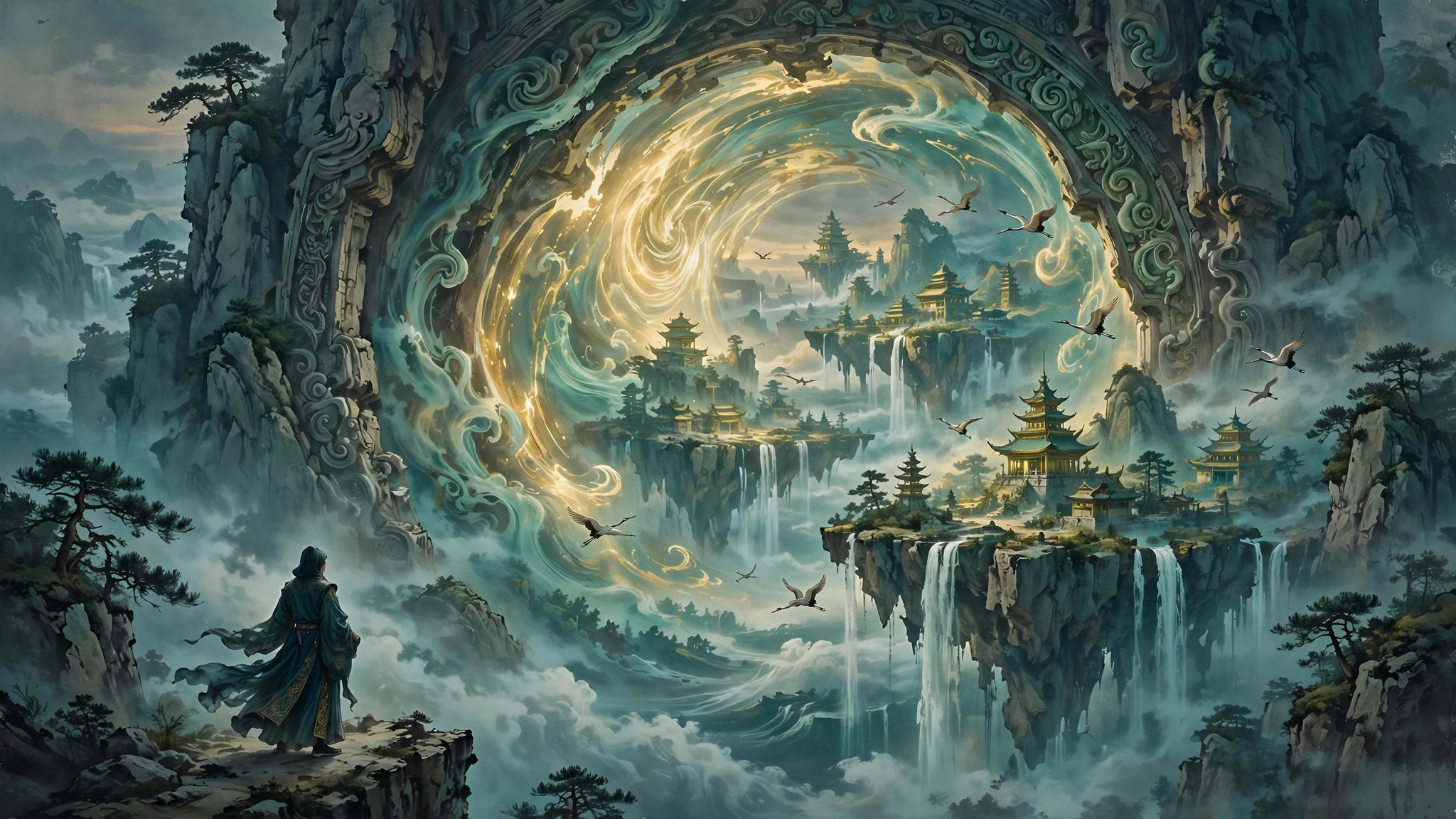
A secret realm (秘境, mìjìng) is a sealed-off pocket world in xianxia novels — a self-contained space hidden behind the everyday world, filled with ancient treasures, rare spirit herbs, and deadly trials. Think of it as a dungeon that is also a place: part treasure vault, part trial ground, part time capsule left behind by powers far stronger than anyone alive. Whenever a secret realm opens, cultivators from every nearby sect and clan scramble to get inside, because one good haul can change a person's fate overnight.
If you have been confused by scenes where characters suddenly vanish into a swirling vortex, race to grab glowing artifacts, and emerge either rich or dead, this guide explains what secret realms are and why they matter so much to the genre.
The Chinese term breaks neatly into two characters. 秘 (mì) means "secret" or "hidden" — the same character in 神秘 (shénmì, "mysterious"). 境 (jìng) means "territory," "boundary," or "realm." Put together, 秘境 (mìjìng) is a territory that is secret: a place the ordinary world cannot reach or even perceive.
English translations vary. You will see "secret realm," "mystical realm," "mysterious domain," or occasionally "secret boundary" depending on the translator. They all describe the same thing: a world that sits apart from the main world and only opens under specific conditions.
Strip away the decoration and a secret realm is defined by three traits:
It is sealed. A secret realm is cut off from the outside world by a barrier, an array formation, or simply by existing in a separate pocket of space. You cannot walk into one — there is usually a single entrance that appears at a fixed location and only under the right conditions: a full moon, a once-a-century alignment, or the breaking of an ancient seal.
It is self-contained. Inside, the realm has its own landscape, its own rules, and often its own dangers. Some resemble lost valleys or floating islands. Others contain entire ruined cities, the collapsed headquarters of an ancient sect, or battlefields frozen at the moment some legendary war ended. The defining feature is that the outside world has been locked out for centuries or millennia — which is exactly why what is inside is so valuable.
It is time-limited. Almost no secret realm stays open forever. Openings last days, weeks, or at most months, and then the entrance closes again — sometimes for decades, sometimes for another century. This ticking clock is what gives secret-realm arcs their tension: the heroes must find what they came for and get out before the door slams shut and traps them inside.
Authors rarely let a secret realm exist without a history, and fans have come to expect a few classic origin stories:
Fallen great powers' legacies. The most common type: an ancient expert, a dead sect, or a lost civilization sealed its treasures, techniques, and knowledge into a pocket world before dying out. Entering such a realm is archaeology with mortal danger — you are walking through someone else's funeral vault.
Ancient battlefields. Sites of legendary wars, preserved in distorted space, where the weapons, corpses, and lingering resentment of beings far stronger than today's cultivators still drift around. The loot is priceless; the ambient danger is lethal.
Natural pockets of heaven and earth. Some realms form on their own where spiritual energy pooled and warped space over eons — untouched gardens where rare herbs grow wild and spirit beasts roam free. These tend to be the most beautiful and the most jealously guarded.
Trials left by design. A deliberate test: an ancient power who built a realm specifically to screen for a worthy successor. These come with the most explicit rules and the most personalized rewards — the inheritance goes to whoever passes, not whoever grabs fastest.
A secret realm is not just a setting; it is a narrative engine. Here is what one opening does for a story:
It levels the playing field — then un-levels it. Secret realms usually restrict who can enter, most famously by cultivation level: only cultivators below a certain realm may pass through the entrance. This is why powerful sect masters can only watch from outside while their juniors — and the young protagonist — go in. (For context on what those levels are, see our guide to cultivation realms.) The restriction turns the realm into a contest of wit and preparation rather than raw power, and it conveniently strands the hero among peers and rivals instead of gods.
It concentrates opportunity. Because the realm has been sealed for centuries, everything inside is ancient: herbs that went extinct outside, pills refined with lost recipes, techniques no living person has read. Economies in these novels run on spirit stones, but the truly fate-changing wealth — the inheritance that turns a nobody into a contender — almost always comes from a secret realm.
It forces the cast together. Opening a secret realm is a public event. Every sect, clan, and rogue cultivator in the region sends people in. That means the protagonist's allies, rivals, sworn enemies, and that one smug young master all end up in the same sealed box with the same ticking clock. Conflict is not optional; the structure guarantees it.
It resets the stakes. A protagonist who was falling behind can catch up in a single good realm run. A protagonist who was comfortably ahead can be humbled by an ancient danger nobody anticipated. Authors use secret realms to redistribute power across the cast whenever the plot needs a shake-up.
After reading enough xianxia, you start to recognize the genre's operating procedures for secret realms. These are not laws of nature; they are storytelling conventions so consistent they may as well be:
Entry tokens matter. Often you cannot simply walk in — you need a key, a jade token, or a quota assigned to your sect. Entire subplots revolve around stealing, trading, or forging entry tokens before the realm opens.
The weak enter, the strong guard. As noted, cultivation-level caps keep the overpowered out. Expect the elders to camp outside the entrance, scheming, while the young do the dying inside.
Treasures are guarded. Nothing valuable sits unprotected. Ancient puppets, remnant soul imprints, poisonous miasma, spatial traps, or guardian beasts — the realm tests whether you deserve what you take. Grabbing blindly is the fastest way to become a cautionary tale.
Time runs differently — or runs out. Some realms have distorted time flow: a month inside might be a day outside, which is both an opportunity (train longer!) and a trap (miss the exit!). Even without distortion, the closing deadline is absolute. Characters who linger for "one more treasure" routinely pay for it.
Legacies choose their heirs. In inheritance-type realms, the ancient expert's remnant will often reject the strong-but-unworthy and favor the protagonist for some quality — resolve, kindness, or a compatible physique. It is the genre's way of saying that character, not just power, opens doors.
New readers sometimes mix secret realms up with similar-sounding concepts. A quick sorting:
Once you know the pattern, these arcs become some of the most fun stretches of any xianxia novel. Watch for the setup chapters: the rumors, the token scramble, the elders' warnings. Notice who the author bothers to name among the entrants — anyone with a name and a grudge will matter later. And when the protagonist finds the real prize (there is always a real prize beneath the obvious ones), ask what it costs: the best secret-realm arcs make the treasure inseparable from a choice, a sacrifice, or a truth about the world's history.
Secret realms are, in the end, the genre's promise made literal: that somewhere behind the sealed door, the world still keeps its wonders for those brave — or reckless — enough to step through.
New to the genre's power system? Start with cultivation realms explained and what are spirit stones.