Article
Wuxia Martial Arts Levels Explained: From Third-Rate to Grandmaster
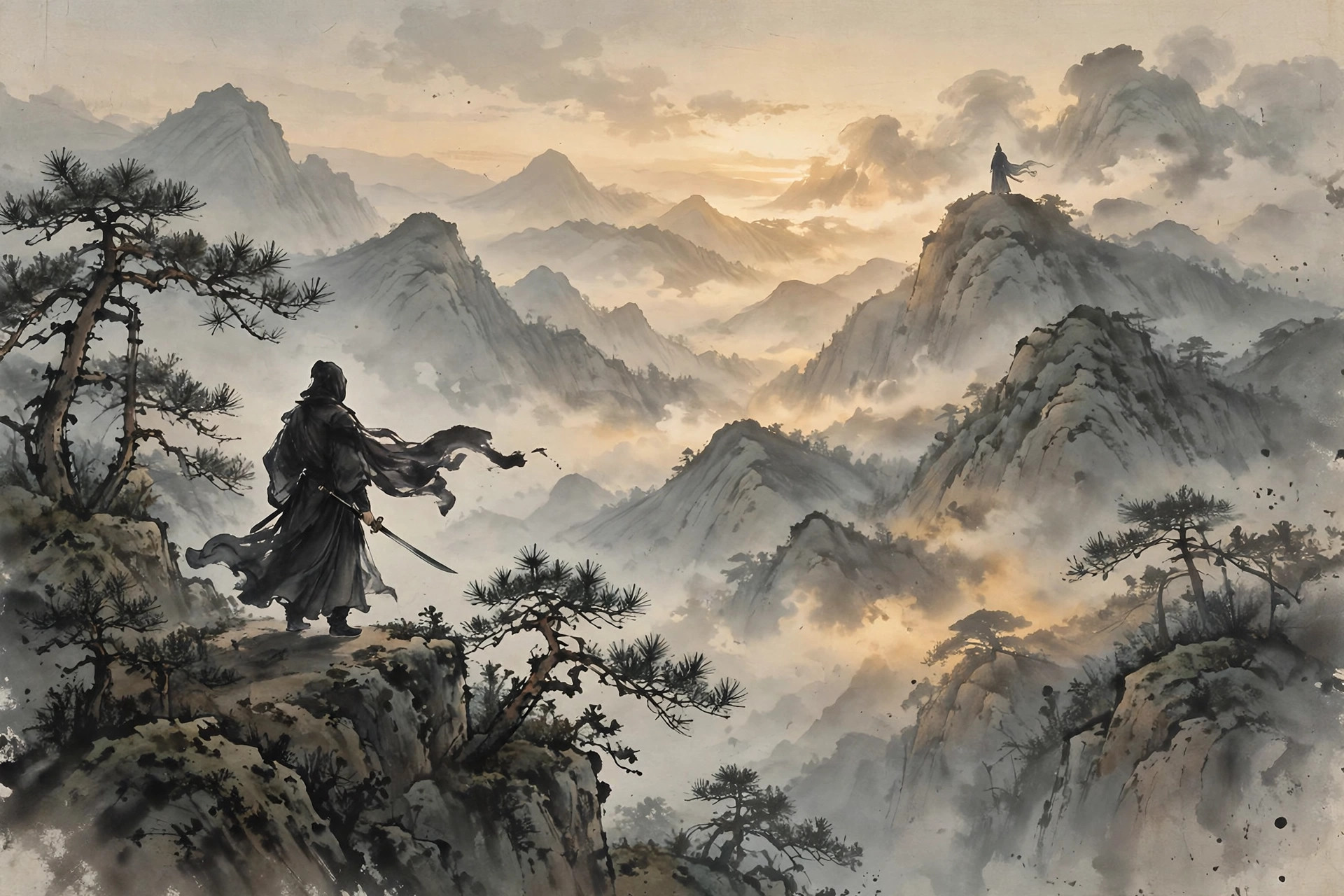
Wuxia martial arts levels are an informal ladder fans use to rank fighters: third-rate (三流, sānliú), second-rate (二流, èrliú), first-rate (一流, yīliú), peak (绝顶, juédǐng), and beyond that, grandmaster or transcendent figures who stand above the ladder entirely. A third-rate fighter is a competent brawler with a few years of training; a first-rate fighter is an elite who can hold their own against a sect's best; a peak master is one of a handful of living legends in the whole martial world. The ladder is not a rule written down anywhere in the genre. It is a shared shorthand that grew up around the novels, and different stories bend it in different ways — but once you know the rungs, you can size up almost any wuxia fighter within a page of meeting them.
The ranks run from the bottom up, and each step is a genuine gap in ability rather than a small improvement. Fans commonly describe the ladder like this:
Third-rate (三流). The beginners and journeymen. They have learned a martial art and some internal energy, but their skill is rough, their energy is thin, and they lose to anyone with real training. Most sect disciples, guards, and bandit leaders live here.
Second-rate (二流). Solid, experienced fighters. They have mastered the basics of internal energy and can use their techniques smoothly in a real fight. A second-rate fighter might lead a small squad, run a branch of a sect, or serve as a respectable escort. They are dangerous to ordinary people and to third-rate fighters, but they are outclassed the moment a true expert appears.
First-rate (一流). The elite. First-rate fighters have completed their foundation: deep internal energy, refined technique, and the ability to channel energy into their weapons. They are the people sects send when something actually matters — elders, hall masters, famous wandering swordsmen. Reaching this level through hard practice alone is possible, which is why so many novels treat it as the ceiling for ordinary talent.
Peak (绝顶). The top of the mountain. Peak masters have pushed their internal energy and technique to the point where they can project energy outward — striking with sword qi, hurting enemies from a distance, fighting several first-rate opponents at once. Only a handful of people in any generation reach this level, and every one of them is a named figure with a reputation that precedes them.
Beyond the peak. Above the peak, novels invent their own titles: grandmaster (宗师, zōngshī), transcendent (超绝顶), or simply "the best under heaven" (天下第一, tiānxià dìyī). These figures are not really on the ladder anymore. They are the benchmarks the ladder is measured against — the old monk who has not fought in forty years, the retired sword god, the villain who has mastered a forbidden art. A story usually has one or two of them, and the hero's journey is often the slow climb toward challenging one.
The ladder looks like a simple list, but three things decide where someone stands on it, and novels use all three to explain why one fighter beats another.
Internal energy (内功, nèigōng). This is the foundation and the single biggest factor. Internal energy is the cultivated power stored in the body — built up over years of breathing exercises, meditation, and practice, and often measured in novels by "years of功力" (gōnglì), as if it were a bank balance. A fighter with sixty years of internal energy hits harder, lasts longer, and recovers faster than one with ten, even if their techniques are identical.
External skill (外功, wàigōng) and technique. Internal energy is the engine; technique is how it gets used. A fighter's moves — sword forms, palm strikes, footwork, throwing weapons — decide whether that energy lands. Novels love the mismatch: a fighter with deep energy but crude technique loses to a cleverer opponent, and a fighter with shallow energy but a legendary technique can punch far above their weight. The most famous techniques in the genre are almost always named, and a named technique is a signal to the reader: this move has a history, a creator, and a reputation.
Experience and mindset. The third factor is the least visible and the most decisive in close fights. Veterans read their opponents, conserve energy, and stay calm when a plan collapses. Novels make a point of this: the hot-headed young hero with a powerful technique loses to the old master who has fought a hundred duels, because the old master has seen the hero's trick before.
Here is the part that confuses new readers: unlike xianxia, where cultivation realms are usually spelled out chapter by chapter, wuxia has never had a single official ranking system. The reason is historical. The modern wuxia novel was shaped by writers like Jin Yong, whose The Legend of the Condor Heroes was first serialized from 1 January 1957 to 19 May 1959 in the Hong Kong Commercial Daily, and whose stories rank fighters through reputation, duels, and comparison rather than through labeled tiers. In his novels, you learn that someone is strong because other strong people fear them, not because a narrator assigns them a rank. The third-rate to peak vocabulary grew up later, largely through fan discussion and through Korean murim novels and web novels that borrowed the Chinese terms and made the ladder explicit.
That history explains why the ladder feels fuzzy. The terms themselves are real Chinese: 一流 literally means "first class" or "first-rate," 二流 means "second-rate," and 绝顶 means "the very peak" or "the utmost." Readers of Chinese use these words in everyday life to describe quality — a first-rate chef, a second-rate film — and wuxia fans simply applied the same everyday ranking to fighters. Because the ladder comes from ordinary language rather than from any single author's system, every novel is free to adjust it: some add a "super first-rate" (超一流) rung between first-rate and peak, some split peak into early, middle, and late stages, and some skip the ladder entirely and rank fighters by titles instead. None of these versions is wrong, because there was never a canonical one to contradict.
New readers often ask whether wuxia levels are the same thing as the cultivation realms in xianxia, and the answer is no — they solve different problems. Xianxia realms are a formal progression: a cultivator breaks through from Qi Condensation to Foundation Establishment to Golden Core, and each breakthrough is a measurable event with physical effects like a longer lifespan. Our guide to cultivation realms covers that system in detail. Wuxia levels, by contrast, are a reputation system. Nobody in a wuxia novel announces "I have broken through to first-rate"; other people call them first-rate because of what they have done. The scale is also smaller: a wuxia peak master is the best fighter in a country, while a xianxia cultivator at a comparable stage might be able to level a mountain. If you are coming from xianxia, think of wuxia levels as a rough scouting report rather than a power-level chart.
There is one more difference worth knowing. In xianxia, the ladder is the story — climbing it is the plot. In wuxia, the ladder is background. The story is usually about loyalty, revenge, or justice, and a fighter's rank only matters because it tells you who can plausibly beat whom. A novel can spend five hundred pages on a third-rate hero's revenge without ever promoting him past second-rate, and nobody considers that a failure. The rank serves the drama, not the other way around.
If you are picking up your first wuxia novel, the ladder is most useful as a translation tool, not a scoring system. When a character is introduced as first-rate, the novel is telling you they are a serious threat and a respected name. When a character is called a peak master, the novel is telling you to pay attention — this person will matter. When a group of third-rate fighters surrounds the hero, the novel is telling you the hero is about to look impressive, not that the fight is in doubt.
A few practical habits help. First, notice who calls whom what: a rank given by an enemy is usually reliable, while a rank a character claims for themselves is usually boasting. Second, watch for the moment a fight breaks the ladder — the second-rate fighter who wounds a first-rate master, the unknown youth who matches a peak master. Those moments are almost always the point of the scene: the novel is telling you that this character is special, or that the ladder was wrong about them.
The martial world, the 江湖 (jiānghú), is a place where reputation is currency, and the ladder is how that currency gets counted. You can read more about the world itself in our guide to the jianghu, and for the genre as a whole, start with what is wuxia. But the ladder alone will carry you through most of what you meet: third-rate fighters fill the roads, second-rate fighters guard the gates, first-rate fighters run the sects, peak masters decide the wars, and somewhere above them all sits a grandmaster who has not drawn a sword in years — waiting, as they always are, for the one young fighter foolish enough to come and challenge them.